LangChain4j in Practice: Analyzing Three Implementation Approaches for an Enterprise-Level RAG Knowledge Base Project

Bilibili creator Hui Ge launches an enterprise-level LangChain4j RAG hands-on project, using a backend-focused, frontend-assisted approach to lower the learning barrier.
This article introduces the enterprise-level RAG knowledge base hands-on project initiated by Bilibili creator Hui Ge based on LangChain4j. It analyzes the pros and cons of three implementation approaches and ultimately selects the compromise of "backend-focused + frontend-assisted" to focus on core RAG logic and lower the frontend barrier. It also lists the prerequisites for learning the project, including Spring/SSM engineering skills, database experience, Redis basics, and proficient command of LangChain4j. The article notes that the project is suitable for developers with a Java backend foundation who want to systematically learn RAG implementation, but the video has only just begun and the actual code details are yet to be updated.
Why Choose LangChain4j for RAG in Practice?
In his latest video series, Bilibili creator Hui Ge launches an enterprise-level RAG knowledge base project built on LangChain4j. He opens by pointing out a reality: there's no programming without third-party libraries. For backend developers, LangChain4j offers a complete RAG solution within the Java ecosystem, but when it comes to real enterprise projects, the trickier questions are how to organize code structure and how to balance frontend and backend workload.
This hands-on project is not a simple API-call demo—it builds a runnable, extensible knowledge base system from scratch. In the video, Hui Ge states clearly that the project will be updated continuously and will cover the entire process from project scaffolding to a complete business loop.

LangChain4j is the Java implementation of LangChain, designed specifically for the Java ecosystem to build applications based on large language models. It provides a unified API wrapper for mainstream LLMs (such as OpenAI, Tongyi Qianwen, Ollama, etc.) and includes built-in components needed for the RAG pipeline: document loaders, text splitters, embedding model interfaces, vector database integrations, retrievers, and prompt templates. Compared with the Python version of LangChain, LangChain4j aligns better with the dependency management and layered architecture of enterprise Java projects, allowing backend developers to integrate AI capabilities directly within the familiar Spring ecosystem and reducing the extra cost of cross-language work.
Weighing the Three Implementation Approaches
Hui Ge planned three implementation approaches and provided a clear trade-off analysis.
Approach 1: Pure Backend Development
This is closest to the daily work of backend programmers—writing only backend APIs, without touching frontend pages. For developers focused on server-side logic, this approach maximizes focus on LangChain4j integration, RAG pipeline implementation, and database interaction. But the drawbacks are obvious: there's no visual interactive validation, making debugging and demos less intuitive.
Approach 2: Full Frontend and Backend Development
This is the most complete approach, but Hui Ge says outright that it is "rather time-consuming." Many backend programmers are unfamiliar with the frontend tech stack, and forcing full-stack development can bring unnecessary trouble and even slow down learning of the core RAG functionality.
Approach 3: Backend-Focused with Frontend Assistance
This is the approach finally chosen. The backend starts from opening IDEA and covers the complete chain: creating the database and tables, setting up the base project, writing code, completing the business loop, and running tests. For the frontend, a ready-made page is provided directly, so learners only need to focus on interaction logic rather than building the page display from scratch.

This compromise ensures complete training in core backend capabilities while lowering the frontend barrier, allowing learners to concentrate on the core mechanisms of LangChain4j and RAG.
RAG (Retrieval-Augmented Generation) is a technical paradigm that combines retrieval and generation. Its core workflow is: first split documents in the enterprise knowledge base and vectorize them for storage in a vector database; when a user asks a question, the system retrieves the document chunks most relevant to the question from the vector store, injects these chunks as context into the prompt, and finally hands them to a large language model to generate the answer. This approach significantly mitigates the hallucination problem of large models and grounds model answers in private materials, making it the mainstream solution for enterprise knowledge base scenarios.
What Prerequisites Are Needed to Learn This Project?
Hui Ge lists several essential foundational abilities. These are not just "good to know"—they require proficient use.
1. Spring/SSM Engineering Skills
You need a basic understanding of project structure, including dependency management, layered architecture, and configuration methods. This is the foundation for subsequently setting up the LangChain4j integration environment.
2. Database Experience
The project uses MySQL as an example, but Hui Ge emphasizes "use whichever database you know"—domestic DM, MySQL, and PostgreSQL are all fine. The key is understanding table design, SQL operations, and the logic of connecting to vector storage later.
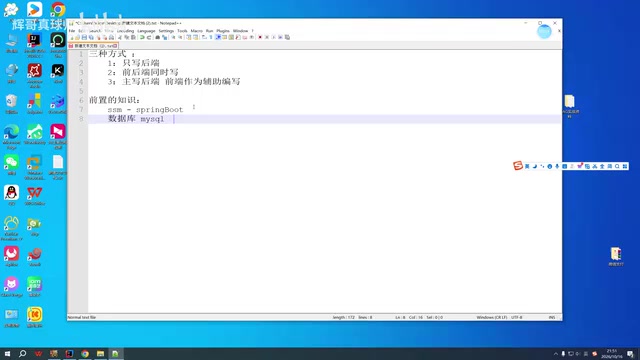
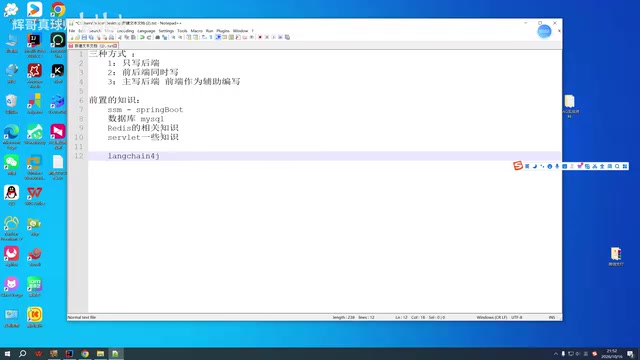
3. Redis Knowledge
RAG projects may involve Redis for caching, session management, or intermediate result storage, so you need to understand basic data structures and usage scenarios.
4. Proficient Command of LangChain4j
This is the most core prerequisite. Hui Ge specifically points out that it's not enough to just "know" it—you need very proficient practice. He suggests first watching his existing LangChain4j fundamentals course, which basically covers the knowledge points in the official documentation. After completing it, entering the hands-on project will be much smoother.
Vector storage is key infrastructure in the RAG pipeline. Common choices include dedicated vector databases such as Pinecone, Milvus, Qdrant, and Weaviate, as well as traditional databases that support vector retrieval, such as Redis, PostgreSQL (with the pgvector extension), and Elasticsearch. LangChain4j provides a unified EmbeddingStore interface for these stores, allowing developers to switch as needed. For beginners, starting with Redis or PostgreSQL is lower-cost; for enterprise scenarios, dedicated vector databases like Milvus are preferred for better retrieval performance and scalability.
The Value and Limitations of This Hands-On Project
Based on the content released so far, this series is better suited for developers with a Java backend foundation who want to systematically learn how to implement RAG. Its advantages are:
- It provides a complete engineering perspective, not just fragmentary code
- It clearly distinguishes core from auxiliary parts, reducing the learning burden
- It is continuously updated, allowing learners to go deeper as the project progresses
A limitation to note is that the video has only just begun, and the actual LangChain4j code has not yet been unfolded. The real technical details (such as document parsing, vectorization, retrieval chain construction, and prompt template design) still await future updates. For developers who want to get hands-on immediately, it is advisable to first complete the LangChain4j fundamentals course and then follow this hands-on series.
The project adopts a "backend-focused + frontend-assisted" approach: the backend is built from scratch to a complete business loop, while the frontend provides a ready-made page where you only write interaction logic.
If you are looking for a path from beginner to practical RAG implementation in the Java ecosystem, this series is worth following.
One-line Summary
Bilibili creator Hui Ge launches an enterprise-level LangChain4j RAG hands-on project, using a backend-focused, frontend-assisted approach to lower the learning barrier.
Paragraph Summary
This article introduces the enterprise-level RAG knowledge base hands-on project initiated by Bilibili creator Hui Ge based on LangChain4j. It analyzes the pros and cons of three implementation approaches and ultimately selects the compromise of "backend-focused + frontend-assisted" to focus on core RAG logic and lower the frontend barrier. It also lists the prerequisites for learning the project, including Spring/SSM engineering skills, database experience, Redis basics, and proficient command of LangChain4j. The article notes that the project is suitable for developers with a Java backend foundation who want to systematically learn RAG implementation, but the video has only just begun and the actual code details are yet to be updated.
Related articles

Qwen 4 First Test Leaks: Performance Rivals Opus 5.5, DeepSeek V4 Series Surfaces
Early Qwen 4 test outputs leak, with front-end generation said to rival Opus 5.5; DeepSeek V4 Mini, Flash, and Pro names appear in a code repo; Ant Group's Ling-3.1-flash surfaces too. Here's the latest on model tiering and on-device lightweight models.

OpenCode Makes DeepSeek V4.1 Flash Free, AI Daily Roundup
AI daily roundup: OpenCode makes DeepSeek V4.1 Flash free, StepFun Step5 Preview and Ling 3.1 Flash open-sourced, Grok Voice 3.0 tops speech leaderboard, Matrix Game 4.0 open-sourced, and the EU opens its first AI Act enforcement probe into OpenAI and Anthropic.

DeepSeek V4.1 Flash 1017 Released: Reasoning and Coding Upgrades, Search and Fetch API Now Available
DeepSeek releases V4.1 Flash 1017 with major gains in reasoning, coding, and agentic tasks, plus web search and fetch APIs at 5 yuan per 1,000 requests. Tencent Hunyuan open-sources High Memory 2.0, Perplexity open-sources multimodal decision models, and MOFCOM seeks comments on AI export catalog.