LangGraph in Practice: A Deep Dive into Real Developer Workflows and Tech Stacks

A Reddit question thread reflects the five challenges and observability anxiety in LangGraph's journey from tutorial to production.
Using a Reddit question thread aimed at LangGraph developers as a clue, the article sorts through the five challenges most commonly encountered when the framework moves from demo to production: real use cases are mostly stateful multi-step orchestration rather than single-turn chat; there is no standard answer for the tech stack, with a common combination being LangGraph for orchestration, provider SDKs called directly, a vector store for retrieval, and Postgres or Redis for checkpoint persistence; graph structures range from single-agent loops to multi-agent collaboration to deterministic workflows, with controllability increasing in turn; the hardest debugging issues are unexpected loops, repeated tool calls, and state problems, with long-running workflows especially needing node-level tracing; the key contradiction in production is the balance between flexibility and controllability, and building observability determines project success more than framework choice.
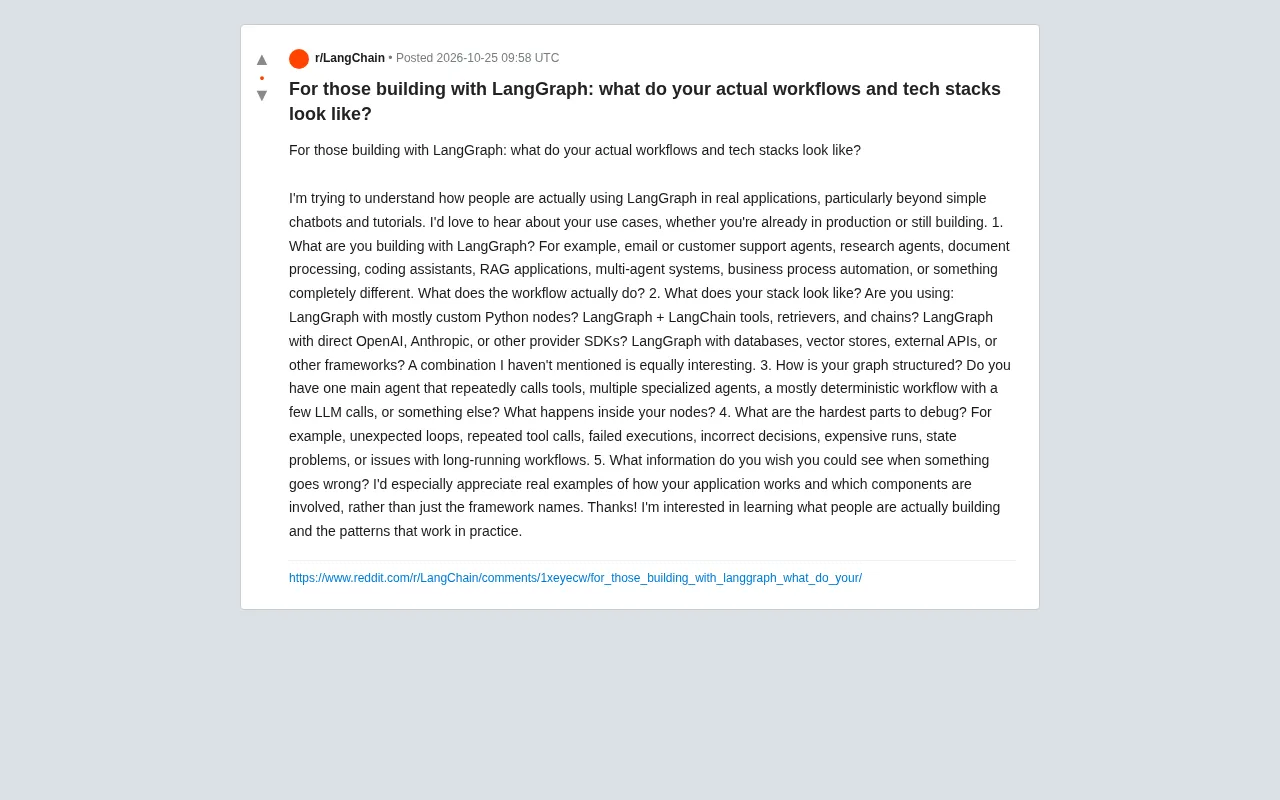
As a framework for building stateful, multi-actor LLM applications, LangGraph's tutorials and examples tend to focus on simple chatbots. But what do real production systems actually look like? A Reddit question thread aimed at LangGraph developers tries to dig up actual use cases, tech stack combinations, graph structures, and debugging pain points. Although the post itself poses questions rather than answers, it precisely outlines the five types of challenges most commonly encountered when moving from tutorials to production, and reflects the community's widespread anxiety around "observability" and "determinism." Below, drawing on the question framework raised in the post as well as common practice patterns in the community, we sort through the key considerations for putting LangGraph into production.
Real Use Cases: Complex Orchestration Beyond Chatbots
The post first asks "what do you build with LangGraph," with a candidate list including email/customer service agents, research agents, document processing, coding assistants, RAG applications, multi-agent systems, and business process automation. This itself shows that LangGraph's appeal lies in orchestrating complex, stateful workflows, not single-turn conversations. For example, a customer service agent might need to first retrieve from a knowledge base, then call an order system, and finally generate a response while deciding based on confidence whether to escalate to a human—such a flow involves multiple tool calls and conditional branches, which is exactly where LangGraph shines. Research agents often manifest as a "plan-search-summarize-reflect" loop, while document processing pipelines require parallel branches and error retries.
Interestingly, the post specifically asks "what does the workflow actually do," implying that many teams have already converged on framework choice, but differences in business logic are where the real value lies. A common pattern in the community is: deterministic skeleton + LLM nodes. That is, the overall flow is controlled by code (such as sequencing, parallelism, conditional routing), and LLMs are called only where language understanding or generation is needed. This hybrid structure is easier to test and debug than "fully autonomous agents," and better fits production requirements for stability.
The ReAct pattern (Reasoning and Acting) is a typical implementation of LangGraph's single-agent loop: the model first outputs reasoning steps, then decides which tool to call, observes the tool's return, and continues reasoning until it gives a final answer. This pattern lets the LLM dynamically combine external capabilities, but the termination condition is entirely up to the model's judgment, making it easy to fall into a "call-observe-call again" loop. LangGraph explicitly defines nodes and edges through its graph structure, allowing developers to add hard termination rules (such as maximum iterations, tool whitelists) beyond the model's output, thereby preserving ReAct's flexibility while adding controllability. Understanding this pattern helps determine when to use a single-agent loop versus when to split into multiple agents or a deterministic flow.
Tech Stack Combinations: No Standard Answer, Only Trade-offs
On tech stacks, the post lists several typical combinations: pure custom Python nodes, LangGraph + LangChain tools/retrievers/chains, LangGraph + direct use of OpenAI/Anthropic SDKs, and combining with databases, vector stores, external APIs, or other frameworks. This reflects LangGraph's positioning—it handles the orchestration layer without forcing a particular way of calling models.
In practice, a common and pragmatic combination is: LangGraph manages state and routing, provider SDKs are used directly for model calls, a vector database (such as pgvector or Pinecone) handles retrieval, and Postgres or Redis persists checkpoints. The benefit of using SDKs directly is avoiding the debugging complexity introduced by LangChain's abstraction layer, while being able to promptly use providers' latest features (such as tool calling and structured output). LangChain's tools and retrievers still have value in rapid prototyping, but many teams gradually replace them in production with thinner, more controllable wrappers. The post's open attitude that "combinations I didn't mention are equally interesting" precisely shows that this field has yet to form best practices, and teams need to make trade-offs based on their own operational capabilities and compliance requirements.
Checkpoint is the core mechanism by which LangGraph achieves persistence and resumable execution. Each time the graph executes to a certain node, the framework can serialize and store the current state (such as writing to Postgres or Redis), forming a checkpoint history. This allows long-running workflows to resume from the most recent checkpoint after a process restart, waiting for human approval, or an external API timeout, without having to rerun from scratch; it also supports time-travel debugging—replaying a checkpoint and observing subsequent branches. The effectiveness of checkpoints depends heavily on the serializability of state: if non-serializable objects (such as database connections or file handles) are mixed into the state, persistence will fail. Therefore, state structures should be designed to remain pure data, which is why the community emphasizes "state serializability."
Graph Structure Design: From Single-Agent Loops to Multi-Agent Collaboration
The post asks whether the graph is "a single main agent repeatedly calling tools," "multiple specialized agents," or "a mostly deterministic workflow with a few LLM calls." These three forms correspond to different levels of complexity and controllability. The single-agent loop (ReAct pattern) is the easiest to get started with, but is prone to infinite loops and repeated tool calls; multi-agent systems (such as separating planner, executor, and reviewer) can improve task decomposition, but communication overhead and state management difficulty soar; deterministic workflows with LLM nodes strike a balance between predictability and flexibility, suitable for scenarios with clear business processes.
What happens inside nodes is equally critical. Common patterns include: a node handles one LLM call and parses the output, a node executes a tool call and updates state, a node makes a conditional judgment to decide the next hop. The post's follow-up question "what happens inside nodes" is really about the granularity of state changes and side-effect management. A lesson repeatedly mentioned in the community is: keep nodes as small as possible with single responsibilities, and make state updates explicit and serializable, so that checkpoints and recovery are meaningful. Otherwise, one giant node turns debugging into a black box.
The Pain of Debugging: Loops, Repeated Calls, and State Issues
The hardest-to-debug problems listed in the post—unexpected loops, repeated tool calls, execution failures, wrong decisions, expensive runs, state issues, long-running workflows—cover almost all the main failure modes of LangGraph applications. Among them, unexpected loops and repeated tool calls are the most common, often stemming from the model misjudging termination conditions or tool return results not being parsed correctly. State issues mostly occur when parallel branches merge or checkpoints are restored, with state fields being overwritten or missed. Expensive runs can be caused by loops, or by context continuously accumulating so that every call carries the full history.
Debugging long-running workflows is especially tricky, because a single run may span minutes or even hours, involving external API timeouts and waiting for human approval in between. The post finally asks "what information do you wish you could see when something goes wrong," which points directly at the observability gap. Developers generally want to see: input/output snapshots of each node, state change diffs, token consumption and latency of each LLM call, raw requests and responses of tool calls, and a complete execution path graph. If this information has to be pieced together from logs, the cost is high; ideally it should be automatically collected by the framework or supporting tools.
LangSmith is the observability platform officially provided by LangChain and can integrate with LangGraph to automatically collect the complete call tree of each run: including the input/output of each node, the prompt and completion of each LLM call, token consumption, latency, and the raw requests and responses of tool calls. Developers can expand layer by layer along the execution path in the interface to quickly locate which node produced a wrong decision or unexpected loop. For teams with high compliance requirements or those who prefer self-hosting, they can also build their own tracing based on standards such as OpenTelemetry, exporting LangGraph's node execution events to their existing monitoring systems. Whichever approach is used, the core goal is the same: turn "piecing together logs" into structured, searchable execution records, so that fault localization for long-running workflows goes from black box to white box.
The Key to Production: Observability and Determinism
Overall, although this post gives no answers, it precisely hits the key contradiction in LangGraph's journey from demo to production: the balance between flexibility and controllability. LangGraph provides powerful orchestration capabilities, but production systems need predictable behavior, clear fault localization, and cost control. Therefore, when choosing a stack, teams might think in reverse: first clarify which steps must execute deterministically and which can be left to the LLM; then design the state structure and checkpoint strategy; finally fill in observability (such as LangSmith or self-built tracing). Tech stack choices should serve these constraints rather than chase framework hype.
For teams currently using LangGraph, the question list in the post can serve as a self-check list for an internal retrospective: Is your graph structure simple enough? Are node responsibilities single? Is the state serializable? When something goes wrong, can you quickly locate the specific node and call? Answering these questions well matters more to a project's success than which vector database you choose.
One-line Summary
A Reddit question thread reflects the five types of challenges and observability anxiety in LangGraph's journey from tutorial to production.
Paragraph Summary
Using a Reddit question thread aimed at LangGraph developers as a线索 (clue), the article sorts through the five types of challenges most commonly encountered when the framework moves from demo to production: real use cases are mostly stateful multi-step orchestration rather than single-turn chat; there is no standard answer for the tech stack, and a common combination is LangGraph handling orchestration, provider SDKs called directly for models, a vector store for retrieval, and Postgres or Redis persisting checkpoints; graph structures range from single-agent loops to multi-agent collaboration to deterministic workflows, with controllability increasing in turn; the hardest debugging issues are unexpected loops, repeated tool calls, and state problems, and long-running workflows especially need node-level tracing; the key contradiction in production is the balance between flexibility and controllability, and building observability determines project success more than framework choice.
Related articles

Zero-Cost Local Jarvis: Open-Source Voice Cloning and Task Automation in Practice
AI Workshop shows how to build a zero-cost local Jarvis with Ollama and Voice Studio: local model switching, open-source voice cloning, file retrieval, and tool-calling tests, with setup steps and hardware trade-offs.

Mistral Large 4 Released: 1T-Parameter MoE Tops Western Open-Source Leaderboard
Mistral releases its flagship Mistral Large 4: a 1T-parameter MoE architecture activating only 49B parameters at inference, trained from scratch on 3,800 Grace Blackwell GPUs, topping the Western open-weight leaderboard with third-party endorsements in law, finance, and cybersecurity.

Mistral Large 4 Review: Can Europe's Strongest Open-Source Model Challenge the US and China?
Mistral Large 4 (L-Charm) review: trillion-parameter MoE, standout cybersecurity benchmarks but behind Kimi K3 in software engineering, 3,800 GPUs, a key step for European sovereign AI.