LangGraph.js in Practice: How Frontend Developers Can Level Up to AI Agent Architecture

How frontend developers can leverage LangGraph.js to break into AI Agent development with compound, business-aware skills.
Based on a Bilibili tech talk, this article argues that AI application development has formed an engineering ecosystem analogous to frontend frameworks — making LangChain/LangGraph.js an ideal entry point for frontend engineers. It breaks Agent skills into three levels, uses an "AI auto video editing" case to expose the complex technical stack (FFmpeg, TTS cost tradeoffs, Agent orchestration) behind a simple requirement, and contrasts code-level LangGraph.js orchestration with visual platforms like Dify and n8n. The takeaway: compound skills — solid coding, business understanding, and architectural thinking — are what truly matter in the AI era.
For frontend developers, AI is no longer a field that has "nothing to do with me." Whether in job interviews or real projects, mastering AI application development frameworks is becoming the new competitive threshold. This article is based on a technical talk shared on Bilibili, distilling the core value of frameworks like LangGraph.js in Agent development and exploring practical paths for frontend engineers transitioning into AI.
Why Frontend Developers Should Learn AI Agent Frameworks
The presenter drew an analogy between the LangChain / LangGraph / LangGraph Agent tool stack and the React or Vue ecosystems that frontend developers know well, calling them "the tech stack for AI Agent development." This comparison highlights a practical reality: AI application development has formed its own engineering system, and for frontend engineers looking to advance, this is currently one of the most accessible entry points.
From a job-hunting perspective, the pressure is even more immediate. As the presenter noted, "nine out of ten companies these days will ask about AI." Interviewers typically won't drill down into framework APIs — instead, they ask open-ended questions like "Do you have any familiarity with AI application development frameworks?" or "Have you tried building an Agent yourself?" These questions assess your sensitivity to overall tech trends, not rote memorization.
Three Levels of Competency Interviewers Look For
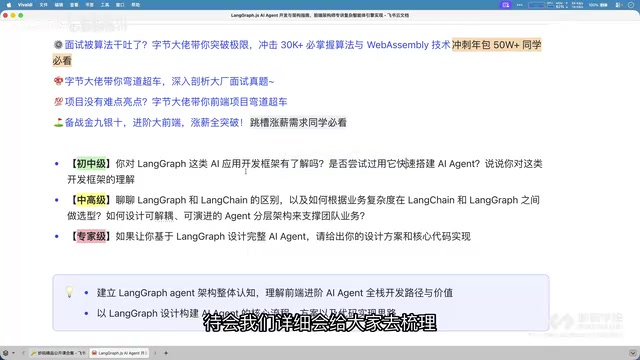
The presenter broke down Agent-related interview readiness and skill progression into three dimensions:
- Junior to Mid-level: Basic awareness of AI application development frameworks; some hands-on experience building an Agent;
- Mid to Senior-level: Ability to articulate the difference between LangGraph and LangChain, make framework selection decisions based on business complexity, and design a "decoupled, evolvable" layered Agent architecture;
- Expert-level: Ability to independently design a complete AI Agent implementation plan based on LangGraph and ship it in code.
These three levels form a complete capability curve — from "knowing" to "doing" to "designing" — and serve as the cognitive framework this talk aims to establish.
What Skills Are Actually Worth Money in the AI Era
A core thesis that runs throughout the talk is this: the people who truly benefit from the AI wave aren't those with a single strong technical skill — they're well-rounded individuals who write solid code, deeply understand the business, and think in terms of product architecture.
The presenter emphasized that AI is an "enabler," not the "determining factor." Whether a project actually ships still depends on the developer's accumulated technical knowledge and business understanding. In other words, large language models lower the implementation barrier, but they don't lower the bar for sound judgment.
Breaking Down Compound Skills with "AI Auto Video Editing"
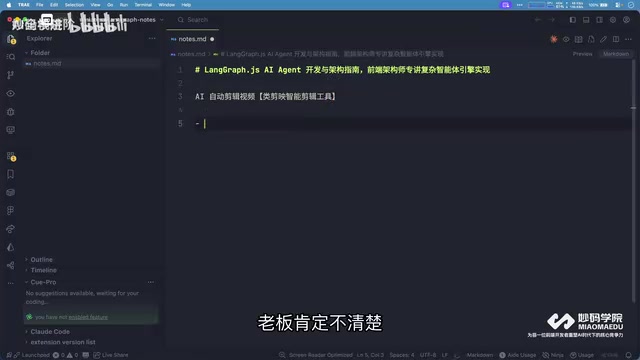
The presenter used "AI automatic video editing" as an example to illustrate how many technical challenges hide behind a single simple requirement:
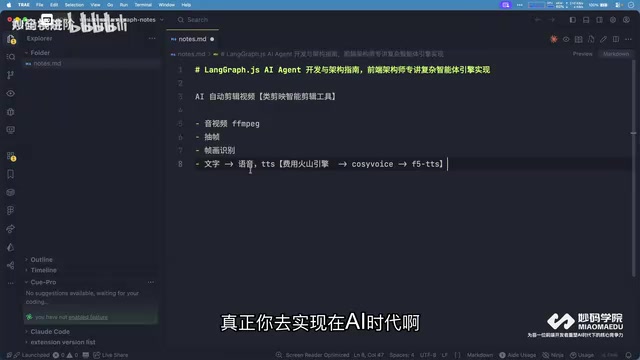
- Audio/video processing: You can't avoid foundational tools like FFmpeg;
- Auto-editing strategy: Involves frame extraction strategies, scene and image recognition;
- Text-to-Speech (TTS): Converting text into voiceover. This also brings up cost considerations — the presenter noted that Volcano Engine (ByteDance) has relatively high TTS pricing, Alibaba's CosyVoice isn't cheap either, while local deployment solutions like F5-TTS offer another viable path;
- Encoding/decoding and asset library matching;
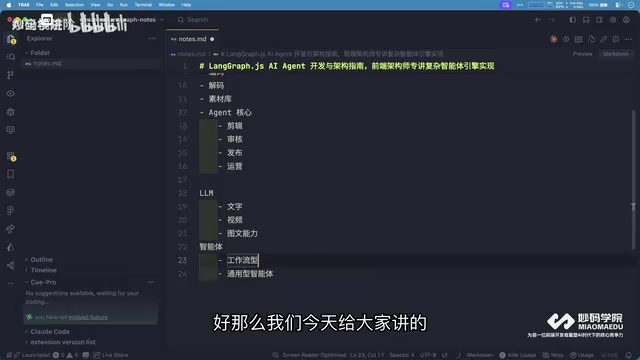
- Core Agent orchestration: From editing, review, and publishing, to automatically collecting comments and managing distribution — the entire pipeline can be handed off to an Agent core for scheduling.
The value of this example lies in revealing an often-overlooked reality: cost is a hard constraint on AI feature deployment. The presenter put it bluntly — if editing a few-minute video costs hundreds of yuan, even if it's cheaper than human labor, management won't accept it. Knowing how to run the numbers on cost is precisely where business experience shows.
The cost differences in TTS (Text-to-Speech) technology are a deployment trap many developers overlook. Commercial TTS services typically charge by character count or audio duration. Cloud-based services like Volcano Engine (ByteDance) and Alibaba Cloud CosyVoice offer stable quality and require no maintenance, but costs can accumulate rapidly in high-frequency or long-duration scenarios. F5-TTS is an open-source local deployment solution that supports zero-shot voice cloning — replicating a target voice from just a few seconds of reference audio — with near-zero marginal cost after deployment. It suits cost-sensitive use cases where some tolerance for audio quality trade-offs is acceptable. Selection should weigh three dimensions: voice quality and naturalness (commercial services generally win), latency (local deployment is hardware-constrained), and cost (local deployment has clear advantages at scale). This kind of multi-dimensional cost-benefit thinking about technical options is precisely what business understanding looks like in practice.
LangGraph.js and Workflow-Based Agents
The presenter divided agents into two major categories: workflow-based agents and general-purpose agents.
This talk focused on workflow-based agents, with an emphasis on "code-level orchestration" rather than "UI-level orchestration." The contrast between these two implementation approaches is worth noting:
- UI orchestration: Platforms like early Coze, Dify, n8n, and ComfyUI, where workflows are built by visually dragging and connecting nodes. The presenter's hands-on project "Miaoma AI Engine" benchmarks against these platforms, walking through a complete from-scratch build of a workflow AI platform — covering node definitions, node outputs, and multi-node support;
- Code orchestration: Using LangGraph.js to orchestrate workflows at the code level, offering greater flexibility and control.
Reference Points for General-Purpose Agents
Beyond workflow-based agents, the presenter listed several mainstream general-purpose agent tools as reference points, including OpenAI Codex, Claude Code (and similar tools like Tencent/WeChat's CodeBuddy), and Alibaba's "Wukong." Many of these products are still in early access — developers who are interested are encouraged to apply for access early and build an intuitive sense of where general-purpose Agent capabilities currently stand.
LangGraph.js is a framework within the LangChain ecosystem designed specifically for building stateful, multi-step Agent applications. Its core idea is to model workflows as directed graphs: each node represents a processing step or LLM call, edges define the transition logic between nodes, and the overall state is continuously passed and updated throughout graph execution. Compared to LangChain's chain-based approach, LangGraph introduces cycle support, allowing Agents to call tools repeatedly, self-correct, and iterate until a termination condition is met — this is the technical foundation for truly "autonomous decision-making" behavior. LangGraph.js is the JavaScript/TypeScript implementation, with syntax and runtime that naturally align with the frontend ecosystem, so frontend engineers can experience the full power of the framework without switching to Python. LangChain acts more like an "infrastructure layer," providing model call wrappers, prompt templates, vector retrieval, and other foundational components, while LangGraph sits on top to orchestrate the execution order and state transitions of those components.
The essential difference between workflow-based and general-purpose agents lies in decision-making autonomy. In a workflow-based Agent, the execution path is predefined by the developer — node trigger order, branching conditions, and termination logic are all fixed at orchestration time. This suits business scenarios with relatively predictable processes, offering strong predictability, easier debugging, and controlled costs. General-purpose Agents (also called Autonomous Agents) place the LLM at the center of decision-making, letting the model autonomously choose which tools to call and in what order. This theoretically handles more open-ended tasks, but also introduces greater uncertainty and token consumption. OpenAI Codex, Claude Code, and similar coding agents fall into the general-purpose category because the loop of writing code, running it, observing errors, and revising doesn't have a fixed number of steps — the model must dynamically decide the next action based on each step's output. For most enterprise applications, workflow-based Agents remain a more robust starting point.
Practical Advice for Frontend Engineers Moving into AI
From a content and capability standpoint, the presenter gave a clear learning priority: the most mature capabilities of current large models are still "text, image-text, and video." So if you're entering from the content layer, text-to-text, text-to-video, and image-text products are directions you can start practicing with immediately — working on these kinds of projects at relevant companies also lets you accumulate experience quickly.
The ultimate capability goal is: for every technical point you've broken down, knowing "how to implement it" and being able to use a Vibe Coding approach to rapidly translate it into working code. When you can take a vague business requirement, decompose it into a clear technical pipeline, and execute each piece — your personal value naturally grows.
It's worth noting that this article is based on a technical talk tied to a bootcamp enrollment pitch, and implementation details weren't fully covered in the original. Readers are encouraged to dive into the official LangGraph.js documentation for deeper study.
Related articles

Felix Rieseberg Personal Homepage
Felix Rieseberg's personal homepage sparks attention on Hacker News. This article covers the Slack engineer's technical background, the rise and fall of nativefier, and the value of a developer homepage as a tech calling card.

@ai-sdk/vue 3.0.306 Patch Release Syncs with [email protected] Update
@ai-sdk/vue 3.0.306 released, synced with [email protected]. A routine patch release for the Vercel AI SDK ecosystem with no public API changes; the Vue adapter layer stays version-aligned with the core package.

Gemini 4 Argon API Launches: The Era of Million-Token Output Begins
Google launches Gemini 4 Argon with sparse MoE architecture, up to 1M output tokens, and a 68.90% Vals Index score, available across API, AI Studio, and the Gemini app.