LangGraph + MCP + RAG: A Practical Deep Dive into Enterprise-Grade Medical Multi-Agent Systems

Using a medical multi-agent project, it explains the practical combo of LangGraph, MCP, and RAG and the direction of developer skill transformation.
The article reviews a Bilibili enterprise-grade Agent course by instructor Loulan: set against a real collaborative medical project, it demonstrates the full process from industry analysis to multi-agent construction. It notes that medical workflows are complex, multi-role, and highly regulated—ideal for multi-agent deployment—and offers a pragmatic Agent criterion: whether it can independently solve specific business problems, not just add a persona to a model. Technically, LangGraph handles orchestration and state management, MCP connects tools and data sources, and RAG provides medical knowledge retrieval to curb hallucinations, together supporting a runnable enterprise business flow. The instructor also argues that coding's value is declining and that requirement control and solution design will become developers' differentiating edge, urging hands-on project experience.
As large model deployment enters its deep-water phase, how to string together mainstream technologies like LangGraph, MCP, and RAG into a genuinely runnable enterprise-grade project has become a core concern for many developers. In a hands-on course on Bilibili, instructor Loulan used the medical industry as a backdrop to give a complete walkthrough—from industry analysis all the way to building a multi-agent system.
Why the Medical Industry Is a Good Fit for Agent Practice
The medical industry naturally involves complex workflows, multi-role collaboration, and strict compliance requirements—exactly the kind of soil that puts a multi-agent system's capabilities to the test. According to the instructor, the course content comes from a real collaboration project with Huimei Weilan, not a fabricated demo.
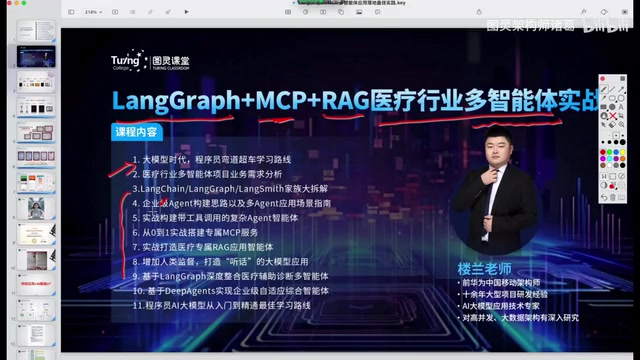
In medical scenarios, patient consultation, triage, medical record comprehension, and medication recommendations are interconnected yet each has its own boundaries—a single agent can hardly cover the entire workflow. A multi-agent architecture can break these steps into agents with different responsibilities that work together, which is why the course chose the medical industry as its entry point.
What Exactly Is an Agent: From Chat Tool to Independent Problem Solver
The course offers a pragmatic criterion for "what is an Agent": whether it can independently solve a specific business problem. The instructor uses Doubao as an example—adding a background setting to a chat tool merely gives the model a persona; it doesn't constitute a real Agent.
Only when a large model is used as the foundation and allowed to autonomously plan and execute around a specific business goal can it be called an enterprise-grade agent. This definition seems simple, but it directly determines the direction of subsequent architecture design: don't just wrap a shell around the model—design the Agent's responsibilities and collaboration methods around business problems.
A Multi-Agent System is relative to a single-agent architecture. In single-agent mode, one model instance must independently handle understanding requirements, calling tools, remembering context, and producing output—once the business chain gets long, prompts balloon quickly, context is easily lost, and it becomes hard to enforce independent permissions and compliance controls for different steps. A multi-agent system splits complex tasks into several sub-agents with clear responsibilities, each with its own system prompt, toolset, and memory space, communicating and sharing state through an orchestration layer. Common collaboration patterns include Supervisor mode, hierarchical mode, and decentralized negotiation mode. In medical scenarios, having separate triage agents, medical record comprehension agents, and medication recommendation agents allows each to focus on its own domain while making it easier to set up separate review and traceability mechanisms for high-risk steps.
Breaking Down the Tech Stack: How LangGraph, LangChain, MCP, and RAG Work Together
The course covers a tech stack including LangGraph, the LangChain ecosystem, MCP, and RAG. The instructor emphasizes that the API-level details of these frameworks can be left to AI-assisted coding, but the design philosophy behind them must be thoroughly understood by the developer.
- LangGraph: Handles multi-agent workflow orchestration and state management—the core backbone for building an Agent collaboration network
- MCP: Serves as a standardized connection protocol between models and external tools/data sources, extending the Agent's action capabilities
- RAG: Provides agents with medical domain knowledge retrieval capabilities, reducing hallucination risk
The combined logic of the three: RAG ensures knowledge accuracy, MCP connects tool calls, and LangGraph organizes multiple agents into a runnable business process.
LangGraph is an orchestration framework in the LangChain ecosystem designed for stateful, multi-step workflows. Its core abstraction is a "graph": nodes represent a unit of computation (typically a model call or tool call), edges represent the direction of state flow, and the entire execution revolves around a shared state object that can be passed and updated between nodes. Compared to linear chain calls, it supports conditional branching, loops, parallelism, and human-in-the-loop control flow, with built-in checkpointing that allows execution to resume after interruption. This makes LangGraph particularly well-suited for building multi-agent systems that require multi-round collaboration and traceable state—for example, letting a triage agent's output feed into a downstream medical record agent, and falling back or escalating to a human when anomalies occur. Understanding state design (which fields enter the graph, how updates are merged) is key to using LangGraph and a decisive factor in whether multi-agent collaboration remains stable.
MCP (Model Context Protocol) is a standardized protocol for connecting large models with external tools, data sources, and services. Before MCP, every application had to write separate adapter code for each model and each tool, creating M×N integration costs; MCP hands these integrations to a unified client-server structure: tools or data sources expose their capabilities as MCP Servers (e.g., querying databases, calling APIs, reading files), and the model side discovers and invokes these capabilities in a unified format through an MCP Client. For medical agents, MCP means operations like "connecting to the hospital information system" or "calling the drug knowledge base" don't have to be hardcoded into prompts—they're loaded dynamically as pluggable tools, improving system extensibility and maintainability, and making it easier to conduct unified auditing and permission control over tool calls.
RAG (Retrieval-Augmented Generation) works by retrieving relevant passages from an external knowledge base before the model generates a response, feeding them into the model as context so that answers are grounded in traceable source material rather than relying solely on parametric memory from training. A typical pipeline includes document chunking, vector indexing, similarity retrieval and reranking, then concatenation into the prompt. In domains like medicine that demand extremely high accuracy, RAG's value is especially pronounced: models often lack reliable memory of the latest guidelines, hospital regulations, or drug inserts, and direct generation easily produces hallucinations; by retrieving authoritative corpora and including citations, it both improves answer accuracy and provides a basis for subsequent human verification. In practice, attention must also be paid to chunking granularity, retrieval recall, and designing a "refuse to answer when retrieval fails" strategy.
The Value of Writing Code Is Declining; the Ability to Control Requirements Is Rising
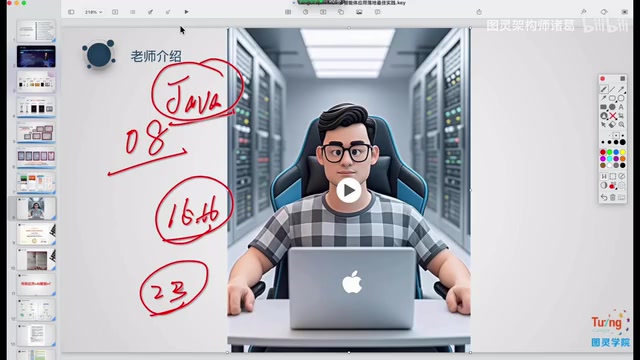
The instructor offers a judgment developers should take seriously: the value of writing code will keep declining. Drawing on his own career—starting in testing in 2008, moving through PHP/Java/big data, then pivoting to large models—he explains that switching between languages is actually quite natural; what's truly scarce is the ability to articulate requirements clearly.
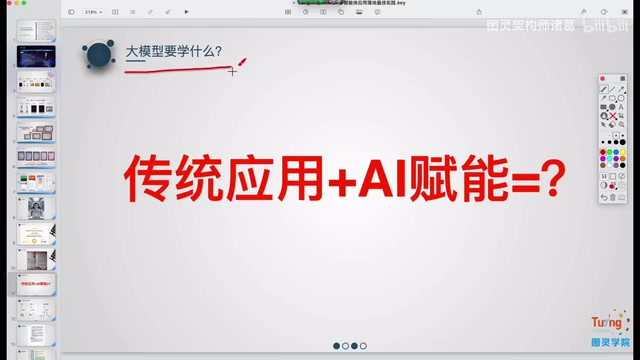
In the era of large models, the share of requirement analysis and solution design in a project will further expand, while purely coding work will shrink. For developers, this means the differentiating competitive edge must shift from "knowing how to write frameworks" to "being able to make judgments and define solutions."
Practical Advice for Developers
The course repeatedly emphasizes one point: you must have personally built a project, even if you just follow along through the entire flow—the experience is completely different. Listening to others explain, memorizing standard answers to pad a resume—these easily fall apart in interviews and conversations.
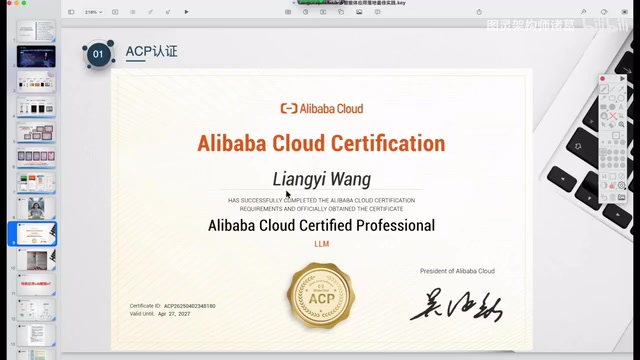
The recommended path: build multi-agent systems with LangGraph as the main thread, pair it with MCP for tool integration and RAG for knowledge augmentation, run the workflow end-to-end in a real or simulated business scenario, and accumulate certifications and project experience to form your own differentiating label. This has real value for both job hunting and entrepreneurship.
For developers interested in enterprise-grade agents, consider starting with this medical multi-agent project—focus on understanding the architectural division of labor and the approach to requirement decomposition, rather than agonizing over how to write any particular piece of code.
One-line Summary
Using a medical multi-agent project as an example, this piece explains the practical combination of LangGraph, MCP, and RAG and the direction of developer skill transformation.
Paragraph Summary
This article summarizes a Bilibili enterprise-grade Agent course by instructor Loulan: set against a real collaborative medical industry project, it demonstrates the complete process from industry analysis to multi-agent construction. It notes that medical workflows are complex, involve many roles, and have high compliance requirements, making them well-suited for multi-agent deployment; it offers a pragmatic criterion for Agents—whether they can independently solve specific business problems, rather than merely adding a persona to a model. Technically, LangGraph handles multi-agent orchestration and state management, MCP connects tool and data source calls, and RAG provides medical domain knowledge retrieval to reduce hallucinations—together supporting a runnable enterprise-grade business flow. The instructor also judges that the value of writing code is declining and that requirement control and solution design will become developers' differentiating competitiveness, recommending that developers personally run through projects and accumulate certifications and hands-on experience.
Related articles

Chain of Thought Isn't Just for AI: How Humans Can Use CoT to Improve Thinking Quality
Chain of Thought isn't just a prompt trick for large models. Starting from a Hacker News discussion, this article analyzes why CoT works for human thinking too, breaks down actionable ways to transfer it, and highlights the key differences between human CoT and machine CoT.
Cloudflare Teams Up with OpenAI: Closi…
Cloudflare Teams Up with OpenAI: Closing the Loop from Vulnerability Discovery to Defense with AI
Cloudflare uses OpenAI Daybreak to investigate security vulnerabilities and generate reviewable remediation plans, while developers use Codex to boost coding efficiency and quality.

Orca Multi-Agent Orchestration in Practice: A Guide to Parallel Collaboration with Claude and Codex
Orca is Stable AI's free open-source agent workbench supporting 34 agents like Claude Code and Codex in parallel. Learn its Git worktree isolation, multi-model orchestration, and mobile management.