LangGraph + Multi-Agent in Practice: A Deep Dive into an AI Travel Route Planning System

An AI travel planner using LangGraph multi-agent orchestration and 236K attraction records for domestic and global route planning.
This travel route planning system uses LangGraph for orchestration, DeepSeek as the inference engine, and a multi-agent architecture for execution — delivered as a complete, runnable graduation project. Its data layer includes ~237K attraction records with 26 fields, supporting both domestic and global planning via an interactive map drill-down. Different agents handle retrieval, matching, and route generation, while a RAG pipeline grounds outputs in real data to reduce hallucinations. The overall tech stack represents a typical modern LLM application deployment pattern with solid learning and development reference value.
Project Overview: A Multi-Agent Collaborative Travel Planning System
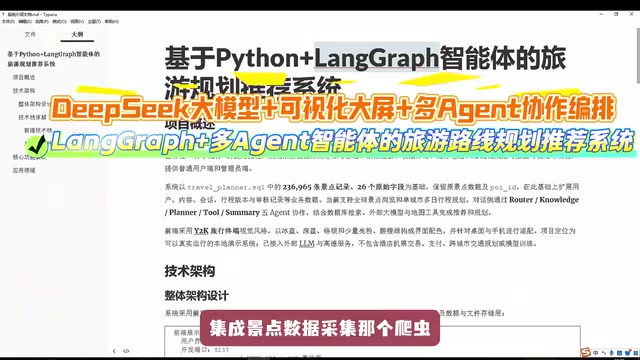
This is a travel route planning and recommendation system built on LangGraph and a multi-agent architecture, powered by the DeepSeekAd large language model, with a data visualization dashboard and multi-agent orchestration. The entire system follows a complete user journey: from discovering attractions and conversational interaction, to route planning, itinerary adjustments, and travel sharing — forming a closed-loop experience.
Based on the demo, the system integrates several functional modules: attraction data collection, attraction search, favorites and reviews, travel notes, AI route planning, and data visualization. As a complete end-to-end case study targeting graduation project scenarios, it strings together several popular techniques from LLM application engineering into a single working product.
Data Foundation: 236,000+ Attraction Records
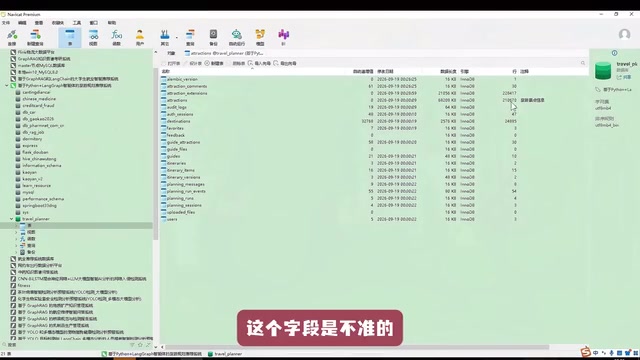
One of the system's core assets is its attraction database. According to the demo, the database contains approximately 236,965 attraction records, covering China with 26 structured fields per entry. These structured fields form the data backbone for downstream retrieval, filtering, and AI-driven planning.
The data was collected via web scraping (the demo references a patch/crawling pipeline), then stored in a database and accessed by LangGraph at runtime. For travel planning applications, the scale and field completeness of the data directly determine recommendation quality — sufficient coverage and dimensional depth give the route planner enough to work with.
In LLM application engineering, integrating a structured external database with an LLM is typically done through one of two approaches: wrapping database queries as Tools so that an Agent can call SQL or vector search interfaces on demand during inference; or pre-processing data into vector embeddings stored in a vector database for semantic retrieval in a RAG pipeline before generation. The former is better suited for precise filtering (e.g., filtering attractions by city or rating), while the latter excels at fuzzy semantic matching (e.g., "nature parks suitable for families with kids"). A 26-field structured data foundation means the system can perform multi-dimensional conditional filtering during Agent calls, rather than relying solely on semantic similarity — which is critical for generating coherent and actionable travel itineraries.
Key Differentiator: Support for Both Domestic and Global Attractions
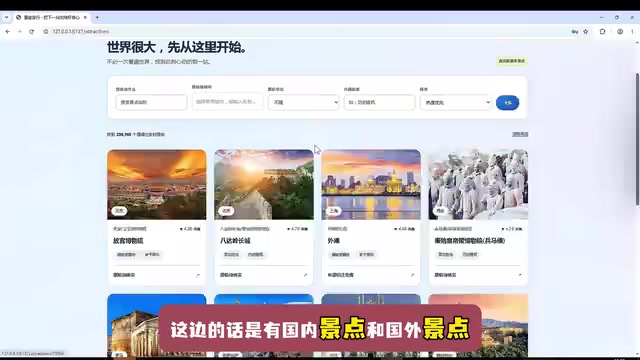
The demo specifically highlights what sets this system apart from similar projects: simultaneous support for both domestic Chinese and global attraction planning. The user interface offers two separate entry points — domestic and international — with a world map for visual interaction.
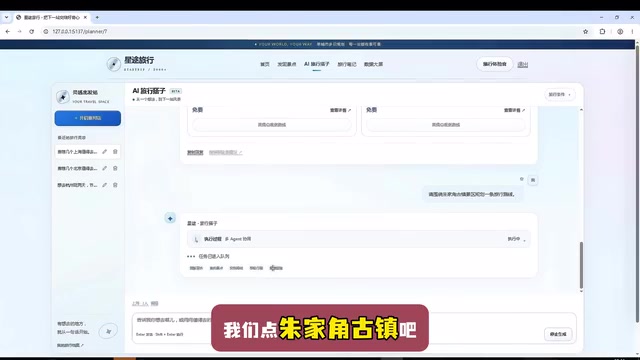
For the China region, users can drill down to see attraction counts by specific city or area. For example, clicking on a location like "Zhujiajiao Ancient Town" prompts the system to generate a day-by-day itinerary based on the attraction's details. This combination of "map drill-down + day-by-day planning" merges geospatial visualization with AI planning capabilities, making it far more intuitive than plain text recommendations.
Multi-Agent Collaboration: The Orchestration Role of LangGraph
The system uses a multi-agent collaborative approach to complete planning tasks. LangGraph plays the orchestration role — scheduling different agents and chaining together data retrieval, attraction matching, and route generation. Compared to a single LLM generating output directly, the multi-agent architecture's advantage lies in separation of responsibilities: a retrieval agent handles data lookup, a planning agent handles itinerary scheduling, and results are aggregated after each agent does its job.
The demo mentions a "chain retrieval feature" along with the ability to process documents for product understanding. This indicates that the system incorporates RAG (Retrieval-Augmented Generation) at the design level, grounding the LLM's output in real attraction data rather than generating from scratch — reducing hallucinations and improving the reliability of itinerary suggestions.
LangGraph is a directed graph workflow framework developed by the LangChain team, designed specifically for multi-step, multi-agent LLM applications. Unlike linear Chain structures, LangGraph allows developers to model the entire reasoning pipeline as a directed acyclic graph (DAG) or a stateful machine with cycles — where nodes represent individual agents or processing steps, and edges represent data flow and conditional transitions. This structure enables the system to decide at runtime which agent to invoke next based on intermediate results, supporting conditional branching, parallel execution, and retry loops — far more flexible than simple sequential calls.
RAG (Retrieval-Augmented Generation) is the mainstream solution for addressing LLM hallucination: before the model generates a response, relevant document chunks are retrieved from an external knowledge base and injected into the prompt as context, so the model answers based on real data rather than training memory. In travel planning scenarios, RAG is especially critical — it ensures that details like attraction information, opening hours, and ticket prices in the planning agent's output come from the actual database rather than being fabricated by the model.
Engineering Deliverables: Complete Code and Documentation
As a graduation project, the system comes with fairly comprehensive deliverables, including backend source code and supporting documentation. The demo presenter notes that the documentation enables a thorough understanding of the system architecture and supports further development. For developers learning LLM application development and looking to get hands-on experience with LangGraph multi-agent orchestration, a complete, runnable project like this offers meaningful reference value.
Summary
This travel route planning and recommendation system showcases a typical technology stack for deploying LLM applications today: LangGraph for orchestration, DeepSeek for inference, multi-agent collaboration for execution, a visualization dashboard for presentation, and a knowledge base of over 230,000 attraction records. It makes meaningful differentiating attempts with dual domestic/international support and map drill-down interactions. That said, the demo focuses primarily on feature demonstration — the system's actual performance in terms of planning algorithm accuracy, data field reliability, and other dimensions still requires further validation.
Related articles

JobRunner MCP Server: AI Agents Can Now Fix Failed Java Jobs
JobRunner launches an open-source MCP server enabling AI agents to view cluster status, diagnose failures, and recover Java jobs—incident response from any cloud coding environment or existing agent.

MLAI Digital Launches 9 Security Agents: MCP Server Safeguards the Full Lifecycle of Agentic AI
MLAI Digital launches Security MCP Server with nine built-in specialized security agents covering vulnerability discovery, attack simulation, prompt injection detection, API and infrastructure assessment, and accelerated remediation—embedding security validation across the full Agentic AI lifecycle from development to production.

Running Isaac Lab on H100 GPUs: Exploring Better Approaches
Exploring optimization methods for running Isaac Lab on NVIDIA H100 GPUs, including MIG configuration, mixed precision, TensorRT acceleration, and community experience to improve robotics simulation and reinforcement learning efficiency.