LangGraph Multi-Agent Tutorial: From Node Control to Hands-On Development

Bilibili LangGraph multi-agent tutorial emphasizes production selection, 0.3 components, and three hands-on projects.
This Bilibili tutorial positions LangGraph multi-agents as the advanced and core part of the course, arguing that multi-agents are more common than single agents in production environments because they can decompose complex tasks and isolate role responsibilities. The course first explains architecture selection logic, then introduces LangGraph's position in the LangChain ecosystem: after version 0.2, LangGraph was extracted and strengthened, integrating agent and Memory capabilities, and the course is uniformly developed on version 0.3. It then arranges three hands-on projects—a code assistant, a prompt generation assistant, and a WebRTC digital human multi-agent—with the first two directly transferable to production. Code is managed in three parts to lower the environment barrier, and learners are advised to study selection and components before moving into hands-on practice.
If you're looking for a systematic path to learning LangGraph multi-agents, the course design of this Bilibili tutorial is worth studying. The creator frames multi-agent architecture as the "advanced portion" of the entire course, and states outright that in commercial and production environments, multi-agent architectures are used more frequently.
Why Multi-Agent Becomes the Top Choice for Production Environments
The course opens with a key question: why choose a multi-agent architecture? The creator's assessment is that in real production environments, multi-agents can better decompose complex tasks and isolate the responsibilities of different roles—this is more controllable than a single agent shouldering all the logic itself.
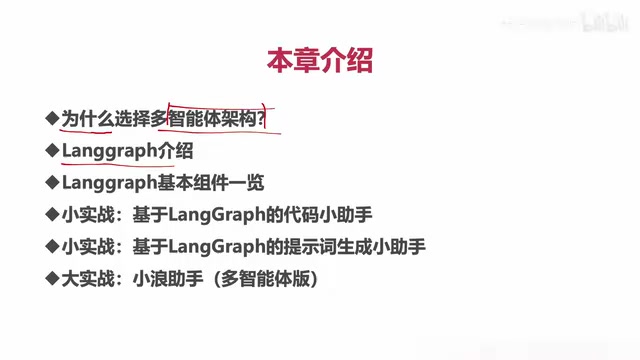
This chapter is positioned as the core of the course, and the creator reminds learners that this part "must be studied carefully." From the content arrangement, this chapter first explains the logic of architecture selection, then moves to the LangGraph framework itself, and finally wraps up with hands-on practice, forming a complete cognitive loop.
LangGraph's Position in the LangChain Ecosystem
According to the creator, LangGraph is the officially recommended agent development framework within the LangChain ecosystem. After version 0.2, the official team extracted LangGraph and strengthened it, integrating the parts of LangChain related to agents and Memory.
The background of this evolution is that LangChain had some engineering stability issues in its early days. The creator states directly in the course that LangChain's engineering only "became a stable version by 0.3," and earlier versions had more compatibility issues. Therefore, the current course is uniformly developed based on LangChain and LangGraph version 0.3, which is also the latest version at present.
The course provides an overview-style explanation of LangGraph's basic components to lay the foundation for subsequent hands-on work. This part is the prerequisite for understanding node control and state flow, and it's also the underlying capability for multi-agent orchestration.
The Relationship Between LangChain and LangGraph: LangChain is an open-source framework for building LLM applications, providing abstractions such as models, tools, prompts, retrievers, and memory. LangGraph is a stateful, multi-participant orchestration framework built on top of it. Its core is modeling applications as graphs, where nodes are functions/subgraphs and edges are control flow, supporting loops, branching, interrupts, and persistent state. After version 0.2, LangGraph was extracted independently and integrated the Agent and Memory related modules originally belonging to LangChain, so that capabilities like agent loops, tool calls, and short-term/long-term memory are uniformly expressed under the graph model. This design better suits the needs of role isolation, state sharing, and controllable workflows in multi-agent collaboration.
LangGraph Basic Components: A graph consists of State, Node, and Edge. State is usually a TypedDict or Pydantic model that defines fields shared across nodes; each Node receives the current State and returns incremental updates; Edge determines which node to go to next, and supports conditional edges for dynamic routing. The compiled graph is executable and supports Checkpointer persistence, thereby enabling multi-turn interaction, human intervention (interrupt), and replay. Multi-agent orchestration is about combining these capabilities so that different role nodes collaborate within the same state space.
Three Hands-On Cases Covering Different Difficulty Levels
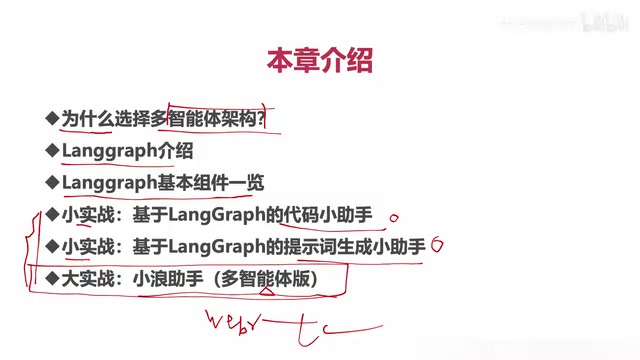
The course arranges three hands-on projects—"two small and one large"—namely a code assistant, a prompt generation assistant, and a multi-agent version combined with a WebRTC digital human.
The creator's assessment of the first two small hands-on projects is that they are "packed with practical value," and can even be used in production after "a little tweaking." Tool-type agents like the code assistant and prompt assistant are indeed relatively easy to migrate into actual business. The large hands-on project demonstrates the combination of multi-agents with the digital human scenario, which is more complex.
WebRTC Digital Human: WebRTC is a set of browser standards for real-time audio and video communication, supporting peer-to-peer low-latency transmission, and is often used for voice/video calls and live interactive streaming. In the digital human scenario, WebRTC is responsible for sending the user's voice or video stream to the backend in real time, while pushing the digital human's synthesized voice, lip sync, expressions, or video stream back to the frontend with low latency, creating a "human-like" conversation experience. When combined with multi-agents, modules such as ASR, dialogue/orchestration agents, TTS, and driving and rendering typically work together, with each role's responsibilities isolated and scheduled by the orchestration layer, thereby handling complex dialogue logic while ensuring real-time performance.
Code Distribution Uses a Three-Part Separation Design
This course has a large amount of code, and the creator manages it in three parts: teaching demonstration code is placed on the Ego2AI tool website, which can be run online without configuring an environment; some code involving local operations or multithreading is, for security reasons, not open for running but can be viewed, and is also packaged on cloud storage for local execution; hands-on project code is placed in the Muke Git repository.
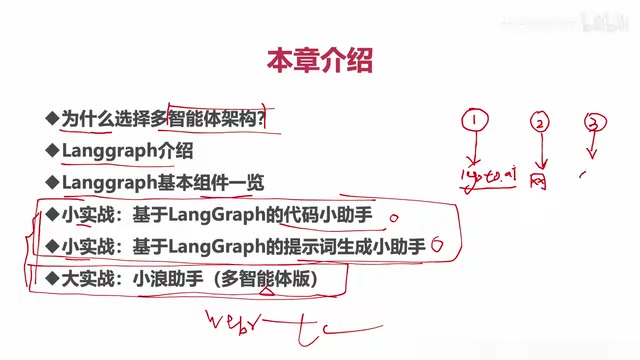
A practical consideration behind this design is that many beginners easily get stuck on setting up their local environment. The creator mentions that in the past, all code was packaged for local execution, and as a result "many beginner users couldn't get their environment set up," which instead increased the learning cost. So simple single-threaded code runs directly online, paired with a code evaluation environment to test mastery; code requiring a local environment comes with detailed installation steps.
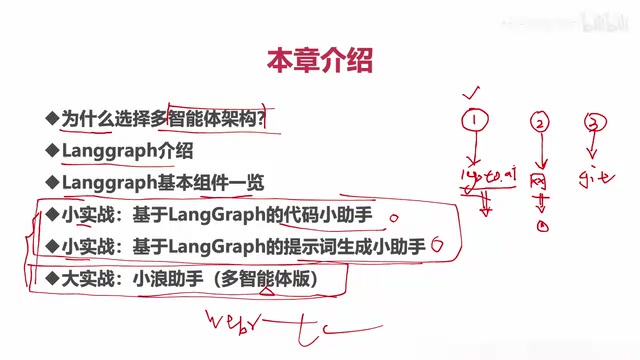
The dependencies and environment versions for each hands-on project are clearly explained in the notebook, and learners can configure them by following the steps. If there are questions, they can ask in the Q&A section of the Muke website or join the community of the tool website for discussion.
Suggested Learning Path
Looking at the course structure, a reasonable order is to first understand the selection logic of multi-agent architecture, then master LangGraph's components and node control, and finally move into hands-on practice. The creator emphasizes that this chapter will take a bit longer, but it is required content. For learners already familiar with the basics of LangChain, jumping directly into the multi-agent section of LangGraph version 0.3 is a more pragmatic choice under the current production-oriented direction.
Related articles

Prompt Engineering for Beginners: From Writing Prompts to Engineering Thinking
Starting from the essence and four functions of prompts, this article systematically explains the six-step process, four success criteria, learning value, and practical limitations of prompt engineering to help you build a complete understanding.

Anthropic Launches Nasdaq IPO: AI Giant's Listing and Risk Disclosures
Anthropic officially launches its Nasdaq IPO under ticker ANT, with market valuation expected to potentially exceed SpaceX's record. The prospectus devotes nearly 100 pages to AI risks, while first-half revenue grew over 14x but net losses widened sharply, reigniting the AI bubble debate.

Rust cURL Clone Uses 4,832 unsafe Blocks—Is the Memory Safety Myth Broken?
A Rust cURL clone uses 4,832 unsafe keywords, challenging Rust's memory safety narrative. We analyze what unsafe really means, compare Fil-C, and examine rewrite motives.