Latent Space Casino: Exploring LLM Tokenization and Neuron Activation Through Gambling Games

A creative project turning LLM tokenization and neuron activation into interactive casino games.
Latent Space Casino is a Game Jam project that gamifies LLM internals by combining Tiktokenizer-style tokenization visualization with Blackjack and MLP hook-based Neuron Roulette. Built in a day with GPT assistance, it transforms abstract concepts like token splitting and neuron activation into interactive gambling games, offering a playful gateway into AI interpretability research.
A Wildly Creative AI Project
In an era where AI technology is becoming increasingly specialized and tool-oriented, one developer has found an extraordinarily fun way to reinterpret the underlying mechanisms of large language models (LLMs). Recently, a project called "Latent Space Casino" caught attention on Reddit. It was an experimental creation completed during a GPT-assisted Game Jam.
The core concept can be summed up in one sentence: Tiktokenizer, but with gambling. Tiktokenizer is OpenAI's open-source tokenization visualization tool that shows how text gets split into tokens. This developer took that foundation and added Blackjack and mlp_hooks-based "Neuron Roulette," transforming dry model internals into an interactive game.
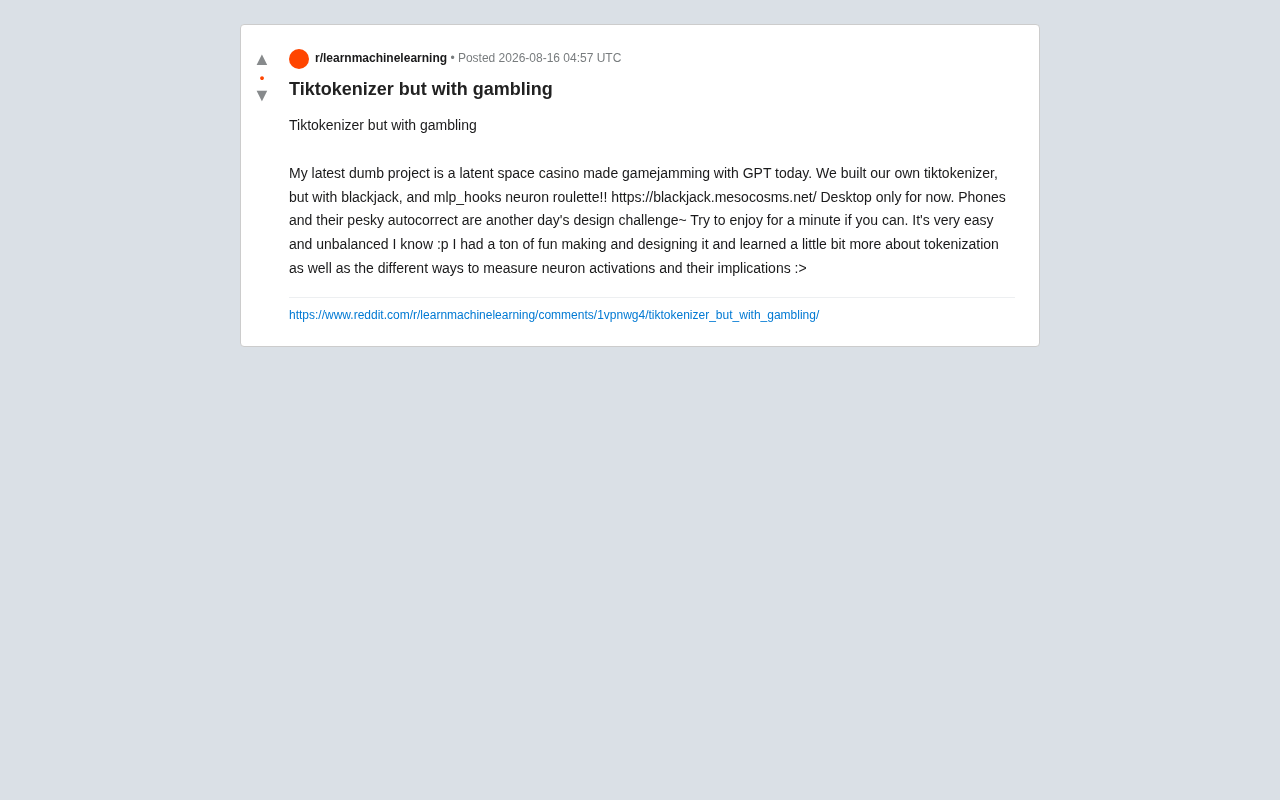
The project is live at blackjack.mesocosms.net and currently supports desktop only. The developer candidly admits that mobile autocorrect interferes with the input experience, making mobile adaptation "a design challenge for another day."
The Fascinating Fusion of LLM Tokenization and Gambling
Starting with Tiktokenizer's Tokenization Visualization
To understand this project, you first need to grasp the central role of tokenization in LLMs. Large language models don't process text directly — they first split text into individual tokens, which might be complete words, word roots, or even single characters. This splitting process directly affects the model's comprehension efficiency and generation quality. Tiktokenizer is a tool that lets you intuitively see this process: input some text, and it shows you exactly which tokens the model "sees."
The developer gamified this mechanism, letting players interact with the tokenizer through casino-style gameplay to experience the randomness and uncertainty of tokens. This design cleverly transforms abstract technical concepts into tangible gaming experiences.
The Technical Core of Neuron Roulette: MLP Hook Functions
The most technically sophisticated part of the project is "Neuron Roulette." The developer leveraged mlp_hooks — hook functions attached to the model's Multi-Layer Perceptron (MLP) layers — to capture neuron activation values.
In Transformer architecture, MLP layers handle a significant portion of information processing. By reading the activation states of these neurons through hook functions, the developer was able to visualize the internal signals when the model "thinks" and map them to roulette outcomes. This isn't just an entertaining mechanic — it's an experimental pathway for understanding a model's inner workings.
Technical Insights from the Project
Multiple Ways to Measure Neuron Activation
During development, the creator mentioned having "learned more deeply about tokenization, as well as different ways of measuring neuron activation and what they mean." This point deserves elaboration.
There isn't just one standard for measuring neuron activation. Common approaches include:
- Raw activation values: Directly reading the numerical magnitude of neuron outputs.
- Activation frequency: The probability of a given neuron being activated across different inputs.
- Relative activation strength: The activation level compared to other neurons in the same layer.
Different measurement approaches reflect different information organization logic within the model. By converting these values into random events within a game, the developer is essentially exploring the cutting-edge research field of Interpretability in an intuitive way.
Imperfect but Fun: The Spirit of Experimentation
The developer was refreshingly honest in calling it a "silly project," admitting the game is "very simple and unbalanced." But this mindset of not pursuing perfection and creating for entertainment and learning embodies the invaluable spirit of experimentation found in the AI community.
In an age where major corporations compete with hundreds of millions of parameters and tens of millions of dollars in training costs, these small, fun, educational personal projects offer an alternative perspective: technology doesn't just have to seriously drive productivity — it can also serve as a gamified medium that sparks curiosity and lowers barriers to understanding.
What Projects Like This Mean for the AI Field
Lowering the Barrier to Understanding AI
For most non-specialists, concepts like tokens and neuron activation are abstract and hard to grasp. Presenting them through gamification allows more people to engage with these underlying mechanisms in a relaxed, enjoyable way. This "learning through play" approach holds significant inspirational value for AI education and outreach.
GPT-Assisted Creation as an Efficient Development Paradigm
Interestingly, the entire project was completed in a single day with GPT's assistance. This demonstrates the tremendous boost that current AI coding assistants provide for creative implementation. An experimental project that might have previously taken days or even weeks can now be brought to life within the short timeframe of a Game Jam. This also signals that more "flash of inspiration" ideas will be rapidly validated and realized in the future.
A Playful Extension of AI Interpretability Research
Although this is just a hobby project, the neuron activation visualization it touches on is one of the core topics in AI interpretability research. Understanding what actually happens inside a model is key to ensuring AI safety and controllability. Exploring this field through games could attract more people to pay attention to and engage in related research.
Conclusion
"Latent Space Casino" is a quintessential geek-style creative project — it doesn't pursue commercial value or solve any grand problem, but it uses humor and cleverness to turn LLM tokenization and neuron mechanisms into a game anyone can play. As AI technology continues to become more specialized, playful experiments like this remind us that the joy of exploring technology is itself a powerful driver of innovation.
If you're interested in LLM tokenization, neuron activation, or AI interpretability, take a minute to fire up your desktop browser and experience this one-of-a-kind "casino" for yourself.
Related articles

Free Unlimited Claude Code Solution: Agnes AI + CC Switch Setup Guide
No paid subscription needed — pair the free AI platform Agnes AI with the open-source tool CC Switch to provide a backend for Claude Code, enabling unlimited free calls to text, image, and video models. This guide covers the full setup, test results, and usage boundaries.

A Complete Zero-Cost Guide to Getting Started with Claude Code for Beginners in China
A beginner's guide to Claude Code for users in China: two installation methods (command line and IDE plugin), full configuration steps for replacing the official API with the free domestic LongCat model, and a hands-on demo of building a small tool with natural language, plus tips.

When the NSA Gets Involved: The AI Supply Chain Crisis Behind Open-Source CVEs and API Key Hijacking
Multiple open-source projects disclosed severe CVEs in one day, PHP flaws alarmed the FBI, and Railway and OpenCode were breached with API keys stolen. This article breaks down the vulnerability window, AI-accelerated exploitation, and the AI supply chain crisis behind the API key black market, with a developer defense checklist.