LawZero Receives Support from Canadian and German Governments, Marking a New Chapter in AI Safety

AI safety org LawZero receives joint government backing from Canada and Germany, signaling a new era in sovereign AI governance.
AI safety research organization LawZero has announced support from the governments of Canada and Germany, reflecting a significant shift in global AI governance. Unlike AI labs dependent on venture capital or tech giant funding, government-backed institutions can maintain greater independence and focus on safety work that is societally critical but commercially unviable. Canada's deep AI research tradition and Germany's rigorous regulatory stance under the EU AI Act make their joint sponsorship a compelling model for transnational AI governance cooperation. The article notes that the tweet revealed limited details, and the real test will be whether these institutions can produce research that genuinely shapes policy and technology.
The Signal Behind a Tweet
Recently, a tweet from the French-speaking tech community caught attention: AI research organization LawZero announced it had received support from the governments of Canada and Germany, and would use it to advance its next phase of development. The author expressed pride in the team's work and deep gratitude for what they called "unprecedented support."
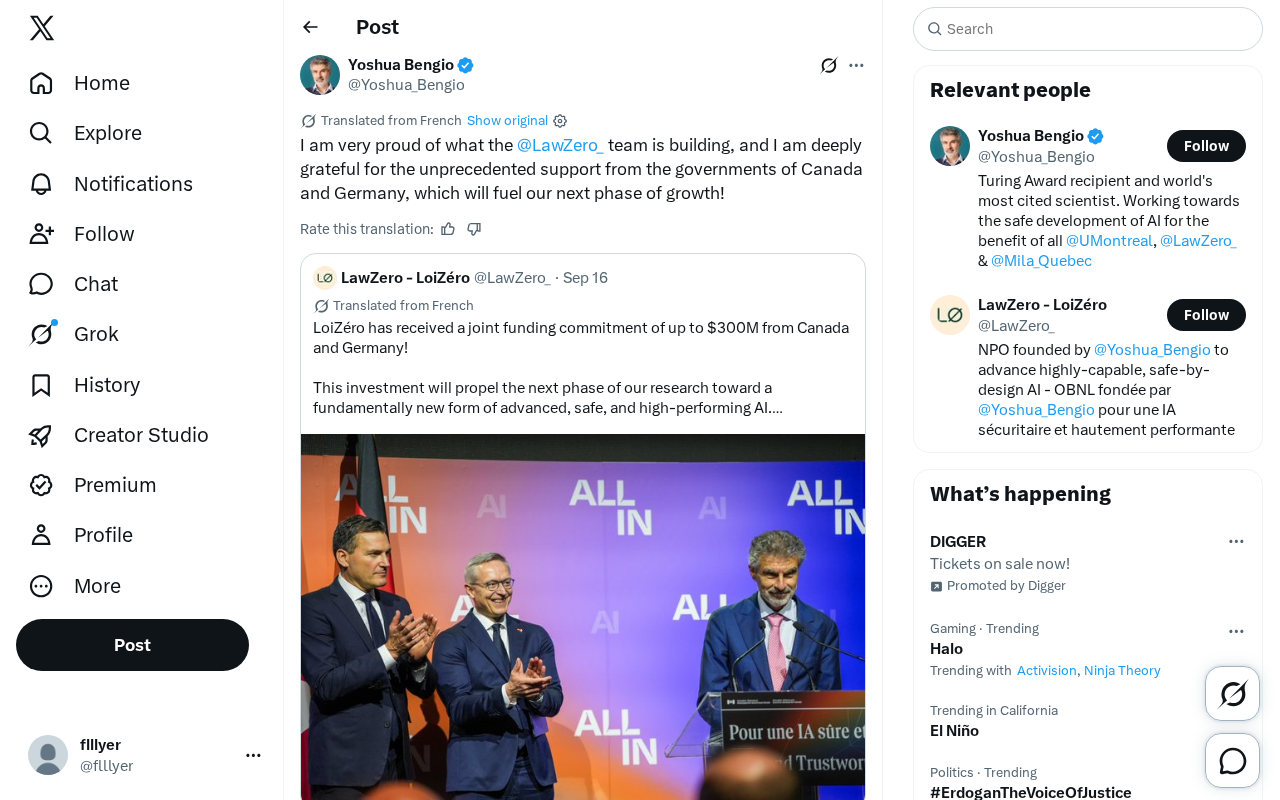
This seemingly brief post reflects an important trend in global AI governance and safety research: sovereign nations are increasing their investment in independent AI safety research institutions, trying to put safety and accountability guardrails on technology that is racing ahead at breakneck speed.
Who Is LawZero
Based on publicly available information, LawZero is positioned as a research organization focused on AI safety and governance. The core mission of such institutions typically centers on foundational research into the controllability, trustworthiness, and risk mitigation of advanced AI systems — rather than pursuing commercialized products.
Notably, the tweet specifically highlighted the element of "government support." Unlike AI labs that rely on venture capital or funding from large tech companies, research institutions backed by national-level funding are often expected to play a more neutral role in service of the public interest. This difference in funding source shapes the independence of the research agenda — freeing researchers from short-term commercial pressures so they can focus on long-cycle, high-stakes safety topics that are critical to society but may not generate quick returns.
AI Safety Research as an academic field emerged in the mid-2010s, with a core question: how do we ensure increasingly powerful AI systems act in accordance with human intentions, and can be corrected or shut down when something goes wrong? The field encompasses several sub-areas: Alignment research focuses on keeping AI goals consistent with human values; Interpretability research aims to understand the decision-making mechanisms inside neural networks; and Red Teaming simulates attacks to discover security vulnerabilities in models. Compared to safety teams embedded within large tech companies, independent research institutions have the advantage of operating without release pressure or commercial baggage — they can publish critical findings more freely, including assessments of their own funders.
Why Canada and Germany
Canada has long been a global hub for AI research. Montreal and Toronto are home to a concentration of top research talent, and several founding figures of deep learning have deep ties to Canadian academia. The Canadian government has continued to invest through a national AI strategy in recent years, supporting the domestic research ecosystem.
Germany, on the other hand, represents Europe's cautious approach to AI regulation and ethics. The EU AI Act has established one of the world's strictest AI regulatory frameworks, and Germany, as a core EU member, has been an active advocate for "responsible AI." The two countries jointly supporting the same institution sends a clear signal: AI safety is no longer a single-nation issue — it is becoming a matter of transnational public collaboration.
The EU AI Act officially came into force in 2024 and is the world's first comprehensive legislative framework targeting AI. It uses a risk-tiered management model, classifying AI systems into four categories based on potential harm — unacceptable risk, high risk, limited risk, and minimal risk — and imposes strict transparency, traceability, and human oversight requirements on high-risk applications (such as biometric identification and decision support for critical infrastructure). Non-compliant companies face fines of up to 3%–7% of global revenue. This legislative backdrop gives Germany a clear policy rationale for co-funding independent AI safety research: regulatory enforcement requires independent technical assessment capabilities, and government agencies alone cannot keep up with rapidly iterating model capabilities.
The Significance of Government Funding Entering AI Safety
Over the past few years, the explosion in AI capabilities has been primarily driven by the private sector, with funding, compute, and talent highly concentrated among a handful of tech giants. This creates a structural concern: investment in safety research has lagged far behind the pace of capability development, and much of the safety work is tied to the very entities being evaluated, raising questions about independence.
The injection of government funding attempts to partially address this imbalance. It means:
- Research independence is protected: Free from the influence of any single company's interests, researchers can objectively evaluate AI systems, including those from leading companies.
- Stronger public interest orientation: Research outcomes are more likely to inform regulatory development, standard-setting, and societal risk mitigation.
- A model for international collaboration: Joint funding by multiple governments offers a replicable framework for global AI governance cooperation.
From a broader funding ecosystem perspective, the global AI safety field currently draws from highly fragmented and uneven sources. A small number of philanthropic foundations — such as Open Philanthropy and the Survival and Flourishing Fund — have long been the primary funders of independent safety research, operating at the scale of hundreds of millions of dollars, while leading AI labs routinely raise billions in a single round. The entry of government funding carries symbolic weight that sometimes rivals its actual dollar amount — it represents safety research being formally incorporated into national science and technology budgets, with more stable institutional backing rather than dependence on the goodwill of a handful of mission-driven donors. This shift also means research outcomes are more likely to feed directly into regulatory policymaking, shortening the path from academic discovery to institutional implementation.
A Beginning That Warrants Measured Optimism
It must be noted that the tweet itself contains limited information — specific funding amounts, research direction details, and timelines have not been disclosed. Government backing is a positive signal, but whether AI safety research can truly keep pace with capability development still depends on the sustainability of follow-on investment, the real-world impact of research outputs, and the ability to maintain stability across shifting political cycles.
For observers following AI governance, LawZero's announcement is worth adding to a long-term watchlist. When more and more governments begin directing resources toward AI safety rather than simply racing to lead in AI capabilities, it may well be a sign that the industry is maturing.
The real test lies ahead: can these institutions, on which so much hope is being placed, actually produce research that influences the trajectory of policy and technology?
Related articles

Build an AI Super Employee System at Zero Cost: A Full Breakdown of Automated Agent Workflows
A deep breakdown of the AI super employee system demoed on Bilibili: agent orchestration, digital human voiceovers, map and enterprise lead generation, 24/7 customer service, and legal modules. We analyze the business logic and compliance risks behind zero-cost signup to help entrepreneurs judge the real ROI of this AI digital employee system.

The Essential Difference Between Chatbots and AI Agents: Crossing from Conversation to Execution
What's the difference between a chatbot and an AI agent? Based on the MCP series on the Learn Tech channel, this article uses examples like booking flights and summarizing notes to explain: a chatbot only gives answers, while an agent actually completes tasks through a think-act-observe loop. It breaks down the four core components—model, tools, memory, and goal—as well as MCP's role as a bridge, and discusses agents' applicable boundaries and permission risks.

Free GitHub Repo: 342 Hours of AI Courses, from Math to MCP Servers
A free GitHub repo offers 342 hours of AI courses: 523 lessons across 20 phases, from math fundamentals to agent building and MCP servers. Nearly 100,000 learners have started.