Laya: Exploring the Open-Source Voice Assistant Landscape
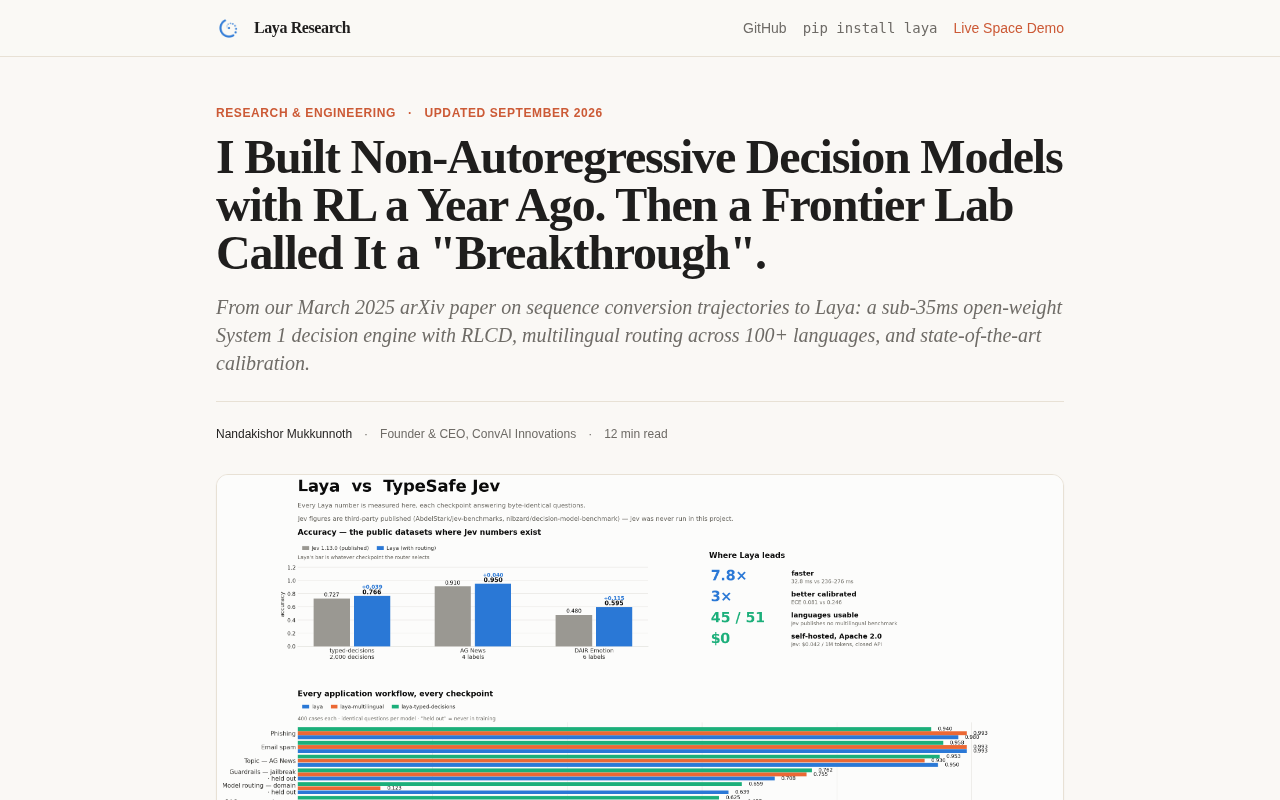
Laya, an open-source voice assistant, reflects developers' ongoing push for privacy control and freedom from vendor lock-in.
Laya, a project that recently appeared on Hacker News positioning itself as the "open-source version of Jev," represents the continued trend toward open-sourcing AI assistants. The article examines three core advantages: verifiable trust through auditable code, flexible customization, and freedom from vendor lock-in. Real-world challenges are equally significant: capability gaps between open-source and commercial models, the technical barrier of self-hosting, and the lack of sustained community maintenance that causes most such projects to fail. The article recommends treating Laya as a window into the open-source AI ecosystem rather than rushing to judge it.
A Voice Assistant Targeting the Open-Source Ecosystem
A project called Laya recently appeared on Hacker News, positioning itself as "the open-source version of Jev." The post attracted only 22 upvotes and 3 comments — a modest discussion — but the trend it reflects is worth paying attention to: more and more developers want to rebuild once-closed AI voice and assistant products in the open, gaining greater transparency and control in the process.
The "open-source version of X" concept is fundamentally a response to two major pain points of closed-source products: data privacy and self-deployment. When an assistant-type tool needs to upload a user's voice, commands, and even context to third-party servers, privacy concerns are almost inevitable. An open-source implementation lets users run the software locally or on their own servers, giving them full control over where their data flows.
Why "Open-Source Alternatives" Keep Emerging
The preferences of the Hacker News community make it clear that developers have a natural affinity for tools that are "self-hostable, auditable, and forkable." The wave of "open-source version of X" projects that has emerged in recent years almost all follows the same logic:
Transparency and Trust
The behavior of closed-source products is a black box to users. Open-source code allows anyone to inspect data-handling logic — which is especially important for assistant applications that deal with voice and personal commands. Trust is no longer built on a vendor's promises, but on verifiable code.
This "auditability" has well-established concepts behind it in technical circles: reproducible builds and code audits. For voice assistant applications, audits typically focus on: the local processing logic for microphone wake words, whether voice data is transcribed locally before being sent, where contextual memory is stored and how it is encrypted, and the network request behavior of third-party SDKs. Even if ordinary users lack the ability to conduct audits themselves, someone in the open-source community will often do this work proactively and publish the results — a "crowdsourced trust" mechanism that closed-source products simply cannot replicate.
Customizability and Extensibility
Open source means developers can modify functionality as needed, and integrate their preferred models or backend services. For teams looking to embed a voice assistant into a specific workflow, this flexibility is something closed-source SaaS cannot offer.
Cost and Lock-in Risk
Commercial assistants typically use subscription models tied to specific cloud services. Open-source solutions let users escape vendor lock-in, giving them greater freedom over both costs and their technical roadmap.
Vendor lock-in is one of the core risks of the SaaS era. For assistant-type tools, lock-in typically occurs at three levels: data format (history and personalized settings cannot be exported), API dependency (deeply integrated workflows make it hard to switch underlying models), and pricing power (switching costs are extremely high when subscription prices rise). Open-source solutions mitigate all three risks by keeping core logic in the user's hands — but the trade-off is that users must take on responsibility for operations, upgrades, and security patches themselves. The true total cost of ownership (TCO) is not always lower than a commercial solution.
The Real-World Challenges Facing Open-Source Assistants
The vision is appealing, but getting an open-source assistant project to actually work in practice is no easy task.
The capability gap in models is the primary challenge. Closed-source products are typically backed by mature commercial large language models, whereas open-source implementations relying on local or open-source models may show noticeable gaps in response quality and speech recognition accuracy. Striking a balance between controllability and user experience is a long-term challenge for these projects.
Maintenance and community activity are equally critical. Whether an "open-source version" can go the distance depends on whether there are ongoing contributors and a steady development cadence. Gaining a small amount of attention from a single launch is not enough to sustain a viable project. Given the current discussion volume of just 3 comments, Laya is clearly at a very early stage.
The barrier to ease of use cannot be ignored either. Self-hosting typically requires users to have a certain level of technical skill to complete deployment and configuration, which locks out a large portion of everyday users. If an open-source project wants to expand its reach, reducing the complexity of installation and setup is a step it cannot skip.
Open-source voice assistant projects typically rely on a combination of several key technical components: Voice Activity Detection (VAD) to determine when a user starts and stops speaking; Automatic Speech Recognition (ASR) to convert audio to text, with common open-source options including OpenAI's Whisper and its derivatives; a Large Language Model (LLM) for natural language understanding and generation, with options like Llama and Mistral that can run locally; and Text-to-Speech (TTS) to convert responses into spoken audio. The cumulative latency across each of these stages determines overall response speed — which is also the technical reason why open-source solutions generally feel less conversationally fluid than commercial products.
The Value of Observing Early-Stage Projects
For a project like Laya that is just getting started, rather than rushing to judge its success or failure, it's more useful to treat it as a data point for observing the evolution of the open-source AI ecosystem. It represents the aspirations of a segment of developers — those who don't want to be locked into a closed ecosystem and want to rebuild critical tools in the open.
If you're interested in voice assistants and self-hosted AI application solutions, it's worth keeping an eye on how projects like this develop. Their model choices, deployment approaches, and community feedback are all important signals for judging whether they have a viable future. A truly valuable open-source alternative will ultimately prove itself through code quality and community vitality — not by riding on the label of "open-source version of X."
Summary
Laya currently has limited information and is not yet ready for a comprehensive review, but the fact that it appeared on Hacker News is itself an interesting signal: the wave of open-sourcing in the AI assistant space continues. For users and developers who care about privacy, controllability, and technical autonomy, projects like this are worth keeping an eye on.
Related articles

Free Unlimited Claude Code Solution: Agnes AI + CC Switch Setup Guide
No paid subscription needed — pair the free AI platform Agnes AI with the open-source tool CC Switch to provide a backend for Claude Code, enabling unlimited free calls to text, image, and video models. This guide covers the full setup, test results, and usage boundaries.

A Complete Zero-Cost Guide to Getting Started with Claude Code for Beginners in China
A beginner's guide to Claude Code for users in China: two installation methods (command line and IDE plugin), full configuration steps for replacing the official API with the free domestic LongCat model, and a hands-on demo of building a small tool with natural language, plus tips.

When the NSA Gets Involved: The AI Supply Chain Crisis Behind Open-Source CVEs and API Key Hijacking
Multiple open-source projects disclosed severe CVEs in one day, PHP flaws alarmed the FBI, and Railway and OpenCode were breached with API keys stolen. This article breaks down the vulnerability window, AI-accelerated exploitation, and the AI supply chain crisis behind the API key black market, with a developer defense checklist.