LayerProof Matte 3.0 Review: Batch-Generate 50 Brand Social Media Posts in One Sitting

LayerProof Matte 3.0 auto-builds brand kits and batch-generates 50 on-brand social media posts in one sitting.
LayerProof Matte 3.0 targets the efficiency bottleneck of social media content production by automatically constructing brand kits and batch-generating 50 on-brand posts, carousels, and stories with publish-ready captions. Co-designed with marketers across SaaS, FMCG, F&B, and consulting industries, it aims to maintain brand consistency at scale. While the batch generation promise is compelling, actual value depends on usability rates and content quality.
The Efficiency Bottleneck of Social Media Content Production
For brands and marketers managing social media accounts, the biggest pain point has never been a lack of creativity — it's that content output speed can't keep up with platform update cadences. Algorithms on Instagram, LinkedIn, Xiaohongshu, and similar platforms reward high-frequency posting, but every single post requires significant time investment from ideation and design to copywriting. For SaaS startups, FMCG brands, or consulting teams, this often means either hiring a full-time designer or sacrificing content quality for quantity.
Modern social media platform recommendation algorithms widely use "content freshness" as a key ranking factor. Take Instagram as an example: its algorithm considers timeliness, user interaction history, and content relevance to determine display priority. LinkedIn's algorithm tends to reward content that receives high engagement within 48 hours, granting consistently active accounts more initial exposure (the so-called "creator mode" weighting). Xiaohongshu's CES scoring system (1 point for likes, 1 point for saves, 4 points for comments, 4 points for shares) similarly favors high-frequency publishers with traffic pool prioritization. This means that if a brand can't maintain a posting cadence of 3-5 times per week, its organic reach rate will decline significantly, creating a vicious cycle.
LayerProof Matte 3.0, which recently launched on ProductHunt and climbed to #16 on the daily leaderboard, targets exactly this pain point. Its core promise is highly attractive: paste your brand or product information, the tool automatically builds a brand kit, then generates 50 on-brand content pieces in a single operation — complete with publish-ready captions.
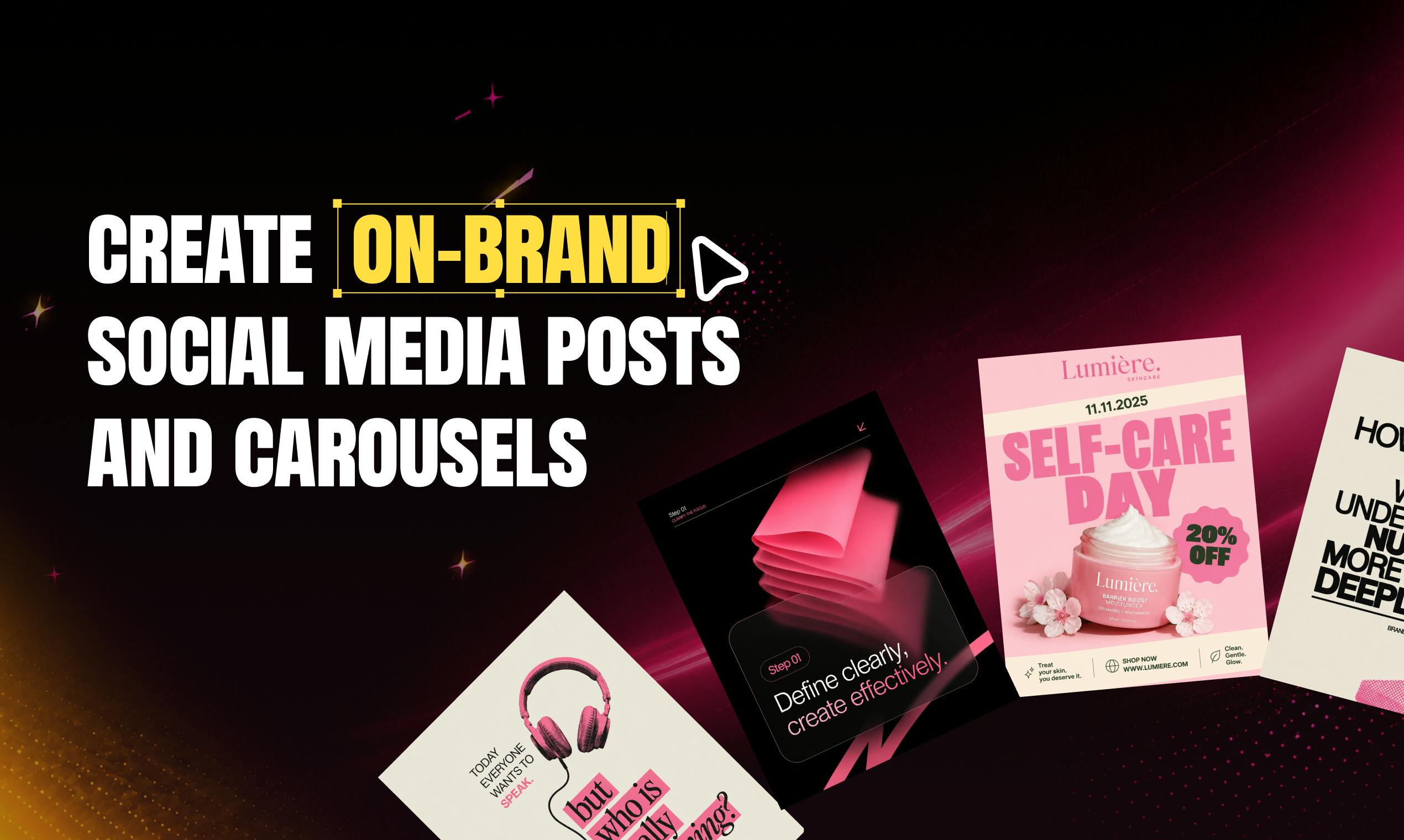
Core Feature Breakdown: From Brand Kit to Finished Content
Automatic Brand Kit Construction
LayerProof's workflow begins with brand identification. Users simply provide basic brand or product information, and the system automatically generates a brand kit — typically including color schemes, typography specifications, visual style, and other core elements. This step is the foundation for ensuring visual consistency across all subsequent batch-generated content, and it's an aspect that many competing AI design tools tend to overlook.
The brand kit concept originates from traditional brand management's VI (Visual Identity) system, which typically includes primary/secondary color Hex or Pantone values, font families (heading and body font pairings), logo usage guidelines, image filter styles, and layout grid systems. In the context of AI tools, automatic brand kit construction typically relies on two technical approaches: one is crawling website CSS and visual elements from user-provided URLs for reverse parsing; the other uses computer vision to extract dominant colors, typography characteristics, and composition preferences from uploaded brand assets (such as logos and historical posts). Canva's Brand Kit feature and Looka's brand generator employ similar technical approaches, though accuracy often varies depending on brand complexity.
The significance of the brand kit is that it prevents batch-produced content from devolving into a pile of cookie-cutter templates, instead maintaining consistent brand recognition. This is particularly crucial for brands that need to maintain a cohesive image across multiple platforms.
Batch-Generating 50 Social Media Posts at Once
The product's most eye-catching selling point is "generating 50 on-brand posts in one sitting." The content formats covered include regular posts, carousels, and stories — the three mainstream social media formats.
Carousel content deserves special attention. On LinkedIn and Instagram, carousel posts typically achieve higher engagement rates and dwell time, but they're also the most time-consuming to produce since they require designing multiple visually cohesive images. According to research published by Socialinsider in 2023, Instagram carousel posts have an average engagement rate of 1.92%, significantly higher than single-image posts at 1.74% and videos at 1.45%. LinkedIn carousel documents (multi-page content uploaded as PDFs) receive approximately 1.6x the impressions of standard image-text posts. This advantage stems from two mechanisms: first, the act of swiping through multiple images is interpreted by algorithms as a "deep engagement" signal; second, platforms will re-surface the post to users who haven't viewed all images. However, producing an 8-10 page carousel requires maintaining visual continuity between pages, logical information progression, and a call-to-action (CTA) on the final page — traditionally requiring 30-60 minutes per set. If LayerProof can consistently output high-quality carousel content, this represents a genuine efficiency gain.
Publish-Ready Captions Included
Beyond visual design, LayerProof also generates publish-ready captions for each piece of content. In theory, users can complete the entire workflow from design to copywriting within a single tool, without switching between multiple applications. This kind of all-in-one integration represents the mainstream evolution direction of today's AI content tools.
Industry-Specific Design for Real Marketing Scenarios
LayerProof specifically emphasizes in its introduction that the product was "co-designed with marketers and business owners across SaaS, FMCG, food & beverage, consulting, and other industries." This reveals the team's product philosophy: rather than building a generic tool, they're pursuing deep adaptation to the specific content needs of individual industries.
Different industries have distinctly different style requirements for social media content:
- SaaS companies: Favor data-driven, professionally rational expression; common formats include feature comparison charts, user growth data visualizations, and product update changelog-style content
- FMCG brands: Require stronger visual impact and emotional resonance, relying on lifestyle scenario staging and UGC-style content
- Food & beverage: Depend on high-quality product photography, where color saturation and lighting treatment directly impact conversion
- Consulting firms: Prefer thought leadership image-text content, building professional authority through knowledge sharing
Claiming co-creation with practitioners from these industries suggests that LayerProof likely offers industry-segmented preset templates and content styles — a potential advantage over generic design tools.
Competitive Landscape and Selection Guidance
From a market perspective, the AI social media content generation space that LayerProof occupies is already quite crowded. Canva's Magic Studio, Adobe Express's AI features, and numerous vertical startups are all competing for this market. LayerProof's differentiation primarily manifests in two aspects: "batch generation" and "industry co-creation."
As of 2024, this space has formed three tiers: the first tier includes AI feature modules from giants like Canva Magic Studio and Adobe Express, which possess massive template libraries and user bases; the second tier comprises vertically-focused SaaS companies with Series A or higher funding — such as Predis.ai, Ocoya, and Lately — which offer end-to-end solutions from content generation to scheduling and publishing; the third tier consists of the numerous early-stage tools emerging on ProductHunt. Key competitive dimensions in this space include: consistency of generation quality, fidelity to brand tone, diversity of output formats, and integration capabilities with downstream publishing tools (such as Buffer and Hootsuite). Notably, as multimodal large models (such as GPT-4o and Claude's vision capabilities) mature, pure template-stitching tools face fundamental technological paradigm challenges.
However, it's important to remain rational. The actual value of marketing claims like "generate 50 posts at once" depends on the quality floor and usability rate of the generated content. When evaluating the practical value of AI batch-generated content, the industry typically uses "usability rate" as a core metric — the percentage of generated content that can be published without modification or with only minor adjustments. Based on feedback from multiple marketing agencies, current mainstream AI design tools typically achieve usability rates between 30%-60%, meaning that out of 50 batch-generated pieces, perhaps 15-30 are actually ready for direct use. If batch output requires extensive manual revision, the efficiency advantage diminishes considerably. The ProductHunt data of 78 upvotes and 7 comments indicates the product is still in an early stage of gaining initial attention, without large-scale user validation.
For teams considering adoption, I recommend running an initial test with your own brand assets, focusing on three key areas:
- Brand kit generation accuracy: Does it faithfully reproduce your brand's visual elements?
- Batch content usability rate: Out of 50 pieces, how many can be used directly or with only minor tweaks?
- Caption publishing value: Do the generated captions match platform tone and audience expectations?
These three points directly determine whether the tool genuinely saves time or merely shifts work from "creation" to "revision." When evaluating, don't focus solely on generation quantity — pay more attention to whether the ratio of "effective output / total time invested" outperforms your traditional workflow.
Conclusion: The Value and Limitations of Batch Content Production Tools
LayerProof Matte 3.0 represents the trend of AI content tools evolving from "single-point generation" toward "batch, branded, full-workflow" solutions. It attempts to solve the most practical efficiency problems in social media operations while improving content utility through industry co-creation. For small and medium brands facing heavy content output pressure but lacking dedicated design resources, this type of tool is worth exploring and testing. But as with all AI generation tools, its true value must be validated through actual use — promises of batch quantity must ultimately be grounded in content quality.
Related articles

Bilibili's Hit Dify Tutorial: A Practical Guide to Building 20+ AI Apps from Scratch
A distilled guide to Bilibili's top-rated Dify tutorial: Windows + Docker deployment, MySQL connection, five app types, model integration strategy, and publishing.

Agent Skills Beginner's Guide: From Concepts to Multi-Agent Collaboration in Practice
A comprehensive guide to Agent Skills: core concepts, components, the importance of Description, standardization, beginner learning paths, and multi-agent collaboration.

One Neuron Detects Both Cats and Cars? We Reproduced It and Found a New Explanation
The cat-car neuron reinterpreted: researcher Cammarata argues it distinguishes pointy from round, not cats from cars. We reproduced the experiment and found the new explanation holds on most inputs—but cars are the exception. The interpretability debate continues on language models.