Layout-Aware PDF Parsing in Practice: Solving the RAG Chunking Problem
Use pdfplumber coordinate detection to reconstruct multi-column PDF layouts and fix semantic disorder in RAG pipelines.
This article introduces a lightweight layout-aware PDF parser built for RAG systems. Standard text extractors blindly concatenate characters left-to-right, scrambling the semantic order of multi-column layouts and tables before vectorization. The solution uses pdfplumber to probe visual grid line coordinates page by page, reconstructing tables as Markdown pipe format and restoring heading hierarchy via font-size tracking — enabling semantic-level chunking with LangChain. Engineered with FastAPI, io.BytesIO in-memory streaming, and a coordinate-isolation fallback, the approach shows that for digitally native PDFs, coordinate extraction beats heavy OCR/visual models on cost and speed. RAG quality is often determined before data ever reaches the vector store.
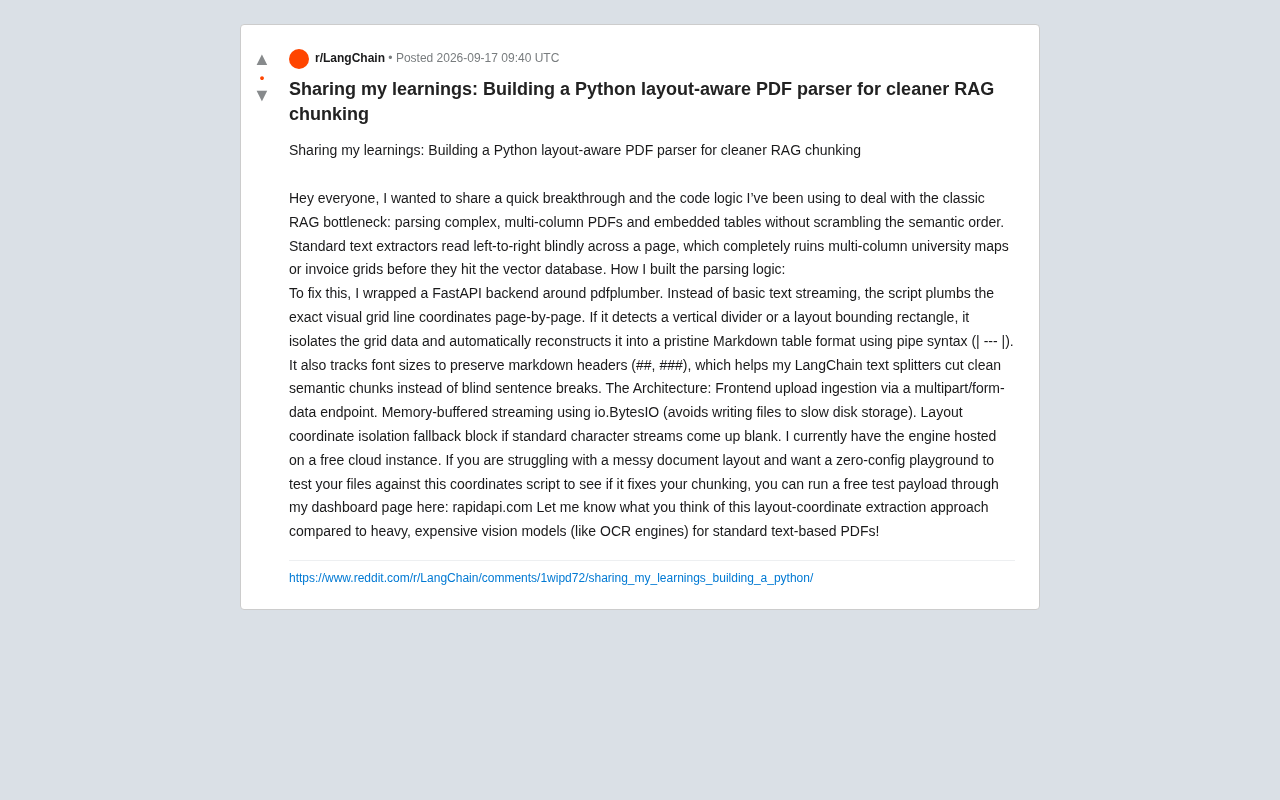
In real-world Retrieval-Augmented Generation (RAG) deployments, PDF parsing is often an underestimated yet critically important step. A developer shared on Reddit their Python-based layout-aware PDF parser, built specifically to address the semantic disorder caused by multi-column layouts and embedded tables. This article breaks down the technical approach and architecture, and explores the trade-offs between this lightweight coordinate-based solution and heavier visual models.
The Hidden Bottleneck in RAG: PDF Parsing
Most RAG projects focus on vector database selection and retrieval strategies, while overlooking the quality of parsing before data enters the index. The root cause lies in how standard text extractors work — they blindly read the entire page from left to right, top to bottom.
For simple single-column documents, this approach is adequate. But once you encounter multi-column university course schedules, invoice grids, or complex financial report tables, problems arise. As the original author put it, standard extractors will "completely scramble the semantic order of multi-column documents or invoice grids before the text ever enters the vector database." Imagine a two-column table where the extractor stitches together the first row of the left column with the first row of the right column — semantic relationships instantly collapse, and downstream retrieval quality has no chance of recovery.
In short: garbage in, garbage out. If the chunking stage receives disordered text, even the most powerful embedding models and retrieval algorithms can't compensate.
From a technical perspective, the root cause with mainstream PDF text extraction libraries (such as PyMuPDF and pdfminer) when handling multi-column layouts lies in the PDF format itself: the PDF specification has no concept of "columns" — text objects are simply scattered across the page at absolute coordinates. Standard extractors typically sort text objects by Y-axis (top to bottom) then X-axis (left to right) before concatenating them. This works naturally for single-column documents, but when two columns appear side by side, the extractor interleaves text from the left column (smaller X coordinates) and the right column (larger X coordinates) rather than reading the left column completely before moving to the right. Embedding models in RAG systems are highly sensitive to input text order — disordered text produces vector representations that deviate from the original semantics, directly causing inaccurate semantic distance calculations between retrieved results and user queries.
Core Approach: From Character Streams to Coordinate Grids
The author's solution doesn't rely on expensive OCR or large visual models — instead, it takes a lighter path: layout reconstruction based on visual coordinates.
Technology-wise, he wrapped pdfplumber with a FastAPI backend. The key difference: rather than doing basic text stream reading, the script probes precise visual grid line coordinates page by page.
The logic proceeds in several steps:
- Detect layout dividers: When the script identifies vertical dividers or layout bounding rectangles, it determines that a table structure exists.
- Isolate and reconstruct tables: Grid data is extracted separately and automatically reconstructed into standard Markdown table format using pipe syntax (
| --- |). - Preserve heading hierarchy: By tracking font sizes, Markdown headings (
##,###) are restored, preserving the document's structural hierarchy.
This step is crucial for downstream processing. The author noted that after preserving heading structure, his LangChain text splitter can make "clean cuts" at semantic boundaries rather than blindly breaking at sentences. For RAG, this means each chunk more closely represents a complete semantic unit.
pdfplumber is a high-level wrapper built on pdfminer.six, and its core advantage is exposing every character, rectangle, and line object in a PDF page as a Python object with precise coordinate attributes (x0, y0, x1, y1) — not just concatenated strings. This coordinate-level access is precisely what makes it possible to detect vertical dividers and determine whether text falls within a given rectangular region. Compared to PyMuPDF (fitz), pdfplumber offers a higher-level abstraction for table border detection (page.find_tables()), with configurable border detection strategies (explicit lines, text-alignment boundaries, etc.) to accommodate different table styles, reducing the need for manual coordinate calculations.
Engineering Details in the Architecture
Beyond the core parsing logic, this system has several noteworthy engineering considerations.
File ingestion: The frontend uploads files via a multipart/form-data endpoint, following standard file transfer conventions.
In-memory buffer stream processing: Using io.BytesIO for in-memory buffered streaming avoids writing files to slower disk storage. For parsing services that need to handle large volumes of documents, bypassing disk I/O significantly improves throughput and eliminates the burden of cleaning up temporary files.
Fallback mechanism: When the standard character stream returns blank content, it triggers a fallback to layout coordinate isolation. This fallback design reflects real-world considerations — not every PDF behaves cleanly; some pages fail standard extraction entirely, at which point coordinate-level parsing becomes the last line of defense.
The engine is currently deployed on a free cloud instance, and the author has also provided a zero-configuration test endpoint on RapidAPI for developers with similar pain points to upload their own documents and verify results.
Coordinate Extraction vs. Visual Models: How to Choose
This approach raises a worthwhile question: for text-based PDFs, is layout coordinate extraction more cost-effective than heavy visual models?
Visual models (such as OCR engines) excel in generality — they can handle scanned documents, image-based PDFs, and even handwritten content. But the costs are equally clear: high computational expense, large latency, and complex deployment. For PDFs that are digitally native and contain an extractable text layer, deploying visual models is overkill.
Coordinate extraction specifically addresses layout disorder in standard text PDFs — it's low-cost, fast, and can run on lightweight instances. Its limitations are equally clear: it struggles with pure image scans or complex layouts without clear grid lines.
A sensible practical strategy might be layered processing: prioritize coordinate-level parsing for digitally native PDFs, and fall back to OCR or visual models when the character stream is empty. The author's fallback design already implies this thinking — it simply replaces the visual model step with coordinate isolation.
In engineering decisions, the distinction between "digitally native PDFs" and "image-based PDFs" is the core branching point. Digitally native PDFs (exported directly from Word, LaTeX, InDesign, etc.) contain an addressable text layer with complete character coordinate information — coordinate extraction applies perfectly. Image-based PDFs typically originate from scanners or photos of printed pages; the page content is essentially a bitmap with no text layer, requiring an OCR engine (such as Tesseract, PaddleOCR, or cloud-based services like Google Document AI) to first convert images to text. The simplest way to determine whether a PDF contains a text layer is to attempt text extraction with any PDF library: if it returns an empty string or garbled text, you can reasonably conclude it's an image-based PDF requiring OCR. In practice, enterprise document libraries often contain a mix of both types, making a layered processing strategy (try coordinate extraction first, fall back to OCR on failure) the pragmatic choice for balancing cost and coverage.
Implications for RAG Developers
The value of this case isn't about any specific tool — it's a reminder that RAG quality competition is often decided before data ever enters the vector store.
Rather than repeatedly tuning retrieval parameters, it's worth stepping back to examine whether the parsing and chunking stages faithfully preserve the original semantic structure of documents. Are tables reconstructed into readable formats? Is heading hierarchy preserved? Is multi-column content stitched together in the correct order? These seemingly minor details are precisely what determine the ceiling of a RAG system.
For teams struggling with chaotic document layouts, this lightweight approach — centered on pdfplumber coordinate detection with structured Markdown output as the goal — offers a low-cost starting point well worth trying.
Related articles
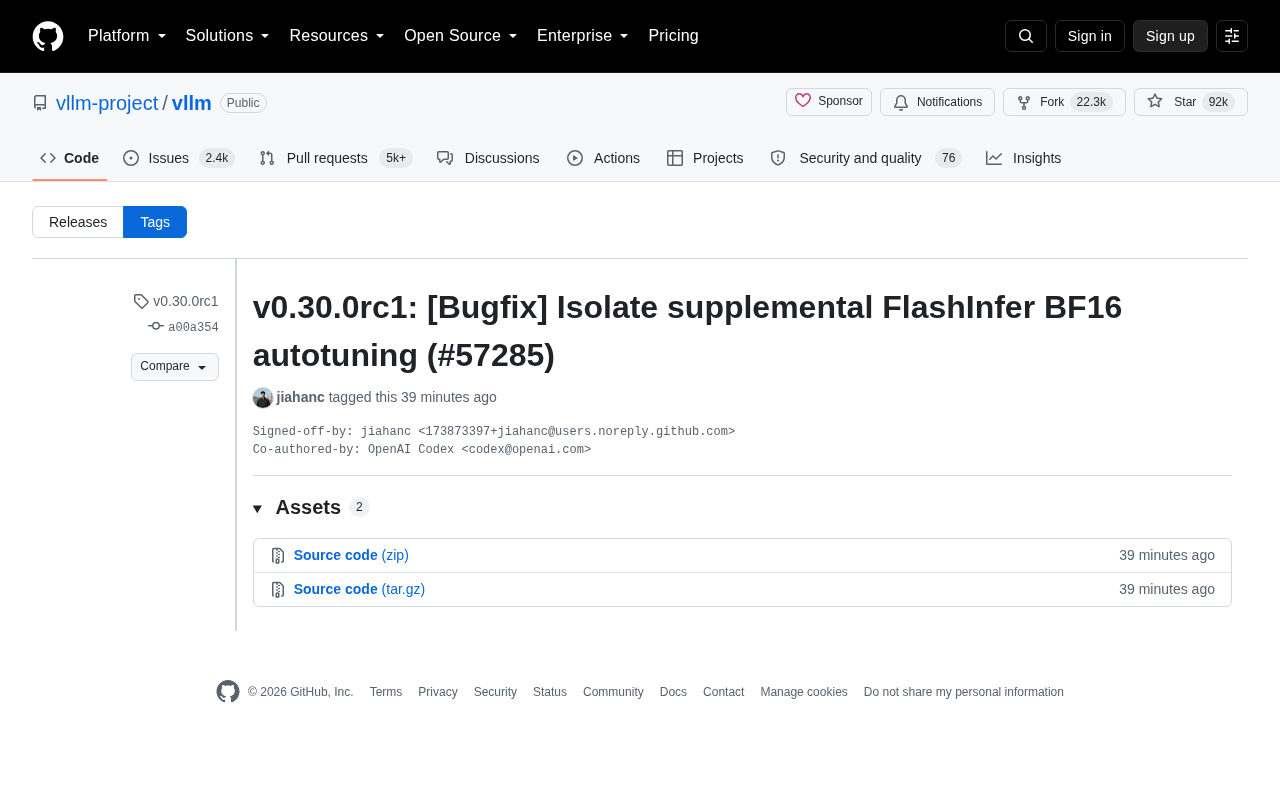
vLLM v0.30.0rc1 Released: Isolates FlashInfer BF16 Autotuning Logic
vLLM v0.30.0rc1 release candidate fixes FlashInfer BF16 autotuning isolation (PR #57285). Learn the technical background and its impact on inference deployment.

Comp AI Raises $34M Series A, Bets on Agentic Security Compliance
Comp AI raises $34M Series A led by Roo Capital and Grand Ventures, betting on "continuously agentic" AI to transform compliance from periodic audits into real-time monitoring.

MIT Technology Review's 35 Innovators Under 35: A Climate Tech Edition Explained
MIT Technology Review's latest 35 Innovators Under 35 list focuses on climate tech, spotlighting nine young global innovators. Here's what the list means and why it matters.