LCOS 1.0 Released: The Anti-AI, Anti-Code-of-Conduct Linux-Compatible System

LCOS 1.0 released: 1990s desktop experience with a modern Linux kernel, explicitly anti-AI, anti-account, and anti-code of conduct.
LCOS (Lunduke Computer Operating System) 1.0 has officially launched and is available for free download, led by developer Brian Lunduke. Positioned as a "Linux-compatible system" rather than a traditional distribution, it combines a 1990s classic desktop interface with a modern Linux kernel and leaves room for a future hard fork of the kernel. The system preinstalls self-developed lightweight software (Lunduke Paint, Lunduke Edit) and components such as Brave Origin, Numeric, and AbiWord, and supports Steam and retro Zork games. Its biggest selling point is that it explicitly excludes AI features, online accounts, identity verification, a code of conduct, and systemd, replacing the code of conduct with a "code of ethics." Lunduke's own controversial stance and anti-woke selling point may polarize community reactions.
The Linux ecosystem has gained another controversial new member. According to a video released by the YouTube channel Lunduke, Lunduke Computer Operating System (LCOS) 1.0 has officially launched and is available for free download. Led by developer Brian Lunduke, the system emphasizes a "1990s desktop experience + modern kernel" and explicitly rejects several features common in today's mainstream operating systems, including AI functionality, online accounts, identity verification, and codes of conduct.
Design Philosophy: A Mix of Classic Desktop and Modern Kernel
LCOS's core philosophy can be summed up as "a 1990s shell with modern internals." In the video, Lunduke quotes himself: "It's like using a 1990s computer, but with modern specs." The system adopts traditional desktop metaphors, with an interface style that clearly pays homage to early Mac OS and Windows, but underneath it is based on a custom branch of the Linux kernel.
According to Lunduke, LCOS is not a traditional Linux distribution but is positioned as a "Linux-compatible system." This wording leaves room for a potential further hard fork of the Linux kernel in the future. Lunduke says that if detaching from mainline Linux becomes necessary for desktop performance and stability, he will do so.
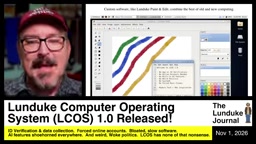
The system comes preinstalled with a large number of self-developed or carefully selected lightweight software. For example, the drawing program Lunduke Paint borrows the interface of MacPaint and MS Paint but adds layers, visual history, and near-infinite undo; the text editor Lunduke Edit emphasizes fast handling of very large files. Lunduke claims that Lunduke Paint launches extremely quickly and is even set as the default image viewer.
systemd and the Linux init system debate
systemd is the most mainstream init system (PID 1) in modern Linux distributions, responsible for mounting filesystems at boot, starting services, and managing process lifecycles, and it provides companion components such as logging (journald) and network configuration. Promoted by Red Hat around 2010, it is now the default in the vast majority of mainstream distributions. But its "big and comprehensive" design has long drawn criticism: opponents argue that it violates the Unix philosophy of single responsibility, is too tightly coupled, uses binary logs that are hard to troubleshoot, and is difficult to replace. Some distributions (such as Devuan and Artix) specifically offer systemd-free alternatives using SysVinit, OpenRC, or runit. LCOS explicitly has "no systemd," placing itself squarely in the anti-systemd camp of this long-running technical debate.
Rust rewriting of Linux components
In recent years, the Linux kernel has begun accepting Rust as a second development language (the Rust for Linux project has been merged incrementally since 6.1), and some userspace tools have been rewritten in Rust to improve memory safety. But the introduction of Rust brings new toolchain dependencies, maintainer disagreements, and build complexity, and there is resistance within the community. LCOS's rejection of Rust-rewritten components, like its rejection of systemd, belongs to the same "keep tradition, reduce modern dependencies" orientation.
Anti-AI, Anti-Account, Anti-Code of Conduct
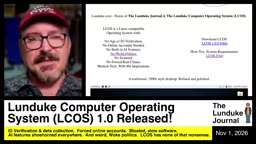
LCOS's most eye-catching selling point is its explicit rejection of current tech industry trends. In the video, Lunduke lists what the system does "not" have: no age or identity verification, no online account requirement, no built-in AI features, no code of conduct, and no systemd.
He particularly emphasizes that a simple text editor or drawing program does not need AI. "You don't need a launch button connected to AI." However, he also says that users can install any AI tools they wish; the system will not prevent it.
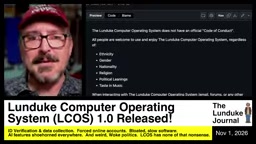
On the code of conduct, Lunduke's stance is especially clear. He believes that the codes of conduct of many open-source projects have been "weaponized" to exclude people with different political, religious, or ethnic views. LCOS therefore has no code of conduct but does have a "code of ethics," whose core contents include: everyone may use the system regardless of background; friendliness in community communication, with cursing prohibited; and meritocracy as a principle. He also personally recommends the Ten Commandments as an ethical reference but explicitly says users are not required to follow it.
Code of Conduct in open-source projects
A code of conduct is a rules document that many open-source communities create to regulate participant interaction; a common template is the Contributor Covenant. Supporters believe it helps create a friendly environment and protect minority groups; critics argue that some provisions are broadly worded and subjectively enforced and may be used to suppress dissenting views—what Lunduke calls "weaponized." LCOS replaces a code of conduct with a "code of ethics," emphasizing meritocracy and friendly communication, which is a clear statement on this controversy.
Software Stack: Curated Lightweight Components
LCOS's software choices reflect a "lightweight, fast, depoliticized" approach. The browser is Brave Origin—a lightweight version of the Brave browser stripped of extra features—and Lunduke praises its team for focusing on the software itself rather than politics. For office software, instead of LibreOffice or Microsoft Office, the system preinstalls the lightweight Numeric spreadsheet and AbiWord word processor.
For gaming, the system preinstalls the Zork trilogy, running in an interface that emulates a CRT terminal to recreate the retro experience. At the same time, Steam also runs properly; Lunduke says that The Elder Scrolls V: Skyrim and Fallout 4 were once part of the daily automated test suite for catching performance and regression issues.
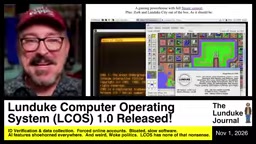
In addition, LCOS includes a city simulation game called Lunduke City, based on the open-source SimCity engine (Micropolis) with a rewritten UI that fixes the bloat and bugs of the original UI.
Micropolis and the open-source version of SimCity
Micropolis is the open-source version of the classic city simulation game SimCity. EA released the source code of the original SimCity under the GPL in 2008, and the community organized it into the Micropolis project. Because the original code is old, its interface and interaction are outdated and it has several bugs, so LCOS rewrote its UI, resulting in the bundled Lunduke City.
Controversy and Positioning
The release of LCOS is likely to provoke polarizing reactions in the tech community. On the one hand, its pursuit of lightweightness, privacy, and a classic desktop experience may attract users dissatisfied with the bloat of modern operating systems. Lunduke claims that the system has low hardware requirements and sarcastically remarks that some Linux distributions "need 6GB of RAM just to launch a text editor."
On the other hand, Lunduke himself has become controversial in recent years because of his statements on political and gender issues, and LCOS explicitly uses "anti-woke politics" as a selling point, which may limit its audience. The system's rejection of Rust-rewritten components and its removal of systemd are also part of long-standing technical debates within the Linux community.
Currently, LCOS 1.0 can be downloaded for free from lunduk.com, where the website provides documentation, system requirements, and screenshots. It can be upgraded directly from the 0.9.x beta version to 1.0. Lunduke says there are "crazy plans" for version 2.0.
For desktop Linux users who want a minimalist, retro-style system without bundled AI and online services, LCOS offers a new option; but for users who value community inclusiveness and a modern technology stack, it may not be the first choice.
One-line Summary
LCOS 1.0 released: a 1990s desktop experience with a modern Linux kernel, explicitly anti-AI, anti-account, and anti-code of conduct.
Paragraph Summary
LCOS (Lunduke Computer Operating System) 1.0 has officially launched and is available for free download, led by developer Brian Lunduke. It is positioned as a "Linux-compatible system" rather than a traditional distribution, combining a 1990s classic desktop interface with a modern Linux kernel and leaving room for a future hard fork of the kernel. The system preinstalls self-developed lightweight software (Lunduke Paint, Lunduke Edit) and components such as Brave Origin, Numeric, and AbiWord, and supports Steam and retro Zork games. Its biggest selling point is that it explicitly excludes AI features, online accounts, identity verification, a code of conduct, and systemd, replacing the code of conduct with a "code of ethics." Lunduke's own controversial stance and anti-woke selling point may polarize community reactions.
Related articles

AI Automated Penetration Testing Learning Roadmap: From Beginner to SRC in Practice
A complete AI automated penetration testing learning roadmap covering AI pentest basics, AI-assisted web vulnerability discovery, AI-driven automated pentesting, and SRC practice to build real-world security skills for the AI era.

Pi Agent Tutorial: How Minimalist Design Reshapes AI Agent Development
An in-depth look at Pi Agent's minimalist design philosophy: why it still draws high attention alongside Codex and Claude Code, from GitHub Star trends to extension mechanisms, with a Bilibili practical tutorial covering installation, configuration, and Agent development for beginners and advanced developers.

Codex in Practice: A Complete Guide to Enterprise-Grade Agent Skills Development
An in-depth analysis of a Bilibili Codex practical course covering core capabilities, agents.md configuration, MCP protocol, multi-agent collaboration, and enterprise plugin development—building a complete framework for enterprise AI coding tool adoption.