Lead Sparker: Turn Any Brand URL Into a Sales Insight Deck in One Click

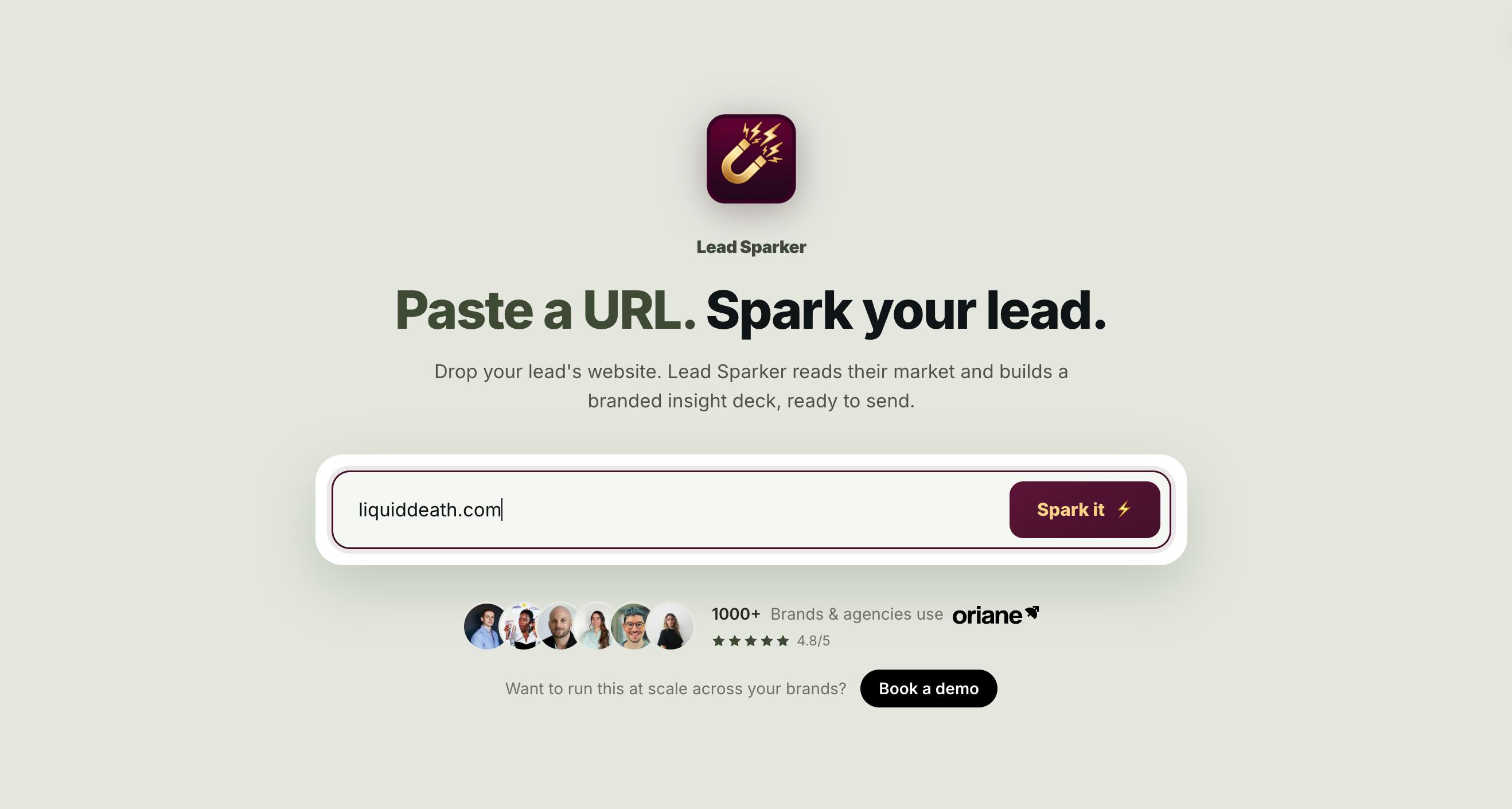
Paste a brand URL to instantly generate a color-matched sales insight deck with competitor data — free, no signup.
Lead Sparker is an automated tool for B2B sales and marketing outreach. Users paste a target brand's URL, and the Oriane API pulls Instagram and TikTok data — including untagged mentions, earned reach, and competitor playbooks — to generate a ready-to-send insight presentation styled in the brand's own colors. Its core value is compressing the prep time between "getting an insight" and "starting a sales conversation," turning what used to be hours of manual research into an instant output. The product launches with a free, no-signup model to drive adoption, with the main limitations being its two-platform data scope and auto-generated insights better suited as a starting point than a replacement for deep analysis.
In B2B sales and marketing outreach, one pain point keeps coming up: how do you prepare a personalized, persuasive pitch for a prospect in the shortest time possible? Traditional approaches either rely on salespeople manually digging through social media data or outsourcing to analytics teams — both are time-consuming and hard to scale. Lead Sparker, launched on Product Hunt, aims to solve this with a single automated pipeline. Paste a brand URL, and it generates a ready-to-send insight presentation.
What One URL Gets You
Lead Sparker's core logic is straightforward: input a prospect's brand URL, and the underlying Oriane API crawls and analyzes that brand's social media performance on Instagram and TikTok. The dimensions it covers include untagged brand mentions, earned reach, competitor playbooks, and live trends.
All of this data gets packaged into a presentation styled in the target brand's own color palette. Sales or marketing teams can add their own annotations and calls-to-action (CTAs), then send it as a PDF. The whole flow is built around being "ready to use" — the output isn't a raw data dump, but a near-finished asset that can go straight into a client conversation.
The product currently has 72 upvotes on Product Hunt and ranks #20, listed under Productivity, Marketing, and Artificial Intelligence. It was built by a team including Thibaut Hadjean.
The Oriane API is the data engine powering Lead Sparker. Public information about it is limited, but based on product descriptions, it handles three layers of work: cross-platform content crawling, semantic analysis, and brand recognition. Unlike conventional social listening tools (such as Brandwatch or Mention), the key differentiator of Oriane API lies in its handling of "unstructured mentions" — identifying content that doesn't use official @ tags or hashtags. This type of detection typically relies on natural language processing (NLP) and visual recognition, such as analyzing post semantics, comment sentiment, or brand visual elements within video frames to infer association. Since both TikTok and Instagram impose strict limits on third-party data access, the API's data compliance and crawl coverage are key variables to evaluate when assessing tools like this.
Why "Social Media Insights" Is the Right Entry Point
The value proposition here targets a real blind spot in brand marketing data: a huge volume of brand conversation happens without any official tags. When users talk about a brand on Instagram or TikTok, they often don't @ the official account or use a standardized hashtag. These "untagged mentions" are the most authentic word-of-mouth signals — and also the hardest to capture with conventional tools.
Lead Sparker presents "earned reach" and "competitor playbooks" side by side, meaning it doesn't just give you isolated data about a single brand — it provides a comparative perspective. For a salesperson trying to pitch services to a brand, opening with "I know your social media landscape better than you do" is itself an icebreaker.
The Last Mile from Data to Deals
What's worth noting is the product's focus on "sendability." Many analytics tools stop at generating reports, leaving the hard work of "how do I use this data to persuade the client" entirely to the user. Lead Sparker integrates brand colors, personal annotations, and CTAs directly into the output — essentially compressing the distance between "having an insight" and "starting a conversation." This is especially meaningful for sales teams doing high-volume outreach.
"Untagged brand mentions" represent a long-standing technical challenge in social media monitoring. Traditional listening tools mainly rely on keyword matching or official hashtag tracking, typically capturing only a fraction of actual brand discussions. Research shows that the proportion of consumers who use official account tags when mentioning a brand varies significantly by category — often below 30% in fast-moving consumer goods. "Earned reach" is a third type of traffic distinct from paid reach (ad impressions) and owned reach (brand-distributed content). It represents the scale at which content is organically shared by users due to genuine resonance, and is generally considered a more reliable indicator of brand influence. Presenting both dimensions alongside competitor data allows recipients to quickly understand what the numbers mean — even without deep industry context.
The Logic Behind Free, No Signup
The product is explicitly labeled "Free, no signup." As an acquisition strategy, this is a smart move. For a tool that depends on a data API, lowering the barrier to trial quickly builds up a base of usage samples — and it fits the lead generation positioning: letting users experience the immediate value of "one URL = one deck" at near-zero cost.
Of course, a free model typically implies a downstream monetization path — such as usage frequency limits at higher tiers, deeper analytical dimensions, or tighter integration with the Oriane API ecosystem. These details haven't been publicly disclosed, so users should pay attention to data accuracy and update frequency before adopting it at scale.
"Free, no signup" is a textbook example of PLG (Product-Led Growth) strategy. In the PLG model, the product itself takes over the "demo" and "trial" roles in a traditional sales funnel — users experience core value without any friction, and naturally convert to paid through repeated use. For API-dependent tools like Lead Sparker, the free tier typically controls costs by limiting daily generations, adding output watermarks, or locking advanced analytics dimensions. This strategy is especially effective in the B2B tools market, because salespeople can often try lightweight tools on their own without IT approval — and once they're hooked, they push for team-level paid adoption.
Who Should Try It
Taken together, Lead Sparker's target user profile is quite clear:
- B2B salespeople: need personalized openers for each prospect but don't want to spend hours on research;
- Marketing agencies: need to quickly demonstrate understanding of a client's social media presence when pitching;
- Social media/content teams: want a fast read on how competitors are operating on Instagram and TikTok.
Its limitations are equally apparent: the data sources are currently limited to Instagram and TikTok. For brands whose primary presence is on other channels — YouTube, LinkedIn, or offline — the relevance will be diminished. Additionally, auto-generated insights can't fully replace manual analysis in depth, making this better suited as a starting point than a finished deliverable.
Summary
Lead Sparker represents a rising category of "insights-as-a-service" tools — using AI to automatically compress scattered social media data into ready-to-use business assets. Its cleverness isn't in the complexity of the data it captures, but in precisely targeting a real pain point in sales outreach: high preparation costs and the difficulty of personalizing at scale. The free, no-signup approach lowers the barrier for rapid adoption. For teams contacting large numbers of prospects every day, a tool that turns a pasted URL into a deck is worth a few minutes of your time.
Related articles

Build an AI Super Employee System at Zero Cost: A Full Breakdown of Automated Agent Workflows
A deep breakdown of the AI super employee system demoed on Bilibili: agent orchestration, digital human voiceovers, map and enterprise lead generation, 24/7 customer service, and legal modules. We analyze the business logic and compliance risks behind zero-cost signup to help entrepreneurs judge the real ROI of this AI digital employee system.

The Essential Difference Between Chatbots and AI Agents: Crossing from Conversation to Execution
What's the difference between a chatbot and an AI agent? Based on the MCP series on the Learn Tech channel, this article uses examples like booking flights and summarizing notes to explain: a chatbot only gives answers, while an agent actually completes tasks through a think-act-observe loop. It breaks down the four core components—model, tools, memory, and goal—as well as MCP's role as a bridge, and discusses agents' applicable boundaries and permission risks.

Free GitHub Repo: 342 Hours of AI Courses, from Math to MCP Servers
A free GitHub repo offers 342 hours of AI courses: 523 lessons across 20 phases, from math fundamentals to agent building and MCP servers. Nearly 100,000 learners have started.