LeaseBase: A Landlord Management Tool That Replaces Data Dashboards with AI Compliance Advice
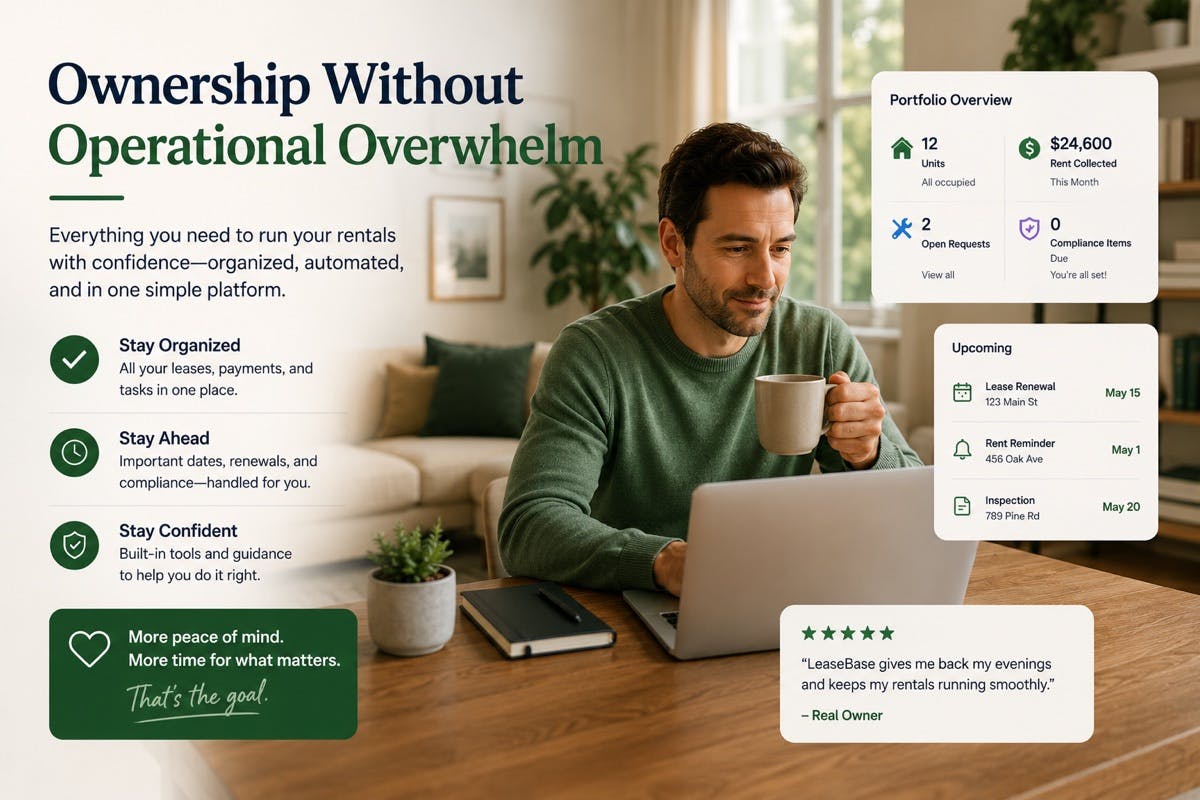
LeaseBase uses AI to turn complex California rental laws into actionable compliance guidance for landlords.
LeaseBase is an AI-powered property management tool targeting individual landlords in California. Instead of just displaying data, it proactively tells landlords what actions to take based on complex, city-level rental regulations. By integrating compliance tracking with payments, maintenance, and lease management, it fills a gap between expensive enterprise software and basic bookkeeping tools, exemplifying the shift from passive AI assistants to proactive AI Agents.
From "Recording What Happened" to "Telling You What to Do"
Among the many AI tools that tout "data insights," most stop at telling users "what happened" — displaying reports, aggregating data, and generating analyses. LeaseBase, which recently launched on Product Hunt, attempts to go a step further by directly telling landlords "what to do next."
The product's core slogan hits the nail on the head: "AI that tells landlords what to do, not just what happened." It targets a long-overlooked market riddled with compliance pitfalls — self-managed property management by individual landlords.
The product currently has 16 upvotes and 3 comments on Product Hunt, ranking 13th. It was built by Maker Rachid Abadli and is categorized under Android, SaaS, and Artificial Intelligence.
California's Compliance Maze: LeaseBase's Core Entry Point
LeaseBase chose a highly region-specific entry point — California's complex and ever-changing rental regulations.
Why Landlords Need an AI "Compliance Brain"
According to the product description, California's rent caps, deposit limits, and required disclosures vary by city, and penalties for violations carry real financial consequences. For individual landlords who self-manage their properties, tracking different regulatory requirements across multiple cities and properties is a nearly impossible task.
California is one of the most complex states in the U.S. when it comes to rental regulations. Take rent control as an example: California's AB 1482 (the Tenant Protection Act), passed in 2019, sets a statewide annual rent increase cap (5% + CPI or 10%, whichever is lower), but cities like Los Angeles, San Francisco, Oakland, and Berkeley each have their own stricter local rent control ordinances — some dating back to the 1970s. On the deposit front, starting in 2024, California unified the security deposit cap at one month's rent (previously two months for unfurnished units), while some cities have additional requirements for paying interest on deposits. Disclosure obligations are even more fragmented: landlords may need to disclose lead paint information, flood zone risks, proximity to registered sex offenders, and dozens of other items — missing any single one could result in fines or lease invalidation.
This is precisely the core pain point LeaseBase targets: fragmented regulations + frequent updates + high violation costs. Traditional property management software typically only addresses bookkeeping and workflow issues but cannot proactively flag compliance risks. LeaseBase makes "compliance" its primary value proposition, using AI to help landlords confidently self-manage within legal boundaries ("Self-manage with confidence").
All-in-One Integration: Operational Capabilities Beyond Compliance
Beyond compliance tracking, LeaseBase integrates payments, maintenance, and lease management into a single platform. The product claims to "track every deadline," unifying rent collection, maintenance work orders, and lease documents. This dual-engine approach of "compliance + operations" sets it apart from standalone bookkeeping tools or legal advisory services.
How AI Plays Its Role: From Passive Queries to Proactive Action Recommendations
In LeaseBase's product logic, AI isn't used for flashy conversations — it serves as the "action decision-maker."
For landlords, the most valuable output isn't a static query like "What's the deposit cap for this property?" but rather an actionable recommendation like "Based on your city and current lease status, here are the three things you should do now." This shift from information display to action directives is LeaseBase's most noteworthy product design philosophy.
This also reflects an important trend in current AI application development: vertical AI Agents are evolving from "information retrieval assistants" to "task execution assistants." Traditional AI applications mostly use RAG (Retrieval-Augmented Generation) architecture — retrieving relevant information from a knowledge base and generating answers — which is essentially still a "Q&A mode." The key difference with new-generation AI Agents lies in three core capabilities: Planning, Tool Use, and Memory. Agents can decompose a user's high-level goals into multiple subtasks, execute them sequentially, and dynamically adjust strategies based on intermediate results. In scenarios like LeaseBase, the Agent needs not only to understand regulatory texts but also to reason based on the landlord's specific property information (address, lease expiration date, current rent, etc.), ultimately producing an action checklist with time-bound milestones. This leap from "passive response" to "proactive planning" is one of the most significant technology trends in the AI application space during 2024–2025.
In highly specialized, rule-driven domains like law, taxation, and compliance, AI excels at its unique ability to "translate complex rules into concrete actions."
Product Positioning Analysis: A Small but Beautiful Vertical SaaS Strategy
Highly Focused Target Users
LeaseBase has a very clear positioning — individual self-managing landlords in California. This is a niche market with clear willingness to pay (due to high violation costs) and a long-standing lack of suitable tools (enterprise property management software targets institutions).
Looking at the broader property management software landscape, the industry has long exhibited a polarized structure. For institutional investors and large property management companies, there are mature products like Yardi, RealPage, and AppFolio — feature-rich but expensive (monthly fees ranging from hundreds to thousands of dollars) with steep learning curves. For individual landlords, there are lightweight tools like Avail (acquired by Realtor.com), TurboTenant, and Stessa, which primarily handle rent collection, tenant screening, and basic bookkeeping. But these tools almost never address regulatory compliance, especially city-level granular regulation tracking. According to U.S. Census Bureau data, approximately 10.7 million individual landlords manage about 22.8 million rental units nationwide, and California is one of the largest rental markets. This group has long been stuck in the awkward position of being "too small to afford a property management company, yet too busy to stay on top of compliance."
For these users, professional property management companies are too expensive, while general-purpose tools can't cover local regulations. LeaseBase sits squarely in this gap, building differentiated competitive advantage through verticalized, localized compliance capabilities.
Potential Challenges to Watch
Of course, products like this face some inherent challenges:
- Liability for Regulatory Accuracy: If the AI provides incorrect compliance advice, it could expose landlords to legal risk. The product must carefully balance "advice" with "disclaimer." The deeper issue at the core is whether AI-provided compliance advice constitutes the "unauthorized practice of law." In the U.S., each state defines "legal advice" differently, but generally prohibits non-lawyers from advising specific individuals on specific legal matters. AI compliance tools typically mitigate risk through several approaches: explicitly stating that the product provides "information" rather "legal advice," including disclaimers in user agreements, and recommending users consult licensed attorneys before making critical decisions. However, as AI recommendations become increasingly specific and personalized — like LeaseBase's "telling you what to do" — this boundary will become increasingly blurred. In 2024, there have already been multiple lawsuits involving AI legal tools (e.g., DoNotPay was sued for claiming to be the "world's first robot lawyer"), serving as a cautionary precedent for all AI compliance products.
- Geographic Scalability: Currently focused on California, expanding to other states in the future would require rebuilding the knowledge base for each region's regulatory framework.
- Timeliness of Regulatory Updates: City-level regulations change frequently, and ensuring real-time updates to the AI knowledge base is critical to the product's long-term reliability.
Two Insights from LeaseBase for the AI Application Market
LeaseBase is a classic "AI + vertical compliance" case that offers two thought-provoking insights for the industry:
First, AI's best deployment scenarios are often in domains where rules are clear but complex and tedious. Rental regulations fit this description perfectly — the rules are definitive, but too complicated for ordinary people. AI's ability to "parse rules + provide action recommendations" fills the gap between professional services and individual capability.
Second, "Telling you what to do" is more commercially valuable than "telling you what happened." Products that remain at the data display level suffer from severe homogenization, while AI Agents that can output executable decisions truly address users' core anxieties. This observation aligns with a long-standing insight in the SaaS industry: users are willing to pay a far higher premium for "saving decision-making time" than for "obtaining information." When AI evolves from a "dashboard" into a "copilot," its commercial value leaps from tool-level to advisor-level.
Although LeaseBase is still an early-stage product with modest upvotes and discussion volume, the product philosophy it represents — using AI to transform professional knowledge into actionable guidance for ordinary people — deserves the attention of every AI application entrepreneur.
Key Takeaways
Related articles
Instacart Launches AI Shopping Assistant Clementine: Reimagining the Online Grocery Shopping Experience
Instacart launches Clementine, a conversational AI shopping assistant offering smart recommendations, natural language interaction, and nutrition advice to transform online grocery shopping.
Geiger: A Deep Dive into AI Agent Behavior Monitoring
Deep dive into Geiger, an AI agent monitoring tool. Explore runtime observability, prompt injection risks, and security strategies for local AI agents.

ROS2 Beginner's Guide: Understanding the Core Framework for Robot Development from Scratch
A comprehensive introduction to ROS2 core concepts, version selection, and learning paths. Covers ROS1 vs ROS2 differences, Humble vs Jazzy comparison, and version compatibility tips for beginners.