LeCun Blasts Anthropic CEO: 'Deluded' on AI Safety and Cybersecurity

LeCun calls Amodei 'deluded' on AI safety, exposing the deep rift between cautionary and pragmatist AI camps.
Meta Chief AI Scientist Yann LeCun has publicly called Anthropic CEO Dario Amodei "deluded" on AI safety and cybersecurity, arguing that current LLMs pose no existential threat and that Amodei lacks genuine domain expertise in security. The clash reflects a fundamental industry divide: Anthropic advocates for preemptive controls and regulatory intervention given the steep capability curve of frontier models, while LeCun insists LLMs fall far short of true intelligence and that cybersecurity is a mature offense-defense field where AI empowers both sides equally. Each camp's stance also carries distinct implications for regulation, open-source development, and commercial strategy.
The Core Dispute: A Public Clash Between Two AI Leaders
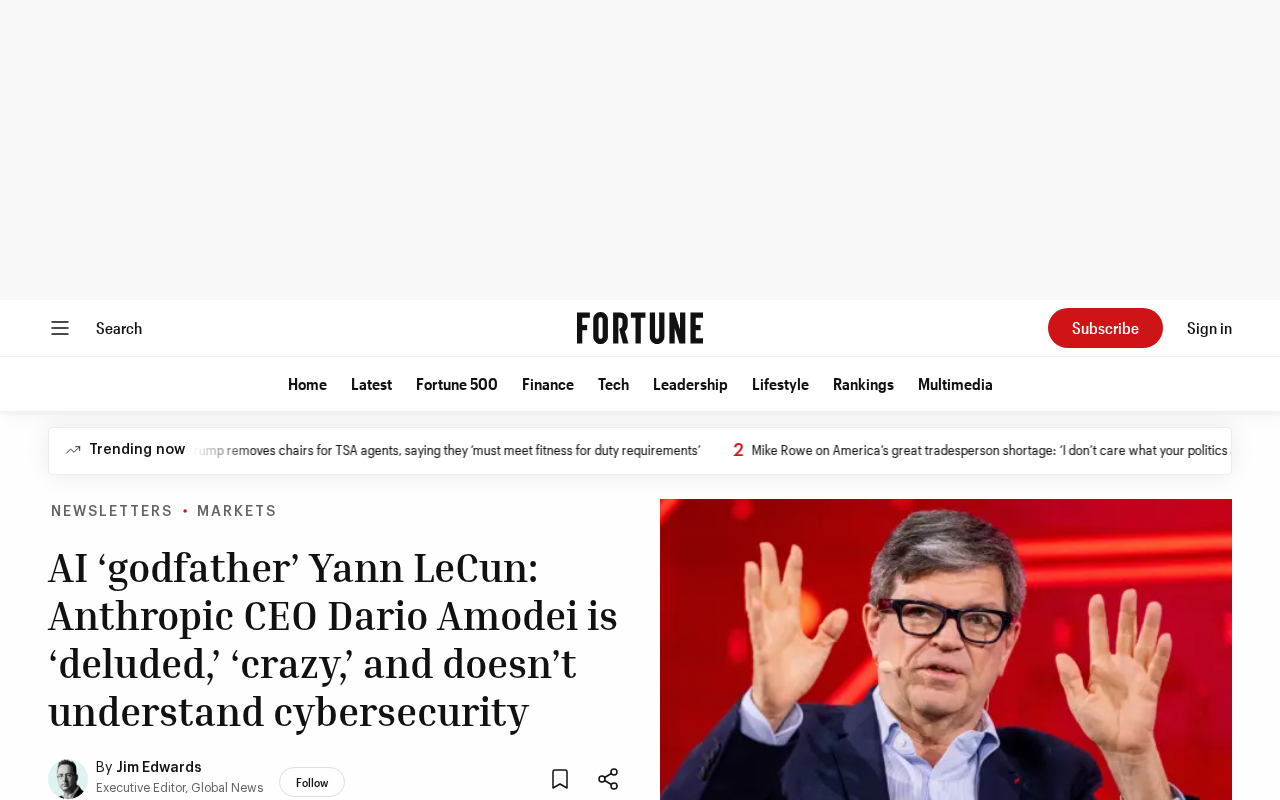
Yann LeCun — Turing Award laureate, Meta Chief AI Scientist, and one of the so-called "godfathers of AI" — has once again fired off a pointed critique, calling Anthropic CEO Dario Amodei "deluded" on questions of AI safety and cybersecurity, and questioning whether Amodei has any genuine understanding of how the cybersecurity field actually works.
This dispute is the latest chapter in a long-running rift within the AI industry over "AI risk." On one side, Anthropic and like-minded labs continue to emphasize the catastrophic risks posed by frontier large models and advocate for strict safety controls. On the other, LeCun and his camp argue that such narratives grossly exaggerate the real-world threat of current technology and risk misleading the public and policymakers.
Two AI Worldviews Behind the Disagreement
Anthropic's "Precautionary" Stance
Since its founding, Anthropic has placed AI safety at the center of its mission. Dario Amodei has repeatedly warned in public forums that as model capabilities rapidly advance, AI could have severe consequences in areas such as cyberattacks, biosecurity, and autonomous behavior. This perspective has driven industry-wide attention to "alignment" and safety evaluation.
In Amodei's framework, the steep capability curve of frontier models means that a system that appears harmless today could cross dangerous thresholds in the near term. Investing early in safety research, setting capability limits, and pushing for regulatory intervention are, in his view, the responsible course of action.
Alignment is a core research direction in AI safety — it refers to ensuring that an AI system's goals, values, and behavior remain consistent with human intentions. As models grow more capable, any divergence between their internal optimization targets and human expectations could produce unpredictable and harmful outcomes. Anthropic's representative work in this area includes the "Constitutional AI" methodology and ongoing research into model interpretability. "Capability evaluations" are systematic tests of a model's actual performance in specific high-risk scenarios — such as synthesizing biological information or assisting with network intrusion — designed to determine whether a model is approaching a "danger threshold." Anthropic has institutionalized such evaluations and uses them to decide whether to release new models. This practice is controversial in the industry: supporters view it as a responsible precedent, while critics argue it uses safety as a pretext to erect market barriers.
LeCun's "Pragmatist" Rebuttal
LeCun has long been a vocal critic of AI doomsday narratives. He argues that current large language models fall far short of genuine intelligence, and that talk of "existential threats" from these systems is divorced from technical reality. This time, he specifically aimed his fire at the cybersecurity domain, suggesting that Amodei lacks real understanding of how that field operates and therefore overestimates the unique destructive power of AI in cyberattacks.
LeCun's argument is that cybersecurity has always been a mature domain of continuous offensive and defensive evolution. AI is both a potential attack tool and a powerful defensive instrument. Emphasizing only AI's offensive potential while ignoring its defensive value is a one-sided, fear-driven narrative.
LeCun's technical assessment of current LLMs has a theoretical foundation. He has long argued that LLMs are fundamentally text-prediction systems based on statistical patterns, lacking genuine world models, causal reasoning, and persistent memory — and therefore fundamentally different from human cognition. His alternative path is a self-supervised learning architecture driven by a "World Model" (such as JEPA), arguing that the road to AGI is not simply scaling up language models. This technical judgment directly shapes his risk assessment: if LLMs are not truly intelligent systems, concerns about them developing "autonomous intent" or engaging in strategic deception lose their technical grounding. This is the fundamental reason he considers "existential threat" narratives disconnected from reality — not mere optimism.
Why This Debate Matters
This is not merely a personal disagreement between two scientists. It reflects a fundamental split in the AI industry over its direction of development.
On the regulatory front, different risk assessments lead to very different policies. Adopting the precautionary view could push regulation toward stricter requirements — model disclosures, capability limits, and even licensing regimes. The pragmatist camp, meanwhile, worries that over-regulation will stifle the open-source ecosystem and innovation. LeCun has long been a staunch advocate for open-source AI, and Meta's Llama series of models is a direct product of that philosophy.
From a competitive industry perspective, safety narratives and commercial positioning are also subtly intertwined. Companies that emphasize risk often position themselves as "responsible frontier labs," while the openness camp stresses democratization and transparency. The differences in their stances partly reflect divergent business models and strategic choices.
The Real Question Through a Cybersecurity Lens
Setting aside the personal charge of "delusion," this debate touches on a substantive issue: to what extent has AI actually shifted the offense-defense balance in cybersecurity?
The reality is complex. AI has indeed lowered the barrier to certain attacks — automated phishing email generation and vulnerability scanning assistance, for example. But defenders are also leveraging AI for threat detection, anomaly identification, and response automation. Cybersecurity has always been an arms race; new tools arm both sides simultaneously, and the net effect is hard to declare simply.
If LeCun's critique holds up, the key point is not to deny AI risks entirely, but to insist that risk assessments be grounded in domain-specific facts rather than generalized panic. That principle is worth heeding regardless of which side you favor.
In cybersecurity, AI is already widely deployed in practice. On the offensive side, AI can be used to generate more targeted social engineering content, automate vulnerability discovery (fuzzing), and produce malware variants that evade traditional signature-based detection. On the defensive side, AI-driven EDR (Endpoint Detection and Response), SIEM (Security Information and Event Management), and UEBA (User and Entity Behavior Analytics) systems have become mainstream components of enterprise security infrastructure. Notably, the cybersecurity community tends to assess AI threats more cautiously than the broader tech press. Reports from professional firms such as Mandiant and CrowdStrike generally indicate that APT (Advanced Persistent Threat) groups are currently using AI primarily to improve operational efficiency, not to create entirely new attack types. LeCun's call to listen to domain experts aligns closely with these professional research conclusions.
Conclusion
At its core, this public clash between an AI godfather and the head of a frontier lab is a methodological dispute about how to handle uncertainty in AI development. Whether precautionary caution or open-minded pragmatism should take precedence remains an open question.
For practitioners and observers following AI's development, rather than picking a side, the more productive approach is to extract what is reasonable from each camp: risks deserve to be taken seriously, but assessments must be grounded in professional facts rather than emotionally driven narratives.
(Note: This article is based on discussions circulating on Hacker News. The original source material is limited, and portions of this analysis represent reasonable extensions based on publicly available background information.)
Related articles

AI Compute Is the New Oil, But the Market Mechanism Has Yet to Take Shape
Hacker News compares AI compute to the new oil, noting the lack of price discovery, concentrated supply, and no hedging tools. The article analyzes structural issues in compute trading and explores a possible three-tier market of spot, contracts, and derivatives, plus the real impact on AI practitioners' cost management.

Running Full iOS 16.5 Firmware on Android Devices: Technical Demo or Marketing Gimmick?
A Hacker News post claims full iOS 16.5 firmware can run on Android, with 315 upvotes. This analysis argues it is more likely a web UI simulation than a true firmware port, and explores the value and risks of such projects.

Etsy Cracks Down on AI Slop: Addressing Buyer and Seller Anxieties
Etsy introduces stricter rules limiting AI-generated content in listings, addressing buyer confusion over AI products and seller fears of original work being diluted by AI slop.