Ledger Launches Android Hardware Wallet Atom: A Phone Without the Phone

Ledger launches Android hardware wallet Atom, isolating signing in a dedicated device—but hits a supply chain trust crisis.
Ledger has launched Atom, a hardware wallet running on Android that resembles a phone in form but lacks cellular communication. Positioned as a companion signing device rather than a standalone terminal, its core idea is to isolate high-risk private key signing from internet-connected phones. Android offers mature interaction frameworks and a near-phone experience, but a more complete system means a larger attack surface requiring extra isolation. The timing is rough: Ledger has already halted sales in parts of Southeast Asia over supply chain tampering. The article argues Atom's success hinges on pricing, phone integration depth, and Ledger's handling of the supply chain incident.
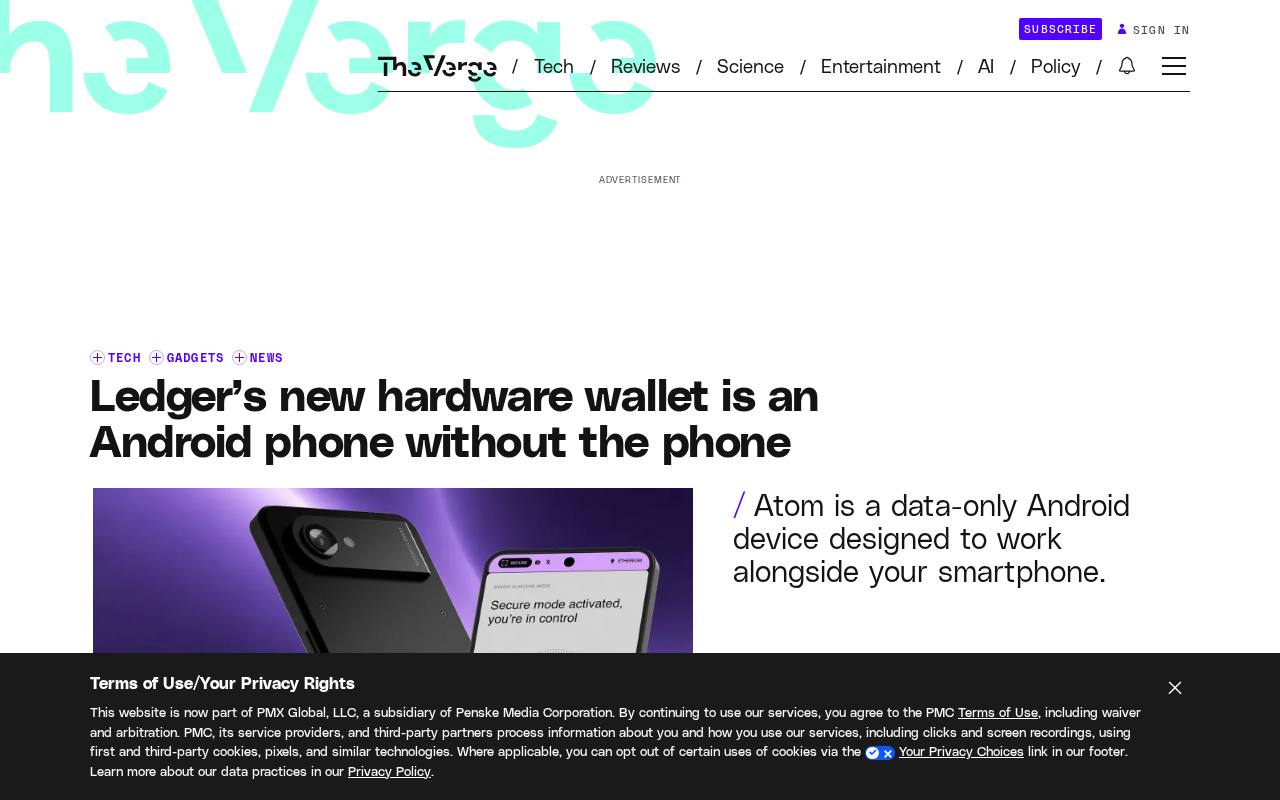
Ledger has just unveiled Atom, its latest crypto hardware product—a device that runs on Android, looks like a phone, and deliberately does not function as one. Its positioning is clear: it's not meant to be a standalone device, but a companion device that sits alongside your existing phone.
What Exactly Is Atom
In terms of hardware form factor, Atom has the basic skeleton of a smartphone: a screen, touch interaction, a battery, and a chip capable of running a full Android system. But it has no cellular baseband, and making calls isn't part of its use case. Ledger's logic is that users continue handling messages, payments, and social activities on their familiar phones, while delegating the high-risk operations related to private key signing to this dedicated device.
In other words, Atom upgrades the "wallet" from an app or a small Bluetooth accessory into a mobile terminal with its own screen, its own system, and its own input method—except this terminal isn't meant to replace your phone, but to live alongside it.
Why Android
Choosing Android rather than a self-developed RTOS or a stripped-down embedded system is a notable engineering decision. Android means Ledger can reuse mature display frameworks, touch drivers, and security update pipelines, lowering the cost of building an interactive system from scratch. For users, this translates to an experience closer to a phone rather than the "a few lines of tiny text and two buttons" typical of hardware wallets.
The trade-offs are equally obvious. The more complete the system, the larger the attack surface. Ledger needs to build sufficiently strong isolation mechanisms on top of this layer to convince the market that a device running Android can still protect private keys. Whether this chain of trust holds will directly determine how Atom is received.
RTOS (Real-Time Operating System) has long been the technical foundation of the hardware wallet industry. Unlike general-purpose operating systems like Android, an RTOS retains only the most essential functions such as task scheduling and memory management, with code typically ranging from tens of KB to a few MB, and virtually no network stack, graphics framework, or third-party app ecosystem. Products like Trezor and early Ledger Nano devices were built on such trimmed systems, which is why they have a small attack surface, low power consumption, and fast boot times—but at the cost of weak interaction capabilities, usually relying on just two or three physical buttons and a small monochrome screen for all operations. Atom's shift to Android essentially represents a move from the "minimal trusted computing base" approach to the "reuse of a mature ecosystem" approach, with the security model shifting from "the system is simple enough to be trusted" to "the system is complex but protects private keys through an isolation layer." Both philosophies have long coexisted in the industry, and Atom's choice means Ledger is betting that the latter can achieve an equivalent level of trust through engineering.
Timing Isn't Easy
Atom's launch timing is rather tricky for Ledger. Source material indicates that due to hardware tampering issues in the supply chain, Ledger has been forced to halt sales of some hardware products in parts of Southeast Asia. A supply chain security incident colliding with a new product launch has renewed sensitivity around the old question of "how can hardware wallet vendors ensure devices aren't tampered with from factory to your hands."
For a device that emphasizes security, launching during a supply chain trust crisis means Atom must not only prove it's useful but also take on the extra task of repairing brand trust.
The Real Pain Point It Aims to Solve
In cases of crypto asset theft, a significant portion are not due to brute-force cracking of private keys, but rather users being phished, having addresses swapped, or being lured by malicious contracts when signing on internet-connected devices. The value of a hardware wallet lies in isolating the signing action into an offline or controlled-network environment.
Atom's approach is to make this isolation more thorough: rather than plugging into a computer and pressing a confirmation key, the entire process of viewing, verifying, and signing is completed on a standalone Android device. In theory, users can see complete transaction information on one screen, instead of deciphering truncated addresses on a small OLED display.
Address Replacement Attack (Address Replacement / Clipboard Hijacking) is one of the core threats hardware wallets are designed to defend against. Malware can silently replace clipboard contents with an attacker-controlled address after a user copies a recipient address; or tamper with transaction details during signing so that the recipient shown in the interface differs from the one actually signed. Traditional hardware wallets' line of defense is "secondary confirmation on the device screen," but if the screen is too small and the address is truncated to something like 0x1a2b...3c4d, users effectively cannot verify the full information, and the defense is hollowed out. Atom's emphasis on "viewing complete transaction information on an independent screen" targets exactly this blind spot—screen size and an independent system together form the prerequisite for "what you see is what you sign." Understanding this is key to understanding why Ledger is willing to pay the cost and power consumption price for a larger screen and a complete system.
Several Questions Worth Watching
First, price and battery life. A device running Android has far higher costs and power consumption than a traditional hardware wallet, and whether the final pricing is acceptable to mainstream users is key to commercialization.
Second, the depth of integration with phones. If Atom can only do simple pairing via Bluetooth, it remains essentially an enlarged hardware wallet; if it can form a clear division of labor with a phone app—the phone handles connectivity and display, while Atom handles signing and confirmation—then the experience difference will truly manifest.
Third, handling of the supply chain narrative. Ledger needs to provide sufficiently specific explanations of the scope, reasons, and remedies for the Southeast Asia sales halt; otherwise Atom's security selling point will be continually diluted by this incident.
Supply Chain Tampering refers to the implantation of malicious hardware or firmware into devices during logistics, warehousing, or distribution after they leave the factory but before reaching users. Common methods include replacing the security chip inside the device, pre-installing leaked seed phrases, or inserting counterfeit recovery cards into the packaging. Such attacks are difficult to defend against through the device's own cryptographic mechanisms, because the device "looks brand new" when users receive it. Industry countermeasures include factory attestation certificates within the secure element, authenticity verification processes at unboxing, and direct shipping from official channels to compress intermediate steps. Ledger's sales halt in Southeast Asia shows that even with a mature security architecture, the trust chain at the physical layer can still break. For Atom, how to layer verifiable factory integrity proof onto a complex system like Android is a more daunting proposition than software isolation.
Summary
Atom represents one line of thinking: rather than cramming security into a phone, give security its own dedicated device. Whether it succeeds doesn't depend on how smoothly Android runs, but on whether Ledger can still make users believe private keys are safe on top of a complete operating system, and whether it can clearly re-establish trust amid the supply chain turmoil.
One-line Summary
Ledger launches Android hardware wallet Atom, isolating signing in a dedicated device—but running headlong into a supply chain trust crisis.
Paragraph Summary
Ledger has launched Atom, a hardware wallet that runs on Android and resembles a phone in form but lacks cellular communication capabilities. Positioned as a companion signing device alongside your existing phone rather than a standalone terminal, its core idea is to isolate high-risk operations like private key signing from internet-connected phones. Choosing Android allows reuse of mature interaction frameworks, lowering development costs and delivering a near-phone experience, but the more complete the system, the larger the attack surface, requiring additional isolation mechanisms to protect private keys. The launch timing is far from ideal: Ledger has already halted sales of some products in parts of Southeast Asia due to supply chain hardware tampering, putting pressure on Atom's security narrative at launch. The article argues that Atom's success doesn't depend on how smoothly Android runs, but on pricing, the depth of integration with phones, and whether Ledger can clearly explain the supply chain incident.
Related articles

Free Unlimited Claude Code Solution: Agnes AI + CC Switch Setup Guide
No paid subscription needed — pair the free AI platform Agnes AI with the open-source tool CC Switch to provide a backend for Claude Code, enabling unlimited free calls to text, image, and video models. This guide covers the full setup, test results, and usage boundaries.

A Complete Zero-Cost Guide to Getting Started with Claude Code for Beginners in China
A beginner's guide to Claude Code for users in China: two installation methods (command line and IDE plugin), full configuration steps for replacing the official API with the free domestic LongCat model, and a hands-on demo of building a small tool with natural language, plus tips.

When the NSA Gets Involved: The AI Supply Chain Crisis Behind Open-Source CVEs and API Key Hijacking
Multiple open-source projects disclosed severe CVEs in one day, PHP flaws alarmed the FBI, and Railway and OpenCode were breached with API keys stolen. This article breaks down the vulnerability window, AI-accelerated exploitation, and the AI supply chain crisis behind the API key black market, with a developer defense checklist.