Lettertrace: A Free, Open-Source AI Visibility Tracking Tool

Free open-source tool that tracks how often AI chatbots mention your brand using your own API keys.
Lettertrace is a free, open-source AI visibility tracking tool that measures how frequently ChatGPT, Claude, and Gemini mention your brand. Using a Bring-Your-Own-Key (BYOK) model, it lets developers and businesses quantify their GEO (Generative Engine Optimization) performance without subscription fees. Its developer-first, self-hostable design makes it a transparent starting point for understanding brand presence in AI-generated responses.
When AI Becomes the New Search Gateway
In the past, businesses invested heavily in SEO (Search Engine Optimization) to rank higher in Google search results. Now, more and more users are going directly to Claude, ChatGPT, and Gemini for product recommendations and purchasing advice. This raises an entirely new question: When users ask about your industry, will AI mention your brand?
This is what's known as "AI Visibility," also referred to as GEO (Generative Engine Optimization). The concept of GEO was formally introduced by academia in late 2023, distinguishing itself from traditional SEO—which targets search engine crawlers and ranking algorithms—by focusing on how to get brand information "remembered" and "recommended" by large language models' training data and reasoning processes. The core logic is this: when LLMs generate answers, they rely on knowledge distribution in their training corpus, citation frequency from authoritative sources, and the quality of content retrieved in real-time (RAG). Therefore, GEO optimization strategies include increasing brand exposure in high-authority media, ensuring product information accuracy in structured data sources, and establishing a systematic presence on AI-searchable content platforms.
Lettertrace was built precisely for this emerging need. Upon its launch on Product Hunt, it shot up to #3 for the day, earning 385 upvotes and 60 comments.
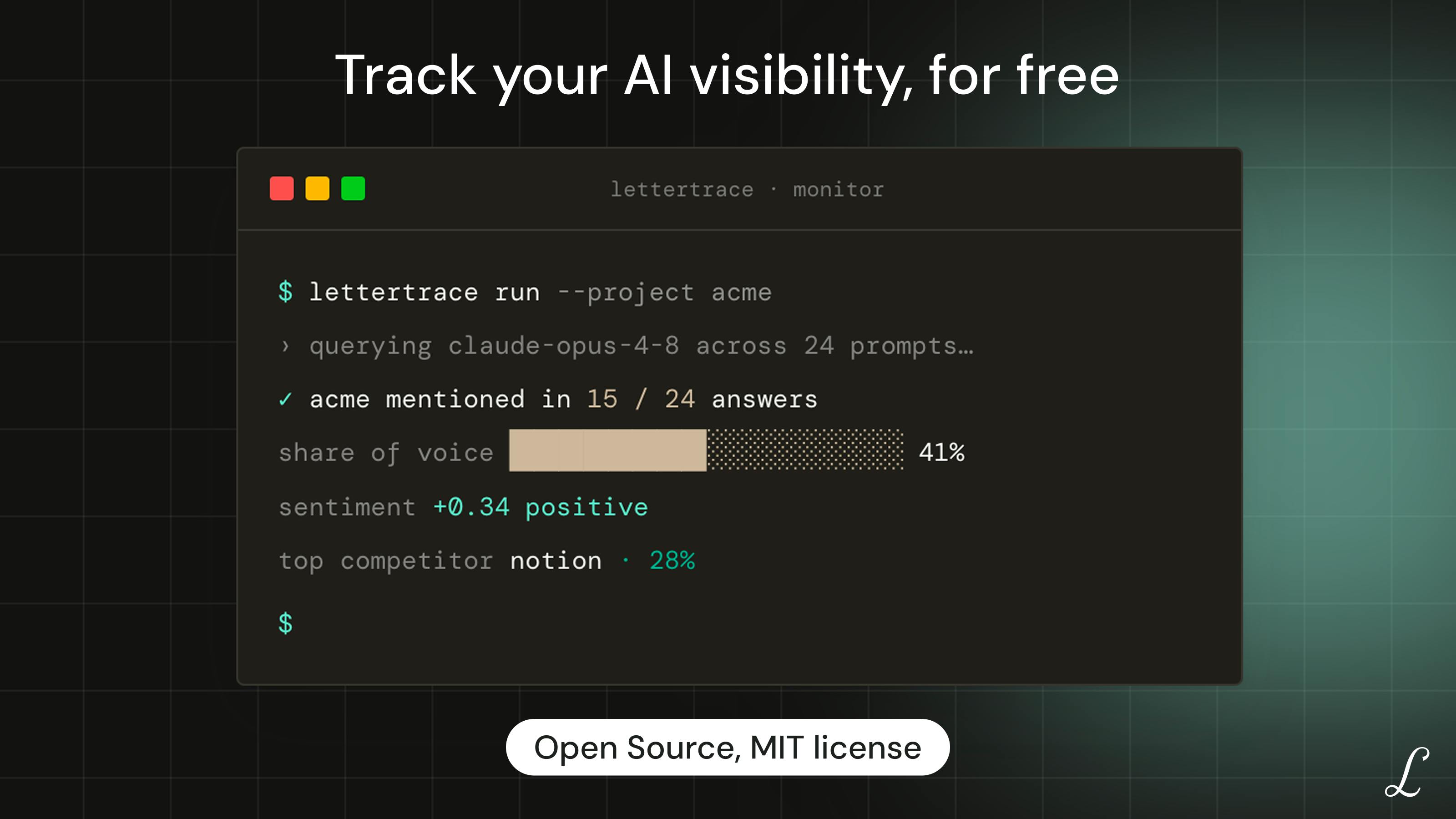
What Lettertrace Is: A Free AI Visibility Tracking Tool
Lettertrace's core functionality is straightforward: it measures how frequently Claude, ChatGPT, and Gemini mention your company. By periodically querying major LLMs with industry-relevant prompts, it tracks and analyzes your brand's appearance in AI-generated responses, helping businesses understand their position in the "AI mindshare."
What truly sets it apart from similar AI visibility products on the market are four key differentiators: free, developer-first, Bring-Your-Own-Key (BYOK), and open source.
The BYOK Business Logic
Most AI visibility tracking tools use subscription models, charging anywhere from tens to hundreds of dollars per month because they need to cover the cost of calling various LLM APIs. Lettertrace takes the opposite approach—it lets users use their own API keys (BYOK model).
The BYOK (Bring Your Own Key) model is becoming increasingly common in developer tools. Its essence is shifting infrastructure costs from the SaaS provider to the end user. In the AI application context, calling APIs for GPT-4, Claude, and similar models isn't cheap—GPT-4o, for example, costs roughly $2.5-5 per million input tokens, with output tokens being even more expensive. For visibility tracking tools that require high-frequency, multi-turn queries to sample AI responses, API costs scale linearly with monitoring frequency and keyword count. The BYOK model lets users pay as they go, avoiding the friction of traditional monthly SaaS billing where you might "pay but not use it all" or "exceed your quota and face surcharges," while also freeing tool providers from unpredictable marginal costs.
The elegance of this design lies in:
- Cost transparency: Users pay OpenAI, Anthropic, or Google directly, only for the tokens actually consumed—no middleman markup.
- Data control: Query data flows through the user's own API key, providing better privacy and security guarantees.
- Free product: Since the tool itself doesn't bear API costs, it can be entirely free.
For budget-conscious startups and independent developers, this model is extremely attractive.
Why AI Visibility Deserves Enterprise Attention
User Search Behavior Is Migrating to AI
With ChatGPT's weekly active users surpassing hundreds of millions, more and more decision-making scenarios are shifting from "search keywords, browse links" to "ask AI directly, accept recommendations." When a user asks "What are some good project management tools?", the few names AI provides likely define that user's entire consideration set.
If your product is never mentioned by AI, you're essentially "invisible" at this new entry point. This is a marketing blind spot that businesses cannot afford to ignore.
The Paradigm Shift from SEO to GEO
Traditional SEO focuses on page rankings, keyword density, and backlink quality. Over nearly 25 years of development, the SEO industry has formed a mature methodology: from technical SEO (site architecture, load speed, structured data) to content SEO (keyword research, content quality) to link building—every aspect has quantifiable metrics and optimization paths. Google has even published guidance documents on some ranking factors.
In the generative AI era, the factors influencing "being mentioned" are far more complex: model training data, knowledge cutoff dates, web browsing capabilities, and brand exposure in authoritative content. GEO faces an entirely different landscape: LLM providers won't publish their "recommendation ranking algorithms," and the specific composition of training data is proprietary. Currently observed GEO influence factors include: brand presence on high-authority platforms like Wikipedia and Reddit, frequency of coverage in authoritative media, GitHub activity (for technical products), and coverage on product review sites. But these remain empirical speculation, lacking official confirmation from LLM providers.
The tracking data Lettertrace provides is essentially the first step in helping businesses quantify GEO effectiveness. Only by first measuring "how often does AI mention me" can you then optimize "how to get AI to mention me more."
The Differentiation Advantage of Open-Source Architecture
Lettertrace chose the open-source route—a bold decision in the highly competitive marketing analytics space. Being open source means:
- Transparency and trust: Users can inspect the code to understand how queries are constructed and results are tabulated, avoiding data distortion from "black box" operations.
- Self-hostable: Technical teams can deploy it on their own servers with complete control over data flow.
- Community-driven development: Developers can contribute support for new models, optimize query strategies, and keep the tool evolving.
The "developer-first" positioning also indicates that Lettertrace's target audience skews toward technical teams rather than pure marketers. This aligns consistently with its BYOK and open-source characteristics to form a coherent product philosophy.
Current Challenges in AI Visibility Tracking
Despite Lettertrace's clear approach, AI visibility tracking itself still faces some inherent challenges:
Instability of AI response results. LLM responses are inherently stochastic—the same question may yield different answers at different times or with different temperature settings. From a technical standpoint, when LLMs generate text, they're essentially performing probability sampling across a vocabulary. The temperature parameter controls the "randomness" of this sampling process: higher temperature makes the model more likely to select lower-probability tokens, producing more diverse output; at temperature 0, the model always selects the highest-probability next token, trending toward deterministic output. But even at temperature 0, due to hardware floating-point precision, batch processing order, and internal random seeds that some models introduce during inference, the same prompt may produce slightly different results. Additionally, sampling strategies like Top-p (nucleus sampling) also affect output consistency. This is why AI visibility tracking needs statistically robust multi-sample designs rather than drawing conclusions from single queries. Designing robust sampling strategies that make statistical data truly reliable is the core technical challenge for these tools.
GEO optimization paths remain unclear. Even if you measure that your brand visibility is low, how should a business improve it? Since LLM recommendation logic is opaque, GEO methodology is still in its exploratory phase—far less mature than SEO.
Continuous model updates and RAG complexity. Major LLMs iterate frequently and web browsing capabilities continue to strengthen, meaning visibility data only has value with continuous tracking—one-time snapshots are of limited use. Modern LLMs increasingly integrate Retrieval-Augmented Generation (RAG) capabilities, retrieving relevant documents from external knowledge sources before generating answers. ChatGPT's Browse feature, Gemini's Google Search integration, and Perplexity AI's real-time retrieval are all practical applications of RAG. This means AI recommendations no longer rely solely on "historical memory" in training data—they're also influenced by real-time web content, structured knowledge bases, and even social media discussions. For businesses, this presents both opportunity and challenge: on one hand, even if training data lacks brand information, optimizing searchable online content may still earn AI recommendations; on the other hand, the ranking and filtering mechanisms for search results are equally opaque, adding complexity to GEO strategies.
Summary
Lettertrace addresses a real pain point of the AI search era, offering a developer-friendly solution through the combination of "free + open source + bring-your-own-key." Its emergence also signals that the marketing analytics field is accelerating its evolution from traditional SEO toward GEO.
For teams looking to understand where they stand in AI-generated responses, Lettertrace provides a low-barrier starting point. As for how to truly improve AI visibility—that's a much larger question the entire industry is still figuring out.
Related articles

Apple HomeView Hands-On Review: Is the $300 Smart Home Hub Worth It?
Apple HomeView hands-on: a $300 smart home hub with facial recognition for quick account switching, but no App Store or voice recognition. Is the wall-mounted version worth it? Should you buy the first generation?

Meta Muse Wonder Launch: What It Means for Meta's Return to the Frontier AI Race
Meta releases Muse Wonder and WonderFull, benchmarks reach the frontier, community feedback is polarized. An in-depth look at Meta's return to the frontier AI race, its personal agent strategy, and Zuckerberg's different path.

Apple Home Smart Home Lineup Leaked: LG and Schneider Team Up, UWB Door Lock on Board
Apple Home ecosystem gains new LG and Schneider devices: UWB smart lock with proximity unlock, 2.5K dual-camera doorbell, privacy indoor camera, and AirPods-like seamless pairing.