Lifelong Review: A Family-Centered AI Health Management App

Lifelong is a family-centered AI health app that manages multiple members' health records in one place.
Lifelong is a new AI-powered health management app built around the family unit rather than individuals. It lets users manage health profiles for all family members, integrates wearable device data, and features an AI companion called Alo for natural language health logging. With fine-grained privacy controls and a subscription model on iOS, it targets the underserved Sandwich Generation market.
A Health App Built for the Entire Family
In the digital health space, the vast majority of products are centered around the "individual": tracking your steps, monitoring your sleep, recording your medications. But in real life, health management is often a "family affair" — parents need to keep track of their children's vaccination schedules, adult children need to monitor their aging parents' chronic disease medications, and spouses regularly remind each other about checkups and follow-up appointments.
This need for "family health management" has deep sociological roots. As global population aging accelerates and childbearing age continues to rise, the so-called "Sandwich Generation" — middle-aged adults simultaneously caring for young children and aging parents — is rapidly expanding. According to Pew Research Center data, approximately one in four American adults belongs to this group. They face not only financial pressure but also enormous challenges in information management and time allocation, needing to remember multiple family members' health matters simultaneously, making cognitive overload the norm.
Lifelong, which recently debuted on Product Hunt, targets precisely this long-overlooked need. Its tagline is straightforward and powerful: "Your whole family's health in one place." The app received 99 upvotes on launch day, ranking 8th on that day's leaderboard, and was categorized across three intersecting domains: Health & Fitness, Artificial Intelligence, and Family.
Lifelong's Core Design: Built Around "Family" Rather Than "Individual"
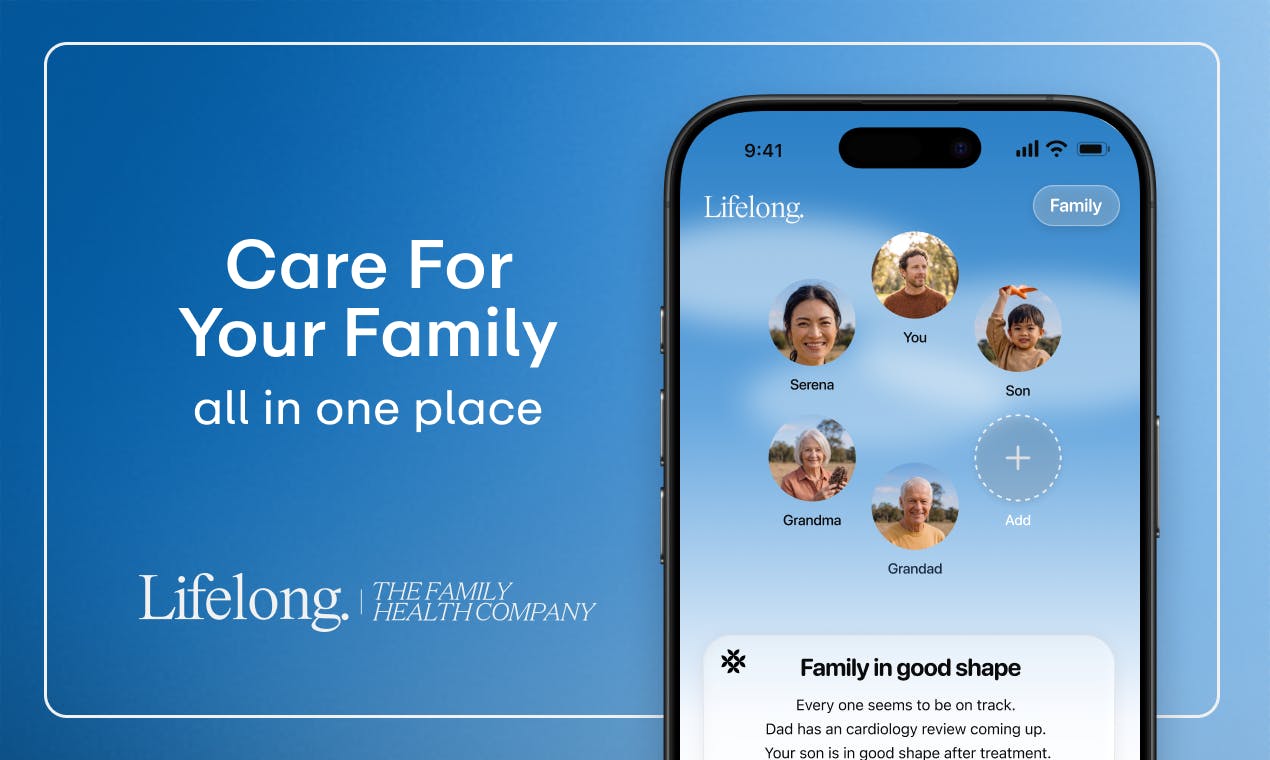
One Account to Manage the Entire Family's Health Records
Lifelong's most fundamental differentiator lies in its design philosophy: the app is built around the "household" rather than a "single user." Users can maintain complete health profiles for every family member within the same space, including:
- Health records and medical history
- Medication information
- Symptom logs
- Appointments and visit schedules
- Daily activity data
- Sleep data
The value of this design lies in "contextual completeness." When a family's health information is fragmented across multiple standalone apps and accounts, caregivers struggle to gain a holistic view. Lifelong attempts to make information flow within caregiving relationships natural — especially for the Sandwich Generation, this centralized management can significantly reduce cognitive burden.
Connecting Existing Wearable Devices
Lifelong doesn't try to reinvent the wheel. It supports integration with users' existing wearable devices, automatically funneling activity, sleep, and other data into family profiles without requiring users to switch hardware ecosystems. This is a pragmatic choice — the value of health data lies in continuity and aggregation, not in creating yet another data silo.
It's worth noting that the "data silo" problem is particularly severe in digital health. Currently, users' health data is typically scattered across different systems: smartwatches record activity data, hospital EHRs store visit records, pharmacies hold medication histories, and various health apps each possess fragmented information. Although the industry has standards like FHIR (Fast Healthcare Interoperability Resources) attempting to enable data interoperability, practical implementation still faces technical barriers and commercial interest conflicts. Platform-level solutions like Apple HealthKit and Google Health Connect offer some degree of data aggregation capability, but they remain designed around individuals, lacking family-dimension data correlation and sharing mechanisms. Lifelong's choice to solve the aggregation problem at the application layer, sidestepping direct competition with hardware ecosystems, represents a pragmatic technical approach.
AI Health Companion Alo: An Intelligent Assistant from Recording to Action
Completing Daily Health Management Through Natural Conversation
Lifelong features a built-in AI health companion called Alo. Unlike many health chatbots that remain at the "Q&A" level, Alo is positioned as an assistant capable of "logging updates and executing simple actions."
This means users can complete daily health management tasks through natural language — verbally recording a family member's symptoms, updating medication status, or setting up reminders. For family health scenarios that are high-frequency, granular, yet require long-term commitment, lowering the input barrier is crucial — if every record requires clicking through a dozen steps in complex forms, users will quickly give up.
The "retention challenge" for health apps is a widely acknowledged industry pain point. Research shows that health management apps typically have 30-day retention rates below 10%, far lower than social and entertainment apps. The primary reason is high friction in data entry — users need to frequently and proactively input information while receiving limited immediate feedback. Alo's conversational UI is seen as an effective means of reducing this friction: users simply need to say "Mom's blood pressure was high today" or "Dad's blood pressure medication is running out" in natural language, and the AI can automatically parse and update the corresponding health profiles. This interaction model leverages large language models' capabilities in intent recognition and entity extraction, transforming structured data entry into unstructured natural expression, thereby significantly reducing users' operational costs. In essence, Alo is solving the retention problem that plagues health apps universally.
AI Compliance Boundaries in Health Scenarios
Interestingly, in the official description, Alo's positioning is relatively restrained — it handles "recording" and "simple actions" rather than providing diagnoses or medical advice. In the current landscape where AI health applications face strict regulation, this represents a prudent product boundary.
This restraint reflects deep regulatory realities. In the United States, the FDA classifies software that provides diagnostic or treatment recommendations as SaMD (Software as a Medical Device), requiring rigorous approval processes that are lengthy and costly. The EU's MDR (Medical Device Regulation) and the soon-to-be-fully-effective AI Act impose high-risk classifications on AI applications in the health domain. Even major tech companies, such as Google's Med-PaLM and OpenAI's health-related features, explicitly state "does not constitute medical advice" in their products. Lifelong's positioning of AI for data entry and task execution (such as setting reminders and logging symptoms) rather than diagnosis or medication recommendations effectively occupies the safest position within the regulatory gray area — such functions are typically classified as "health management tools" rather than "medical devices," thereby avoiding lengthy and expensive compliance approval processes. Using AI to reduce data entry friction rather than replace professional judgment both leverages the natural language advantages of large models and avoids medical compliance risks.
Privacy and Data Sharing: Fine-Grained User Control
Family health data is far more sensitive than personal fitness data. Lifelong's response to this is "Sharing stays user-controlled."
The app allows users to "keep the right people informed," meaning fine-grained decisions about which family members or caregivers can view which information. This level of permission granularity is critical in real-world scenarios: adult children might want to share their parents' medication information with siblings but may not wish to expose their own complete health records. A family-oriented app that lacks fine-grained privacy controls could actually become a catalyst for family conflicts.
From a privacy engineering perspective, this involves core concepts like Role-Based Access Control (RBAC) and Attribute-Based Access Control (ABAC). In family health scenarios, permission relationships are more complex and emotionally charged than in enterprise settings: a mother might be willing to let her husband see their children's health records but not want her mother-in-law to see her mental health data; adult siblings might need to share their parents' medical information to coordinate care duties. Such scenarios require not only technical permission granularity but also product design consideration of the subtle dynamics of family relationships. Furthermore, from a data protection regulation perspective (such as GDPR and HIPAA), the "data subject consent" issue in family sharing scenarios is more complex — managing health data for minor children or elderly individuals with declining cognitive abilities involves legal issues such as proxy consent and guardianship, and product design must find a balance between convenience and compliance.
Product Status and Market Outlook
Lifelong is currently available only on iOS and offers a two-week free trial. From a business model perspective, this suggests a subscription-based monetization path — given that family health is a high-stickiness scenario requiring long-term commitment, subscription pricing is logically sound.
From a market perspective, family health management is a "essential but fragmented" market. Previously, users often cobbled together management using calendar reminders, notes, or even paper records. Lifelong's opportunity lies in integrating these fragmented needs through a unified entry point while leveraging AI to lower the usage threshold.
Of course, the challenges are equally apparent:
- Needing to convince entire families rather than individual users to adopt the product means higher cold-start difficulty
- The depth of integration with Apple Health and major wearable manufacturer ecosystems will directly determine data completeness
- Building trust around health data takes time, and privacy promises must withstand long-term scrutiny
Conclusion: From "Quantified Self" to "Quantified Family"
Lifelong represents a new direction in digital health — moving from "Quantified Self" to "Quantified Family."
Looking back at history, the "Quantified Self" movement originated in 2007, initiated by Wired magazine editors Gary Wolf and Kevin Kelly, advocating the systematic tracking and analysis of personal life data through technology. This movement gave rise to wearable devices like Fitbit and Oura Ring, as well as logging apps like MyFitnessPal. However, over a decade of development has shown that pure individual quantification often lacks sustained motivation — data alone doesn't generate action; social relationships and a sense of responsibility are stronger drivers. The shift from "Quantified Self" to "Quantified Family" essentially transforms health tracking from personal interest-driven to social responsibility-driven. The latter possesses stronger intrinsic motivation and higher usage stickiness, because the psychological drive of "being responsible for family" is typically far stronger than "being responsible for oneself."
Lifelong doesn't pile on flashy features but instead seizes the real pain point of "caregiving relationships," using an AI companion to reduce usage friction and fine-grained permissions to protect privacy. For users shouldering family caregiving responsibilities, the value of such a product lies not in how cutting-edge the technology is, but in whether it can truly help them "worry a little less." Whether it can successfully navigate the market remains to be proven, but this entry angle itself deserves the attention of the entire industry.
Related articles

Cursor AI Programming in Practice: Build a Student Management System from Scratch in 30 Minutes
A Bilibili creator demonstrates Cursor AI programming: generating a student management system in 30 minutes with natural language. Details on Agent mode, Claude selection, prompt techniques, and thresholds.

Top 20 AI Coding Tools Ranking: From Rock-Solid to Lackluster, a Scored Matrix
Bilibili creator releases top 20 AI coding tools ranking, tiered T0–T4 from rock-solid to lackluster, with Claude Code and Codex tied at T0. This article details the scoring dimensions (capability, reliability, robustness, durability, cost, domestic availability) and tool performances to help developers choose the right AI coding assistant.

Vibe Coding Systematic Tutorial: Master AI-Assisted Programming from Zero
A three-month Vibe Coding tutorial from a Bilibili creator covering Codex, ClaudeCode, and Cursor, from core logic to commercial project practice for beginners.