Lightweight Image Annotation Tool: Simplifying Machine Learning Dataset Preparation

Developer open-sources a lightweight image annotation tool focused on a simple interface and low resource consumption.
A developer frustrated by bloated, resource-heavy image annotation tools built a lightweight open-source alternative based on his own computer vision project pain points. The tool focuses on core annotation features, emphasizing lightweight operation, a simple interface, and a streamlined workflow. It targets students, researchers, and developers, and is especially suitable for custom dataset preparation in small projects or rapid prototyping. Open-sourced on GitHub, the author hopes to refine the annotation workflow through community feedback.
Why We Need Lightweight Annotation Tools
In computer vision and machine learning projects, data preparation is often the most time-consuming part. Many annotation tools are feature-rich, but for users who only need to annotate images simply, these extra features actually increase the learning curve and resource consumption. A developer (a Reddit user) built a lightweight image annotation tool based on his own pain points, aiming to make dataset preparation simpler and more resource-efficient.
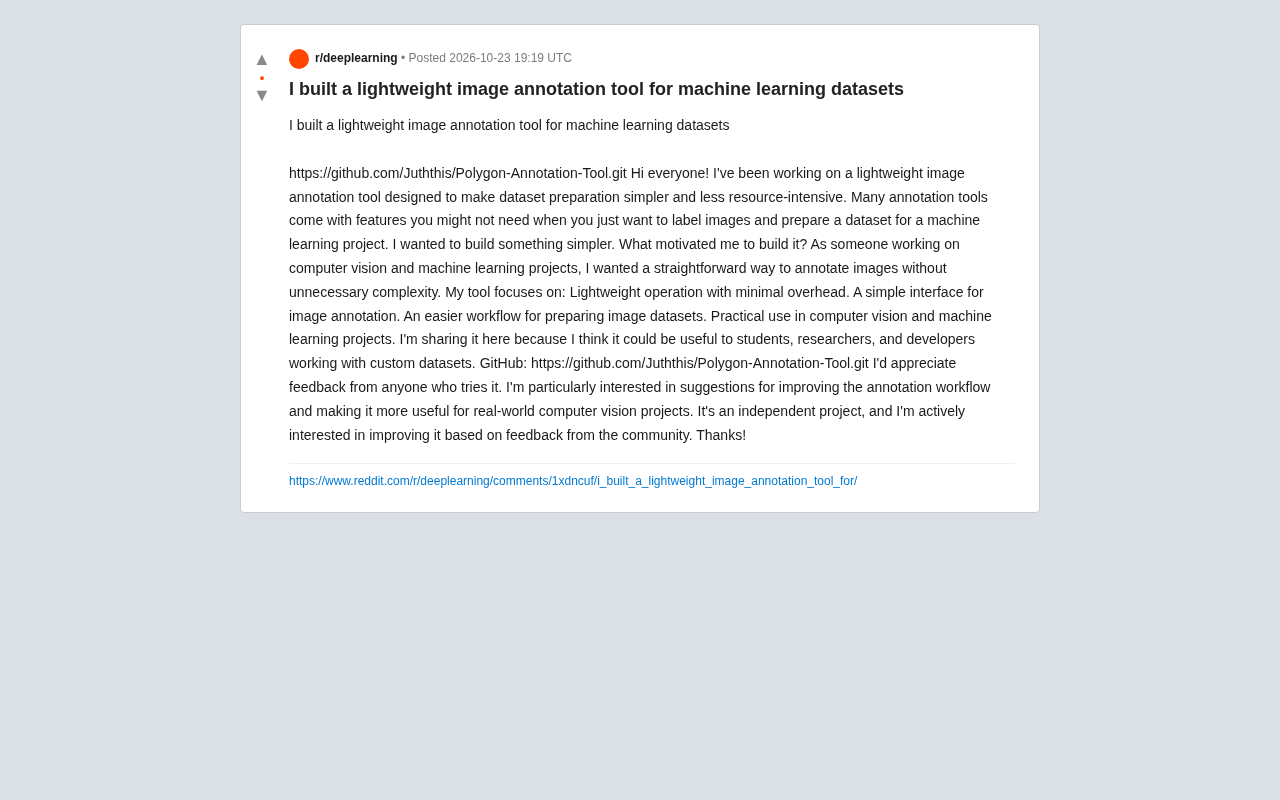
The tool's author said that while working on computer vision projects, he wanted a straightforward annotation method that avoided unnecessary complexity. So he developed this tool focused on core functionality and open-sourced it on GitHub.
Image annotation is a fundamental step in computer vision, referring to generating labeled training data for tasks such as object detection, image segmentation, and pose estimation. Common annotation types include bounding boxes (object detection), polygon/semantic segmentation masks (segmentation), keypoints, etc. Unlike using ready-made datasets, custom datasets often lack ground truth and require manual annotation. For this reason, the efficiency, usability, and resource footprint of annotation tools directly affect project startup speed and iteration cycles. Full-featured annotation platforms (such as Label Studio and CVAT) usually come with team collaboration, model pre-annotation, and data version management, but these can become a burden at small scale or in the prototype stage; lightweight tools trade non-core features for lower deployment costs and a shorter learning curve.
Core Features of the Tool
According to the author, the tool focuses on the following aspects:
- Lightweight operation: Minimized overhead, suitable for resource-constrained environments.
- Simple interface: Provides an intuitive image annotation interface that lowers the barrier to entry.
- Streamlined workflow: Makes the image dataset preparation process smoother.
- Practical orientation: Geared toward the real needs of computer vision and machine learning projects.
The author emphasizes that this is an independent project, and he hopes to continuously improve it through community feedback, especially by optimizing the annotation workflow to make it more suitable for real-world computer vision projects.
Polygon annotation is a method commonly used to annotate the contours of irregular objects. Users generate a closed polygon by clicking along the edges of the image in sequence, thereby precisely outlining the target region. Compared with rectangular bounding boxes, polygon annotation can provide pixel-level masks that better fit object shapes, and it is widely used in instance segmentation, semantic segmentation, and scenarios with high contour precision requirements such as remote sensing and medical imaging. Because polygon annotation requires point-by-point drawing, the tool's operational smoothness, vertex editing capabilities, and keyboard shortcut design significantly affect annotation efficiency—this is also a key point where lightweight tools must balance interface simplicity and practical functionality.
Use Cases and Target Users
This tool is mainly aimed at students, researchers, and developers—especially those who need to work with custom datasets but don't want to be burdened by complex tools. For small projects or rapid prototyping, lightweight tools can significantly reduce environment setup and operational steps, allowing teams to focus more on the model itself.
Open Source and Community Feedback
The tool is open-sourced on GitHub (repository: https://github.com/Juththis/Polygon-Annotation-Tool.git), and the author welcomes users to try it and provide feedback. He is particularly interested in suggestions for improving the annotation workflow so that the tool better fits the needs of real computer vision projects.
The ecosystem of open-source annotation tools is already quite rich, covering everything from general-purpose platforms to domain-specific solutions. Typical open-source options include LabelImg (bounding box annotation, lightweight but with slowed maintenance), LabelMe (supports polygons, semantic segmentation, etc., with relatively comprehensive features), CVAT (enterprise-grade annotation for video and images, supporting team collaboration and auto-annotation), and Label Studio (a multimodal data annotation platform). These tools differ significantly in feature depth and deployment complexity: LabelImg and LabelMe are suitable for small projects that need quick onboarding, while CVAT and Label Studio are better suited for teams that require multi-person collaboration and process management. For a new tool to gain attention in the community, it usually needs to clearly define its differentiation in terms of lightweight design, specific annotation types, or workflow.
Conclusion
Lightweight image annotation tools fill the gap between simple annotation needs and complex annotation suites. For users who don't need advanced features and prioritize efficiency, such tools can be a practical choice. The open-source model also means it has the opportunity to evolve continuously with community-driven efforts.
One-line Summary
Developer open-sources a lightweight image annotation tool focused on a simple interface and low resource consumption.
Paragraph Summary
Frustrated by the bloated features and high resource consumption of existing image annotation tools, a developer built a lightweight open-source image annotation tool based on pain points from his own computer vision projects. The tool focuses on core annotation functionality, emphasizing lightweight operation, a simple interface, and a streamlined workflow. It targets students, researchers, and developers, and is especially suitable for preparing custom datasets in small projects or rapid prototyping. The tool is open-sourced on GitHub, and the author hopes to continuously optimize the annotation workflow through community feedback so that it better fits the needs of real computer vision projects.
Related articles

M&M's Spent Millions Replacing Artificial Blue Dye — Why Is It So Hard?
Mars spent millions trying to replace artificial blue dye in M&M's with spirulina, but thick material clogs pipes and residue risks mold, forcing a full production-line rebuild. Here's the engineering behind the reformulation.
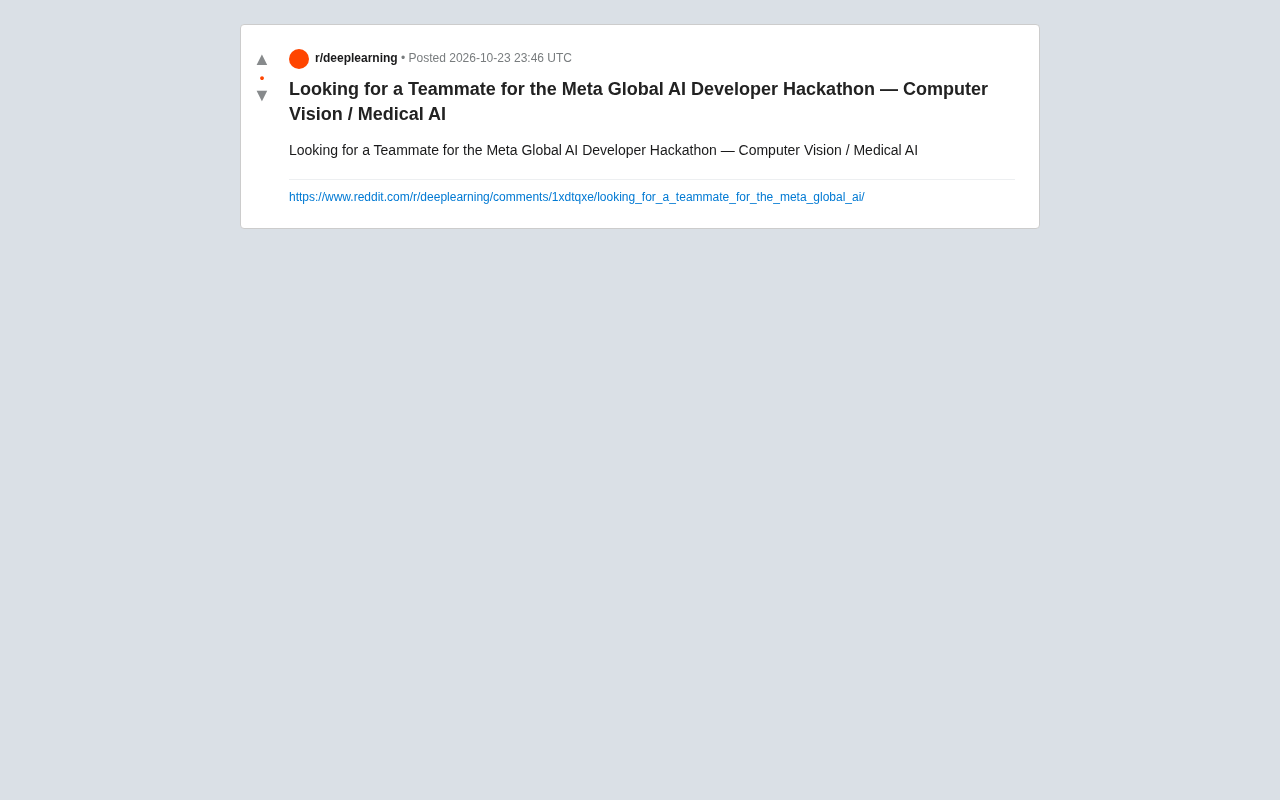
Teammate Wanted for Meta Global AI Developer Hackathon: Computer Vision & Medical AI
A Reddit developer seeks teammates for the Meta Global AI Developer Hackathon, focusing on computer vision and medical AI. This article analyzes the track logic, skills-complementarity needs, and topic selection strategy behind this teaming signal.
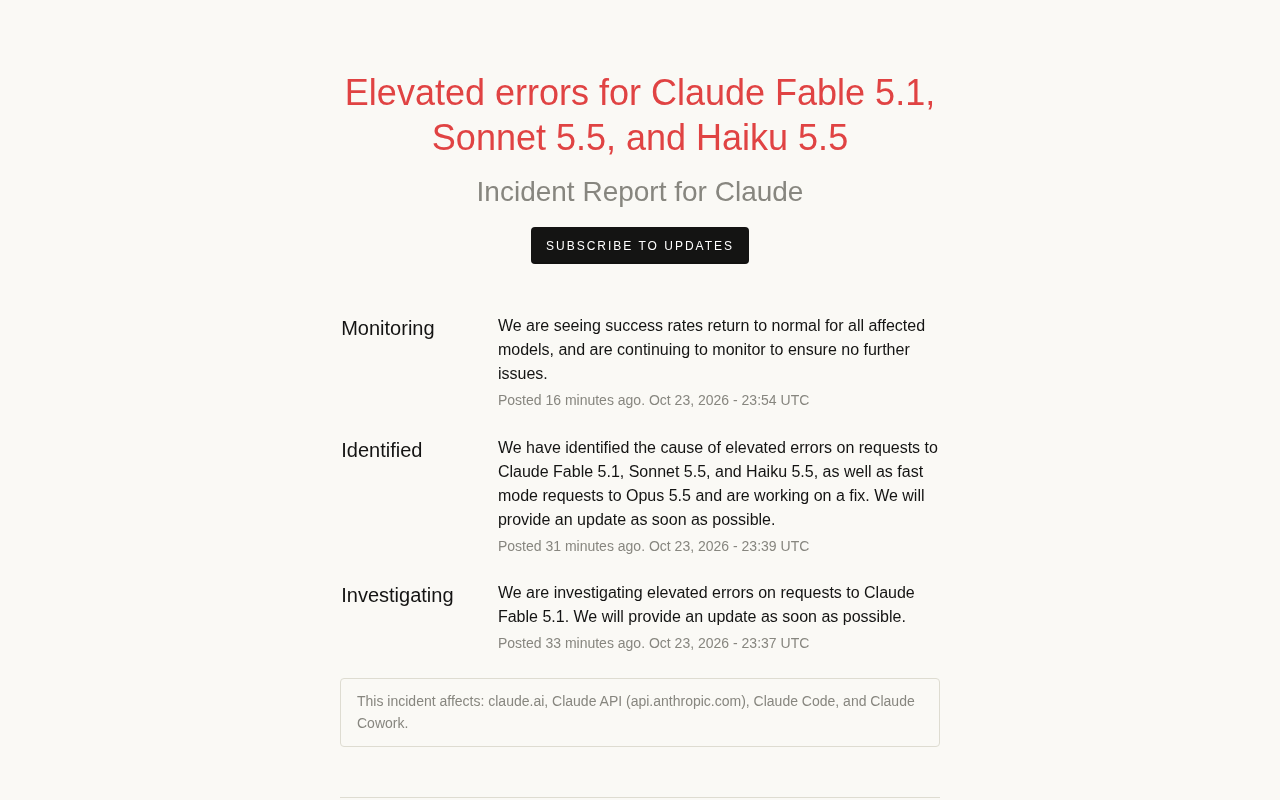
Multiple Claude Models Hit by Errors: A Postmortem of Fable 5.1, Sonnet 5.5, and Haiku 5.5
Claude Fable 5.1, Sonnet 5.5, Haiku 5.5, and Opus 5.5 fast mode saw elevated errors; Anthropic identified and resolved the issue in 17 minutes. This postmortem covers the timeline, the technical reasons for the multi-model cascading failure, and practical lessons for retry and degradation strategies.