Limit Theory for Online Expectile Estimation: New Breakthroughs under Short and Long Range Dependence
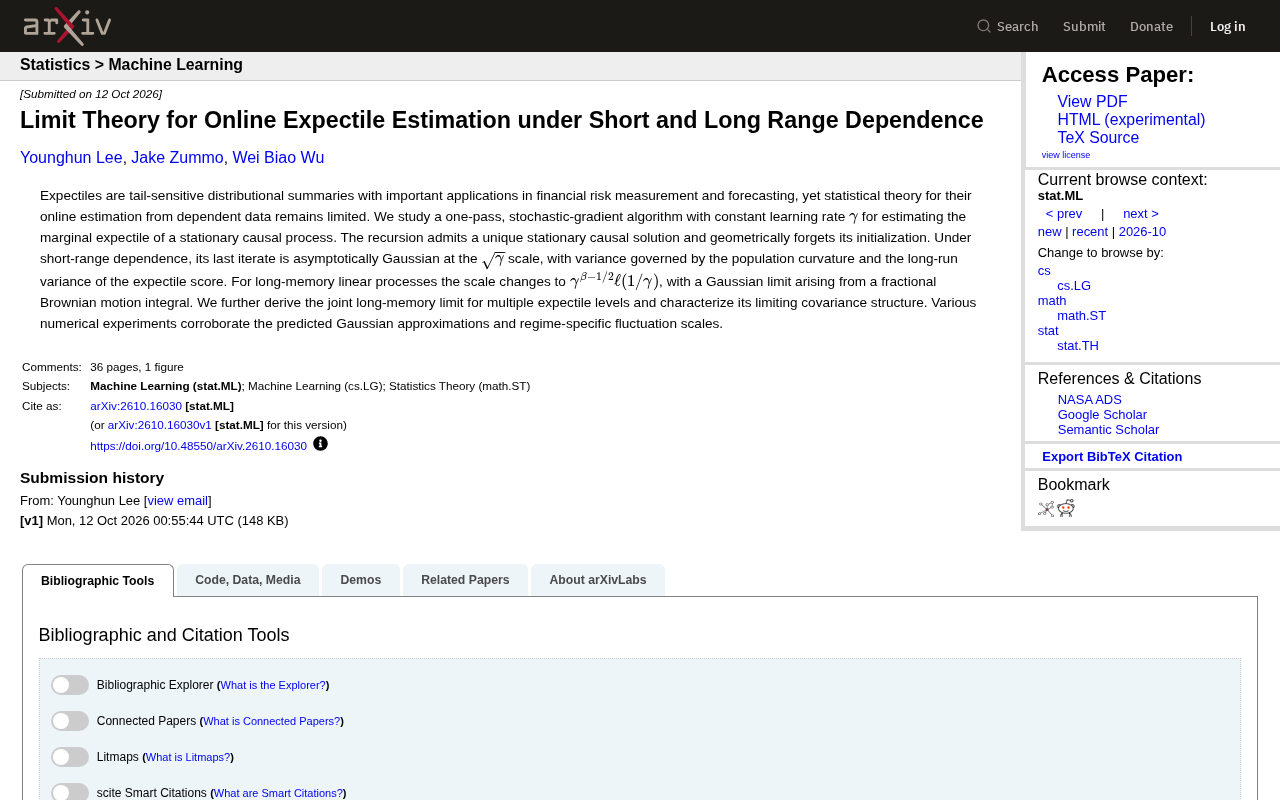
The paper establishes a complete limit theory for online Expectile estimation under short- and long-range dependence, guiding uncertainty quantification in practice.
This paper studies one-pass stochastic gradient online estimation of the marginal Expectile of a stationary causal process, filling a theoretical gap. The algorithm uses a constant learning rate γ with a unique stationary causal solution and geometric forgetting. Under short-range dependence, the estimator is asymptotically Gaussian at rate √γ; under long memory, the scaling becomes γ^{β−1/2}ℓ(1/γ) with limits driven by fractional Brownian motion. Numerical experiments validate the theory. These results are critical for online EVaR computation in financial risk management and can be extended to broader online M-estimation problems.
Introduction: Expectile — A New Perspective on Risk Measures
In the fields of financial risk management and forecasting, Expectile, as a tail-sensitive distribution summary, is attracting increasing attention. Compared with traditional Quantiles, Expectile possesses better mathematical properties (such as additivity and convexity) and demonstrates unique advantages in extreme value theory. However, the statistical theory for online estimation from dependent data has long lagged behind. A recent paper, "Limit Theory for Online Expectile Estimation under Short and Long Range Dependence," fills this gap by providing solid asymptotic theoretical support for online Expectile estimation.
Quantile is a statistic that divides a probability distribution into equal parts by cumulative probability. For example, the 0.95 quantile indicates that there is a 95% probability that the value does not exceed that point, and VaR (Value at Risk) is defined based on quantiles. Quantiles only focus on "how many observations exceed the threshold" and are insensitive to the magnitude by which the threshold is exceeded. Moreover, as an optimization objective, they are non-convex and non-additive, posing difficulties for online estimation and portfolio aggregation. Expectile, on the other hand, is defined by asymmetrically weighting the squared loss: the solution that minimizes E[w_τ(Y−θ)²] is the τ-Expectile, where the weight w_τ equals τ when Y>θ and 1−τ otherwise. Because it is based on squared loss, Expectile possesses convexity, additivity, and a differentiable score function, and as τ→1 its asymptotic behavior approaches extreme quantiles, thus combining favorable mathematical properties with tail sensitivity in characterizing extreme risks.
Online Estimation Algorithm: One-Step Stochastic Gradient Descent
The paper investigates a one-pass stochastic gradient algorithm for estimating the marginal Expectile of a stationary causal process. The algorithm adopts a constant learning rate γ through the recursive update form:
θ_t = θ_{t-1} + γ * ψ(Y_t, θ_{t-1})
where ψ is the Expectile score function and Y_t is the observation sequence. This online setting is highly suitable for real-time data stream scenarios, such as high-frequency financial trading or sensor network monitoring.
The key theoretical contribution is that this recursive process admits a unique stationary causal solution and a geometric forgetting initialization condition. This means that regardless of the initial value, the algorithm quickly converges to a stable state, with the forgetting rate controlled by the learning rate γ.
Stochastic Gradient Descent (SGD) and Stochastic Approximation are core optimization paradigms for handling streaming data. Classical SGD performs unbiased gradient steps on the objective function with a decreasing learning rate, and Robbins–Monro type stochastic approximation theory provides its convergence conditions. Here, however, a constant learning rate γ is used, giving the algorithm an exponential weighting "forgetting" property for old data, thereby enabling it to track slow drifts in the distribution. The Expectile score function ψ(Y,θ)=w_τ(Y−θ) is the gradient of the asymmetric squared loss, and its zero point is the population Expectile. The recursion θ_t=θ_{t−1}+γ·ψ(Y_t,θ_{t−1}) is equivalent to solving an empirical criterion with exponential weights, and its solution is called the stationary causal solution: this solution depends only on current and past observations, satisfies causality, and converges to a unique stationary distribution at an exponential forgetting rate governed by γ. This is precisely the starting point for the subsequent asymptotic analysis.
Asymptotic Normality under Short-Range Dependence
When the data exhibit short-range dependence, such as ARMA processes or mixing sequences, the paper proves that the final iterate is asymptotically Gaussian at the √γ scale. Specifically:
- Convergence rate: √γ, meaning that a smaller learning rate leads to smaller fluctuations but slower convergence.
- Asymptotic variance: jointly determined by the population curvature and the long-run variance of the Expectile score.
This result is in line with classical stochastic approximation theory, but for the first time incorporates the Expectile score function into the framework and considers general causal processes.
Anomalous Scaling and Fractional Brownian Motion Limits for Long-Memory Processes
For long-memory linear processes, such as FARIMA models, the scaling undergoes a dramatic change: it becomes γ^{β-1/2}ℓ(1/γ), where β is the memory parameter and ℓ is a slowly varying function. The limiting distribution is no longer standard Gaussian but a Gaussian process driven by an integral of fractional Brownian motion.
The paper further derives the joint long-memory limits across multiple Expectile levels and characterizes their limiting covariance structure. This implies that in practice, if the data exhibit long memory, using traditional √γ confidence intervals will severely underestimate uncertainty, and inference must adopt the new scaling.
Long-Memory and Fractional Brownian Motion are key to understanding the second class of results in this paper. For short-range dependent processes, the autocorrelation of the sample mean decays rapidly, satisfying the classical √n-type central limit theorem. In contrast, for long-memory linear processes (such as FARIMA), the autocovariance decays slowly as a power law |k|^{2β−1}, with the memory parameter β∈(1/2,1) characterizing the speed of decay. In this case, the sample mean no longer converges at rate √n but at the slower anomalous rate n^{β−1/2}, and its limiting process is an integral of fractional Brownian motion B_H—a Gaussian process with self-similarity and long-range dependence, where the Hurst exponent H=β+1/2>1/2. This scaling shift explains why using conventional √γ confidence intervals on long-memory data systematically underestimates uncertainty, and this is precisely the value of this paper's first characterization of such an effect in the online Expectile setting.
Numerical Experiments
The authors validate the theoretically predicted Gaussian approximation and fluctuation scales under different regimes through a variety of numerical experiments. The experiments cover both short-range and long-range dependence scenarios, and the results show that the empirical distributions are highly consistent with the theoretical limits. These experiments not only confirm the theory but also provide guidance for practitioners in choosing learning rates and constructing confidence intervals.
Implications for Financial Risk Management and Online Learning
This research is quite important for financial risk management. Expectile itself is already used to compute Expectile Value at Risk (EVaR) and conditional Expectile, and online algorithms can update risk measures in real time. The theoretical results enable us to quantify the uncertainty of online estimation, especially when dealing with financial time series with long memory (such as volatility), where the scaling given in the paper must be used to avoid overconfidence.
Moreover, the theoretical framework can be extended to other online M-estimation problems, providing a general tool for statistical inference on dependent data streams. Future work could consider adaptive learning rates, multivariate Expectile, and nonlinear processes.
Expectile Value at Risk (EVaR) and Conditional Expectile are typical applications of Expectile in risk measurement. Unlike VaR, which relies on quantiles, and ES (Expected Shortfall), which relies on tail conditional means, EVaR can be viewed as a "tail-weighted" loss measure under asymmetric squared loss, possessing the favorable properties of a convex risk measure, and can be efficiently aggregated to the portfolio level through a small number of Expectile levels. Online algorithms allow risk managers to update EVaR estimates in real time as new trades and new market conditions arrive, using a single pass, while the asymptotic scaling given in the paper attaches confidence intervals to these online values: under short-range dependence one can use √γ, while under long memory one must switch to a scale based on γ^{β−1/2}ℓ(1/γ); otherwise, the volatility of the estimate will be underestimated.
Conclusion
The paper provides a complete limit theory for online Expectile estimation, covering both short-range and long-range dependence. Under short-range dependence, the estimator converges to a Gaussian distribution at rate √γ; under long-range dependence, the convergence rate slows down, and the limit is characterized by fractional Brownian motion. These results fill a theoretical gap and lay the foundation for uncertainty quantification in practical applications.
One-line Summary
The paper establishes a complete limit theory for online Expectile estimation under short- and long-range dependence, guiding uncertainty quantification in practice.
Paragraph Summary
This paper studies one-pass stochastic gradient online estimation of the marginal Expectile of a stationary causal process, filling a theoretical gap. The algorithm uses recursive updates with a constant learning rate γ and has a unique stationary causal solution with geometric forgetting. Under short-range dependence, the estimator is asymptotically Gaussian at rate √γ, with variance determined by population curvature and the long-run variance of the score. Under long-memory processes, the scaling becomes γ^{β−1/2}ℓ(1/γ), and the limit is driven by fractional Brownian motion, with the paper deriving joint limits across multiple levels and the covariance structure. Numerical experiments validate the theoretical predictions. These results are particularly critical for online EVaR computation in financial risk management, indicating that under long-memory data a new scaling must be adopted to avoid underestimating uncertainty, and can be extended to broader online M-estimation problems.
Related articles

Free Unlimited Claude Code Solution: Agnes AI + CC Switch Setup Guide
No paid subscription needed — pair the free AI platform Agnes AI with the open-source tool CC Switch to provide a backend for Claude Code, enabling unlimited free calls to text, image, and video models. This guide covers the full setup, test results, and usage boundaries.

A Complete Zero-Cost Guide to Getting Started with Claude Code for Beginners in China
A beginner's guide to Claude Code for users in China: two installation methods (command line and IDE plugin), full configuration steps for replacing the official API with the free domestic LongCat model, and a hands-on demo of building a small tool with natural language, plus tips.

When the NSA Gets Involved: The AI Supply Chain Crisis Behind Open-Source CVEs and API Key Hijacking
Multiple open-source projects disclosed severe CVEs in one day, PHP flaws alarmed the FBI, and Railway and OpenCode were breached with API keys stolen. This article breaks down the vulnerability window, AI-accelerated exploitation, and the AI supply chain crisis behind the API key black market, with a developer defense checklist.