Linguistics to Computational Linguistics: Can You Still Find a Job in the LLM Era?

Linguistics grads can still thrive in computational linguistics by leveraging differentiated positioning in the LLM era.
As LLMs reshape NLP, traditional specialized NLP roles are shrinking, but demand is growing for professionals who combine linguistic expertise with technical skills. This article analyzes how linguistics graduates can find their niche in computational linguistics through differentiated positioning in areas like model evaluation, alignment, multilingual processing, and annotation design—turning their background from a perceived weakness into a competitive advantage.
A Real Academic Dilemma
Recently, a Reddit post from an undergraduate linguistics student struck a chord with many. This student had been admitted to Stuttgart University's Computational Linguistics (CompLing) Master's program in Germany, while also holding an offer for a Master's in L2 Teaching.
Computational Linguistics is an interdisciplinary field bridging linguistics and computer science, born in the 1950s from early machine translation research, aimed at using computational methods to analyze, generate, and understand human natural language. Stuttgart University has a deep tradition in this area—its Institute for Natural Language Processing (IMS, Institut für Maschinelle Sprachverarbeitung) is one of Europe's earliest established computational linguistics research institutions, with decades of accumulated expertise in statistical language models, corpus linguistics, and multilingual processing. The Master's program emphasizes a practical orientation: students must not only master formal linguistic theory but also complete coursework in programming, machine learning, and system development, making it an ideal transitional platform for humanities-background students looking to pivot.
Their core anxiety was straightforward: In an era where Large Language Models (LLMs) are rapidly reshaping the entire NLP field, can someone without a solid technical background (a pure linguistics BA) actually find a job after completing this Master's? Will they grind through two years of study only to discover they have zero advantage against competitors with "CS bachelor's + master's + practical experience"?
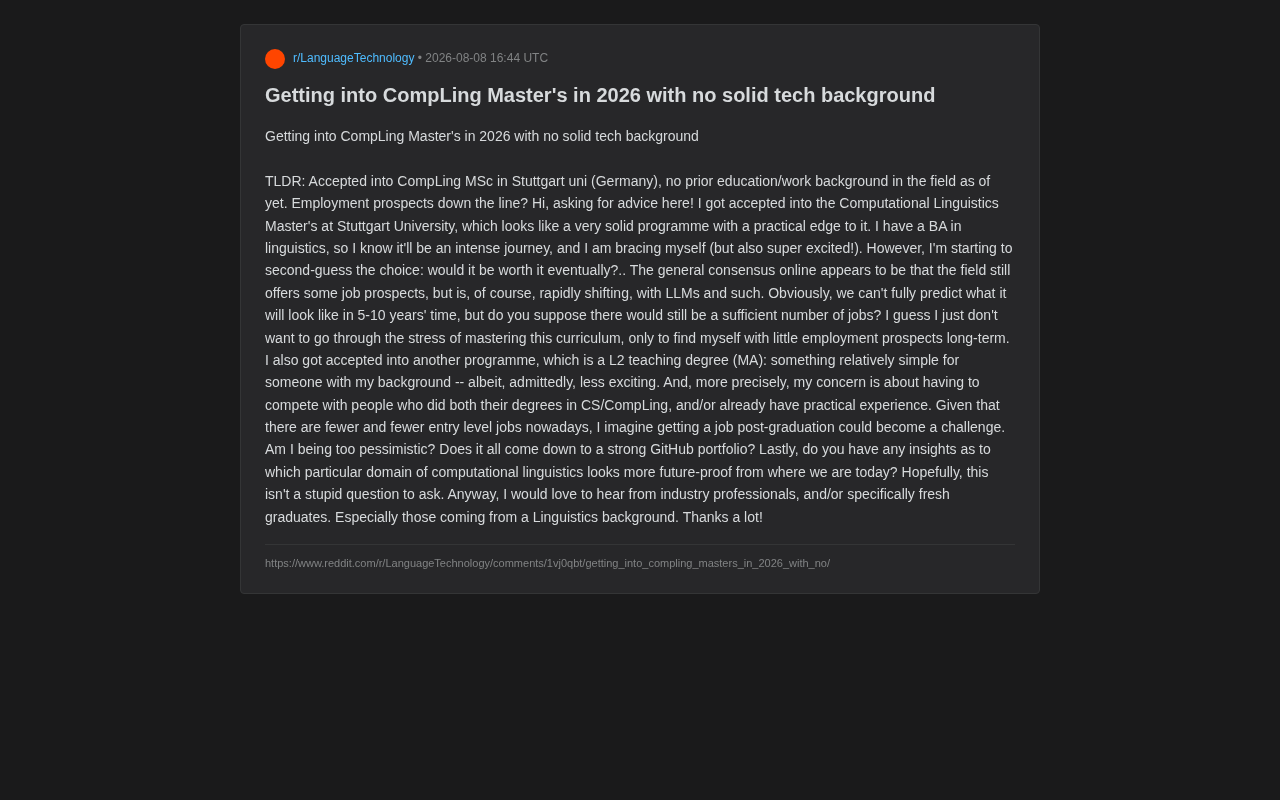
This question may seem like a personal choice, but it actually reflects deeper changes sweeping through the entire language technology industry under the impact of LLMs. It deserves careful analysis.
Computational Linguistics Is Being Reshaped in the LLM Era, Not Disappearing
What LLMs Have Changed
Let's be honest: the poster's concerns aren't unfounded. Over the past decade, much of computational linguistics work revolved around "task-specific pipelines"—tokenization, POS tagging, named entity recognition, syntactic parsing, component tuning for machine translation systems, and so on. Many of these tasks that once required dedicated teams and specialized models are now handled "in passing" by a single general-purpose large model.
Specifically, tokenization is the process of segmenting continuous text into minimal semantic units—particularly critical for languages like Chinese and Japanese that lack spaces between words. POS tagging assigns grammatical category labels to each word. Named Entity Recognition (NER) extracts proper nouns such as person names and place names from text. Syntactic parsing builds hierarchical structure trees of sentences, revealing grammatical dependency relationships between words. Before LLMs, these tasks typically required independent models and specialized annotated data for training—each task was itself a research direction and career path. Models like GPT and BERT, through pre-training on massive text corpora, implicitly learn these linguistic structural representations internally, enabling a single model to accomplish all the above tasks through prompting or minimal fine-tuning—directly leading to the contraction of demand for "specialized NLP engineer" positions.
This means the job market for "training a specialized NLP model" in the traditional sense is shrinking. Meanwhile, as the post mentions, entry-level jobs across the entire tech industry are decreasing, which is especially unfriendly to fresh graduates.
Linguistic Expertise Is Actually More Valued in the LLM Era
However, the flip side of the coin is this: the LLM era has actually amplified the demand for talent who "understands language and human semantics." The following directions are clearly growing:
-
Evaluation & Alignment: How do we measure the quality of LLM outputs? What constitutes a "good" answer? This requires deep linguistic and semantic foundations to design evaluation criteria and annotation guidelines. "Alignment" originates from the AI safety field, referring to keeping model behavior consistent with human intentions and values. When OpenAI released InstructGPT in 2022, they introduced RLHF (Reinforcement Learning from Human Feedback) as a milestone in alignment technology—human annotators rank model outputs by preference, train a reward model, then use reinforcement learning to optimize generation strategies. In this workflow, annotators need to judge whether responses are accurate, harmful, biased, or violate instructions, and designing these judgment criteria itself requires deep understanding of linguistic issues such as ambiguity, pragmatic implicature, and implicit assumptions. Recently, new methods like Constitutional AI and DPO (Direct Preference Optimization) continue to emerge, but the core challenge remains "how to define good language output"—which is precisely the knowledge domain of linguists.
-
Data Quality & Annotation Design: Building high-quality corpora and designing annotation schemas still heavily depends on linguistic expertise.
-
Prompt Engineering & Linguistic Analysis: Understanding why models produce certain linguistic behaviors requires systematic knowledge of pragmatics, syntax, and semantics.
-
Low-Resource & Multilingual Processing: There are approximately 7,000 languages currently spoken worldwide, but the training data for mainstream LLMs is highly concentrated in a handful of languages like English, Chinese, and French. It's estimated that over 50% of internet content is in English, while the vast majority of African, Oceanian, and Southeast Asian languages have virtually no digitized text online. Core bottlenecks in low-resource language processing include: lack of annotated corpora, absence of standardized orthography, and high morphological complexity (such as Turkish agglutinative morphology or Inuktitut polysynthetic structures). These problems cannot be solved merely by scaling up data—they require linguists to participate in designing targeted morphological analyzers, building foundational corpus resources, and developing cross-lingual transfer learning strategies. UNESCO's digital linguistic diversity initiative and Google's 1000 Languages Initiative are both heavily investing in this direction, creating numerous positions that require linguistic expertise.
In other words, the pure "implementation engineer" role has been compressed, but the value of the composite role—"language expert + capable with technical tools"—is rising.
Is a Linguistics Background a Weakness or a Differentiating Advantage?
The Root of Anxiety: Competing with CS Graduates
The poster's most concrete worry is competing against people who have CS/CompLing backgrounds at both bachelor's and master's levels plus practical experience. This anxiety is reasonable—in terms of pure engineering implementation ability, someone from a linguistics background does start at a lower point.
But there's a thinking trap here: positioning yourself in the "same lane" competing with CS graduates. The truly smart approach is to establish differentiated positioning. Someone who understands morphology, syntax, and semantics while also proficiently writing Python and running model fine-tuning workflows is inherently a scarce combination. Stuttgart's program, with its "practice-oriented" positioning, serves precisely as a bridge to help humanities students fill their engineering gaps.
The Importance of a GitHub Portfolio for Career Changers
The poster asked, "Does everything come down to a strong GitHub portfolio?" The answer: a portfolio is very important, but not the only factor.
In the tech industry, especially in NLP and AI, GitHub has evolved from a mere code hosting platform into a job seeker's "technical resume." Recruiters assess candidates' code quality, project completeness, documentation standards, and collaboration skills through their GitHub repositories. For career changers from non-CS backgrounds, a GitHub portfolio is even more significant—it's the most direct evidence that "I'm not just talking theory." A high-quality NLP project repository typically includes: clear README documentation, reproducible experimental code, data processing pipelines, model training scripts, and results analysis.
For career changers, a project portfolio demonstrating "I used technology to solve real language problems" is more convincing than a diploma alone. It proves two things: you can actually build things, and you can translate linguistic insights into working solutions.
The recommendation is to produce output continuously during your studies: reproduce papers, contribute to open-source NLP projects, build an analysis tool targeting a specific minority language or linguistic phenomenon. For example, a student with a linguistics background could build a morphological analysis tool for an endangered language, or develop a systematic evaluation framework for LLM multilingual capabilities. These kinds of projects showcase both programming ability and the unique value of a linguistic perspective. All of these speak louder than simply saying "here are the courses I took."
Computational Linguistics vs. L2 Teaching: Practical Advice for the Decision
CompLing vs. L2 Teaching: How to Weigh the Options
The two offers represent two fundamentally different paths:
- Computational Linguistics Master's: High risk, high ceiling. The industry is in upheaval, but the ceiling is high, and the skills transfer to a broader range of tech positions.
- L2 Teaching Master's: Low risk, clear path. Career direction is well-defined and stable, but growth potential and salary ceiling are relatively limited.
The key isn't which is "objectively better," but rather the poster's own words—they described CompLing as "super excited" and teaching as "less exciting." In a field that demands continuous learning and rapid adaptation, intrinsic interest is the decisive variable in whether you can persevere and outcompete others. Someone passively going through the motions will struggle to stand out in competition.
Choosing Future-Proof Directions
If you ultimately choose computational linguistics, actively orient yourself toward these more "future-proof" directions:
- Model Evaluation & Safety Alignment: This is a hard requirement for LLM deployment, and linguistic expertise is highly valued.
- Multilingual / Low-Resource Language Processing: Deep technical moat where linguistics is irreplaceable.
- Dialogue Systems & Pragmatic Analysis: Connecting human-computer interaction with real-world language use scenarios.
- Engineering Implementation Capability: Regardless of direction, you need to be able to turn ideas into code.
Conclusion: Pessimism Is Reasonable, But Not Fatal
Returning to the poster's question—"Am I being too pessimistic?" My assessment: their concerns are real and necessary, but not fatal.
Computational linguistics hasn't died—it's transitioning from "building wheels from scratch" to "understanding and harnessing existing powerful tools." For someone with a linguistics foundation who's willing to build up their technical capabilities, this isn't necessarily bad news. The real risk isn't in choosing this field, but in measuring yourself by "pure engineer" standards while being unable to out-compete those with formal CS training.
Find your differentiated positioning, prove your hands-on ability through a portfolio, and keep your eyes on future-proof sub-specialties—that's the right approach to navigating industry turbulence.
Key Takeaways
Related articles

Why Does Gemini Keep Throwing Errors? Root Cause Analysis and Solutions
Many users report Google Gemini frequently throwing errors. This article analyzes the three main causes — server load, canary releases, and safety filters — and offers practical solutions.

How to Disable the Ask Gemini Bar at the Bottom of the Google App on Samsung Phones: 3 Methods
Tired of the Ask Gemini bar popping up in your Samsung phone's Google app? Here are 3 proven methods to disable it, including app settings, default browser, and system permissions.

Ollama Mascot Goes Interactive: A Developer Brings the Llama to Life with Frontend Tech
A developer turned Ollama's llama mascot into an interactive browser experience. Explore the frontend tech, mascot design value, and open-source fan creation culture behind it.