Ollama Mascot Goes Interactive: A Developer Brings the Llama to Life with Frontend Tech

A developer creates an interactive web version of Ollama's llama mascot using frontend technologies.
A developer shared a browser-based interactive version of Ollama's iconic llama mascot on Reddit, sparking community discussion. The project showcases frontend animation techniques like Canvas 2D, WebGL, and physics engines, while highlighting the value of brand mascots in open-source ecosystems and the passion-driven fan creation culture that drives healthy communities.
When an Open-Source AI Tool Gets a "Soul"
Recently, a developer shared a fun project on the Reddit community: an interactive, browser-based version of Ollama's mascot. This seemingly simple creation sparked quite a bit of discussion in the open-source community.
As one of the most popular local LLM tools of the past two years, Ollama's iconic llama mascot has become deeply recognizable. Ollama is an open-source framework for running large language models locally, and since its launch in 2023, it has quickly gained widespread attention from the developer community. Its core value lies in dramatically lowering the barrier to running LLMs on personal computers — users can download and run mainstream open-source models like Llama, Mistral, and Gemma with a single command, without dealing with complex environment configurations or dependency management. Under the hood, Ollama integrates the llama.cpp inference engine, supports both CPU and GPU-accelerated inference, and provides a local API interface compatible with the OpenAI API format, making it easy for developers to integrate into various applications. As of now, Ollama has earned over 100,000 stars on GitHub, making it one of the most popular tools in the local AI inference space.
What this developer did was bring this originally static brand image to life — users can interact with it directly in the browser.
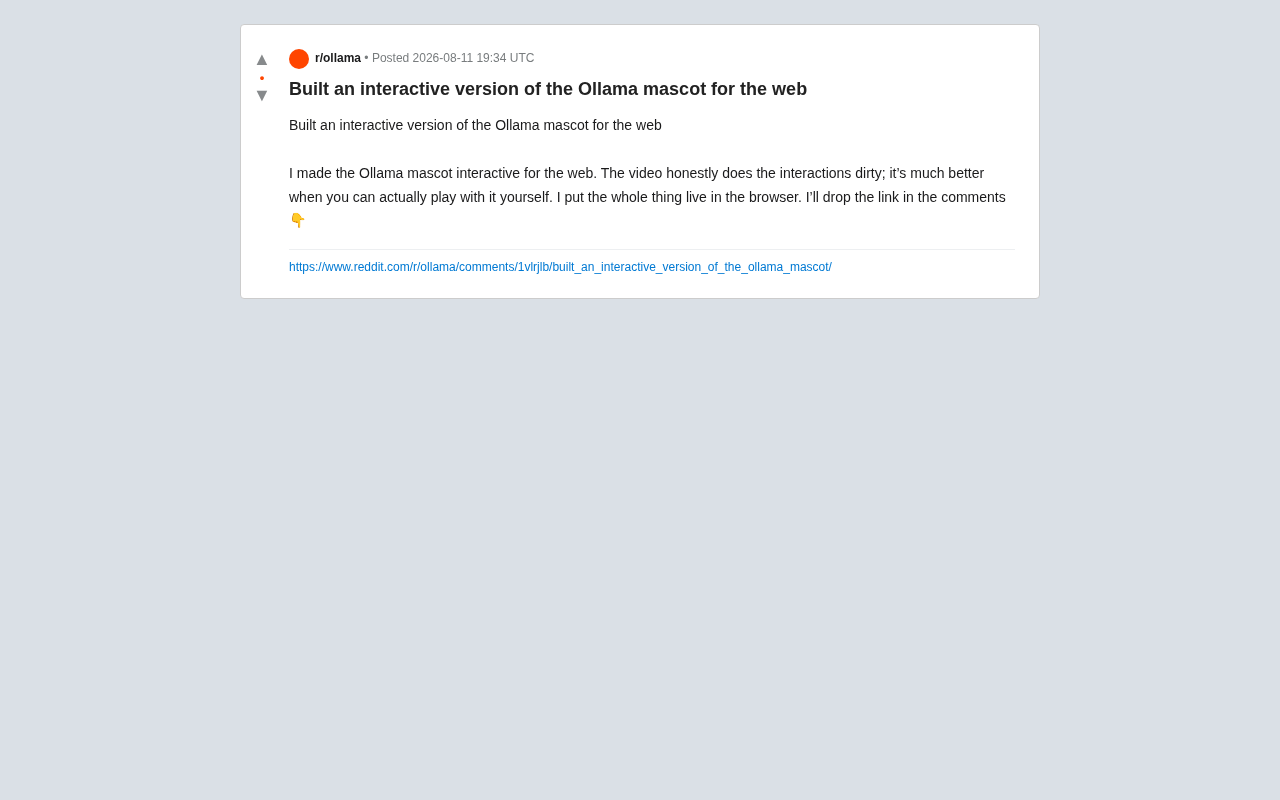
As the author admitted in the post: "The video doesn't really do it justice — it's much better when you actually get your hands on it and play with it yourself." For interactive works based on real-time rendering and user input response, static screenshots or screen recordings indeed struggle to convey their true charm.
The Value of Turning a Brand Mascot into an Interactive Web Experience
Why Do Open-Source Tools Need a Mascot?
In an era where technical tools are increasingly homogenized, brand differentiation is becoming a crucial factor for open-source projects to stand out. Ollama's llama mascot is more than just a logo — it carries community identity and emotional connection.
The tradition of open-source project mascots dates back to Linux's penguin Tux — drawn by Larry Ewing in 1996, this adorable penguin remains the symbol of the entire Linux ecosystem to this day. This tradition emerged for deeper reasons: open-source projects lack the advertising budgets and brand promotion resources of commercial companies, so a highly recognizable, easily shareable visual symbol becomes an effective low-cost strategy for building brand awareness.
When a developer tool has an appealing visual symbol, users' recall and affinity for it increase significantly. This is why more and more open-source projects are investing in mascot design — from GitHub's Octocat to Rust's crab Ferris, to Go's Gopher designed by renowned illustrator Renée French, all are successful examples. Notably, these mascots are more than just logos — they've spawned thousands of community variant versions, merchandise, and various meme creations, becoming core symbols of community identity. Mascots essentially transform abstract technical brands into perceivable emotional carriers, which is especially important in an age of scarce attention.
Technical Implementation of Interactive Web Animations
Transforming a static mascot into an interactive web element involves frontend animation, real-time input response, and physics simulation, among other technologies. While these projects aren't large in scope, they serve as excellent material for practicing web interaction development.
Making a virtual character respond to mouse movements, clicks, and other actions essentially means building a mapping system from user input to visual feedback. On the technical implementation side, several approaches can be used:
- Canvas 2D Rendering: Canvas 2D is a fundamental drawing interface introduced with HTML5. It uses JavaScript to directly manipulate pixel-level 2D graphics rendering, making it suitable for frame animations, particle systems, and simple graphic transformations. With relatively low performance overhead, it's the go-to option for entry-level interactive animations.
- WebGL / Three.js: WebGL (Web Graphics Library) is a browser-based 3D graphics interface built on the OpenGL ES standard, capable of directly leveraging GPU hardware-accelerated rendering for complex 3D scenes and advanced visual effects. Three.js, the most popular abstraction library built on top of WebGL, encapsulates much of the underlying shader programming and matrix computation details, allowing developers to create 3D scenes, lighting, and materials in a more intuitive way.
- CSS Animations + JavaScript: A lightweight approach that leverages CSS properties like
transform,transition, and@keyframescombined with JavaScript event listeners. It's suitable for simple follow and morph effects and has the least impact on browser performance. - Physics Engines (e.g., Matter.js): Matter.js is a 2D physics engine written in pure JavaScript that supports rigid body collisions, constraints, gravity simulation, and other physical effects. It gives mascot movements a realistic physical feel and is commonly used in game development and interactive animations to give elements natural bouncing, swaying, and inertia behaviors.
Open-Source Community Culture and the Spirit of Fan Creation
Perhaps the most commendable aspect of this project isn't its technical difficulty, but rather the open-source community culture it embodies — a spontaneous, passion-driven spirit of fan creation.
The developer had no commercial purpose whatsoever. Simply out of appreciation for Ollama as a tool and fondness for its mascot, they invested their time to create this interactive piece and shared it freely with the entire community. This kind of "creating for the love of it" is the most precious part of the open-source ecosystem.
Fan-made content holds unique ecological significance in open-source communities. Unlike the closed ecosystems of commercial software, open-source projects naturally encourage community members to build upon existing work. This culture manifests not only at the code level through Forks and Pull Requests, but also extends to non-code contributions such as visual design, documentation, and tutorial creation. The Mozilla Foundation has specifically studied the "Participation Ladder" model of open-source communities and found that non-code contributors are often a vital source of community vitality — by lowering a project's cognitive barrier and enhancing its emotional appeal, they indirectly facilitate the involvement of more technical contributors. An open-source project with a rich ecosystem of fan-created content typically indicates that its community has developed a healthy mechanism of self-propagation and self-motivation.
Lessons for Frontend Developers from Small Projects
For many aspiring web frontend interaction developers, these small but beautiful projects offer valuable inspiration:
- Choose a topic you're passionate about: Creating around tools or brands you're familiar with and love helps sustain development motivation. The "intrinsic motivation" theory in psychology suggests that when the act of creation itself brings satisfaction, developers are more likely to enter a flow state and see projects through to completion.
- Focus on the actual interactive experience: As the author emphasized, the core value of interactive works lies in their "playability," not static visual presentation. This is why many excellent frontend interactive pieces pay special attention to response latency, animation smoothness, and feedback immediacy — these details directly determine whether users feel that "this thing has a soul."
- Proactively share with the community: Publishing your work publicly not only generates community feedback but also inspires more people to create. Technical communities on platforms like Reddit, Hacker News, and Twitter/X typically respond positively to these kinds of creative small projects, and this positive feedback loop is a vital driver for a developer's continued growth.
Conclusion
While this is just a small, fun project, it reflects a community vitality and creative enthusiasm that's quite representative. At a time when competition among LLM tools is intensifying, the fact that Ollama has such an active user base willing to create fan works is itself proof of its community's health. The long-term success of an open-source project often depends not only on the quality of the technology itself, but also on whether it can build a community ecosystem filled with belonging and creativity.
For developers, projects like this also remind us that technology doesn't always have to solve serious problems. Sometimes, a little interactive llama that brings a smile to someone's face is equally worth taking seriously. Interested readers can find the author's live demo link in the original post's comments section and try it out for themselves.
Related articles

Bilibili's Hit Dify Tutorial: A Practical Guide to Building 20+ AI Apps from Scratch
A distilled guide to Bilibili's top-rated Dify tutorial: Windows + Docker deployment, MySQL connection, five app types, model integration strategy, and publishing.

Agent Skills Beginner's Guide: From Concepts to Multi-Agent Collaboration in Practice
A comprehensive guide to Agent Skills: core concepts, components, the importance of Description, standardization, beginner learning paths, and multi-agent collaboration.

One Neuron Detects Both Cats and Cars? We Reproduced It and Found a New Explanation
The cat-car neuron reinterpreted: researcher Cammarata argues it distinguishes pointy from round, not cats from cars. We reproduced the experiment and found the new explanation holds on most inputs—but cars are the exception. The interpretability debate continues on language models.