Linus Torvalds' Years-Old Take on NVIDIA Resurfaces and Sparks Debate
An old Reddit post invokes Torvalds' criticism of NVIDIA, mixing unverified rumours with stock claims and reminding readers to separate public-opinion noise from verifiable signals.
Starting from a low-information Reddit post, the article discusses why the open-source community's long-standing dissatisfaction with NVIDIA keeps being reactivated. It reviews Torvalds' public criticism of NVIDIA's insufficient driver support cooperation and notes that it really points to the structural tension between proprietary hardware ecosystems and open-source collaboration models, not to a specific event. The article then analyzes how the post juxtaposes personal rumours with a stock decline and mixes in geopolitical labels, emphasizing the lack of an evidence chain and framing it as typical public-opinion noise. The conclusion: the open-source community's resistance to closed hardware ecosystems is a long-term issue, and readers should distinguish discussed emotions from verified facts.
Screenshot Info
Why a Reddit Post Is Resurfacing an Old Grievance
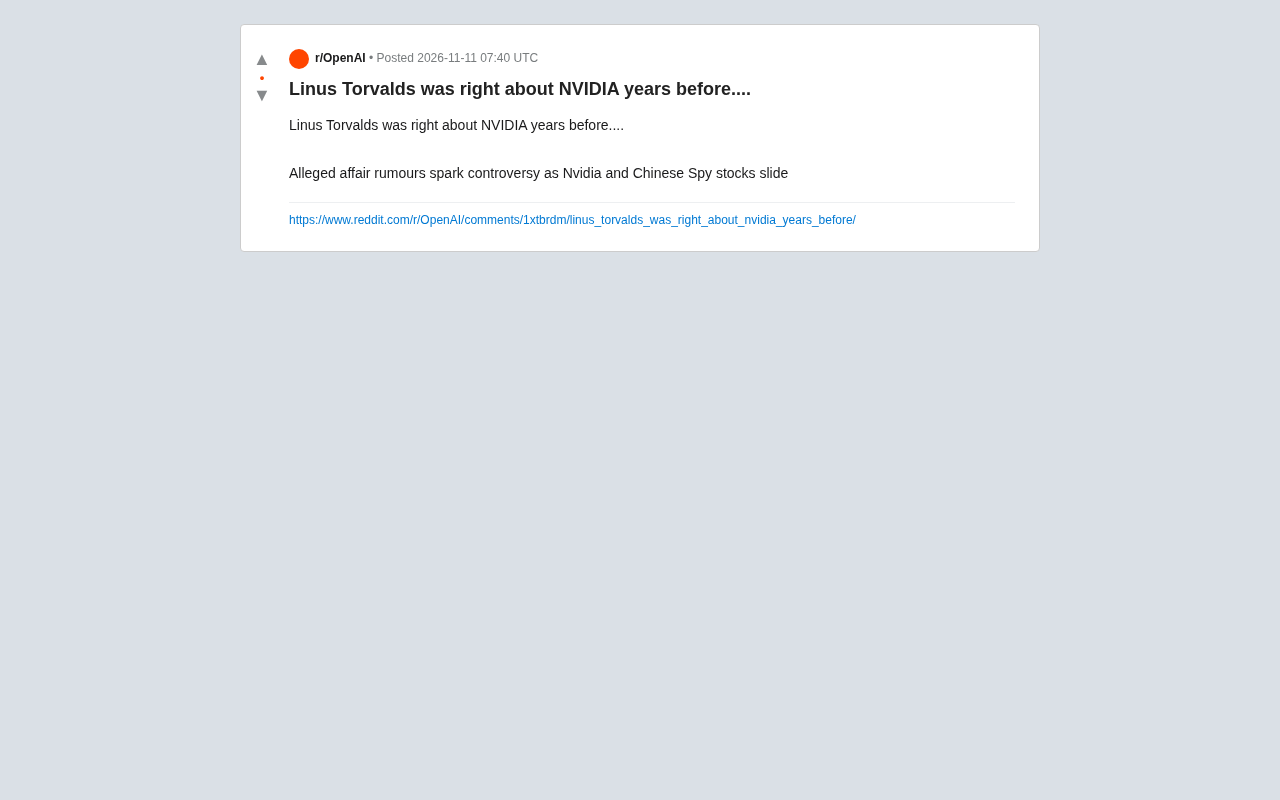
A Reddit post titled "Linus Torvalds was right about NVIDIA years before...." has appeared, with a screenshot of the discussion thread as its image. The post body is extremely short, adding only a single line: "Alleged affair rumours spark controversy as Nvidia and Chinese Spy stocks slide." The information content is minimal, but it has triggered a repeatedly discussed topic: the open-source community's long-standing dissatisfaction with NVIDIA, and how that dissatisfaction gets reactivated in public discourse.
The post itself does not provide a verifiable chain of facts. The so-called "rumours" come with no sourcing, and the claim about stock price fluctuations comes with no data attached. It functions more as an emotional prompt, juxtaposing two things that are not directly related—criticism of NVIDIA's business practices and unverified personal rumours. When reading posts like this, it's necessary to separate "emotions being discussed" from "facts that have been verified."
What Torvalds Actually Said Back Then
To understand why this post resonates, we need to go back to Torvalds' public criticism of NVIDIA. On one public occasion, he expressed his dissatisfaction with how NVIDIA cooperates with the open-source community in extremely blunt terms, with the core issue being driver support: the Linux kernel community has long held that NVIDIA is insufficiently cooperative on open-source drivers, which limits users' experience when using its hardware on Linux.
That statement was later turned into a huge number of memes and short videos, becoming a cultural symbol in the open-source world. Its传播力 comes from two things: first, the speaker is the creator of Linux; second, the target of criticism was a chip company whose market value and influence were both rising at the time. Looking back years later, the reason this statement is repeatedly quoted is not that Torvalds foresaw some specific event, but that it represented a structural tension—the friction between proprietary hardware ecosystems and open-source collaboration models.
To understand the technical background of this criticism, one needs to know the Linux kernel's "upstream first" principle: the community expects hardware vendors to merge driver code directly into the kernel mainline, where kernel maintainers uniformly review and evolve it, rather than releasing it as standalone modules or closed-source binaries. NVIDIA long adopted the latter approach; after users installed its official drivers, kernel upgrades often led to module compilation failures or graphics stack conflicts, an experience problem that was especially prominent among distribution users. It was not until around 2022 that NVIDIA began releasing some open-source code for kernel-mode modules, but firmware and user-space components (such as the CUDA runtime and graphics libraries) remained proprietary. This structural arrangement is the real basis for Torvalds' criticism, and it also explains why that statement struck such a broad chord.
The Old Driver Problem and the Reality of the Ecosystem
NVIDIA later made adjustments on open-source drivers, gradually advancing open-source work on kernel-mode drivers, but the community still debates the degree of openness of its firmware and user-space components. The technical backdrop of such debates is that the GPU ecosystem relies heavily on proprietary stacks, and it is very difficult for the open-source community to independently improve support without vendor cooperation.
From this perspective, Torvalds' criticism was less aimed at a particular company than at a model. Any hardware vendor that adopts a closed strategy at key links will encounter similar resistance in the open-source community. NVIDIA is simply the most visible one, because it simultaneously occupies a core position in AI compute, and any discussion about it is easily amplified.
The Mixed Effect of Rumours, Stock Prices, and Public Opinion
Returning to that Reddit post, it places "personal rumours" and "stock decline" in the same sentence, creating a causal implication. But from an information-structure standpoint, no evidence is given to connect the two. Tech company stock prices are affected by multiple factors, and attributing short-term fluctuations to unverified rumours is a typical narrative simplification.
More noteworthy is the phrase "Chinese Spy stocks." It mixes geopolitical labels with stock discussion; the emotional concentration is high, but the verifiable content is very limited. Such wording spreads easily on social platforms, yet it is very difficult to use as a basis for analysis. For people following the AI chip industry, distinguishing "public-opinion noise" from "verifiable signals" is a basic skill.
In the semiconductor and AI sectors, stock prices are inherently highly sensitive to news: earnings expectations, export control policies, changes in major customer orders, and supply chain capacity information can all cause significant fluctuations within a short period. Attributing a one-day decline to an unnamed "rumour" is statistically almost untenable, because it lacks the time window, control group, and significance testing required for event studies. If readers want to judge such claims, they should at least check whether other public information that day (such as regulatory announcements, analyst rating changes, or overall sector index movements) could explain the fluctuation, rather than accepting the single-line narrative that "rumours caused the decline."
Consensus and Disagreement Across Multiple Sources
Looking at the Reddit discussion, Torvalds' public statement, and subsequent progress on open-source drivers together, some cross-verification emerges: the open-source community's criticism of NVIDIA's driver strategy has existed for a long time, and this repeatedly appears across different sources, so it can be regarded as consensus. The disagreement lies in how to evaluate the practical significance of this criticism—one side sees it as legitimate pressure from open-source ideals on a closed ecosystem, while the other side believes that commercial companies need to balance patents, security, and engineering costs when opening up drivers, and that the criticism has been overly moralized.
As for the rumours and stock price connection mentioned in the post, there is currently only vague wording from a single source, with no cross-verification, so it should not be cited as fact.
What This Post Really Reminds Us Of
Its value does not lie in providing new information, but in demonstrating a传播 mechanism: a harsh statement from years ago can be reactivated at a new controversy point and become a vehicle for emotion. For content consumers, when seeing posts like this, they can first ask three questions—what was the context of the original statement, does the newly added accusation have a source, and is there data to support the stock price claim?
For NVIDIA and the entire AI hardware industry, open-source collaboration remains an issue that will not disappear. The more concentrated compute power becomes, the stronger the community's demand for openness, and this tension will continue to surface in various forms in the future. The reason Torvalds' statement is still being quoted is precisely that the problem itself has not yet been fully resolved.
One-line Summary
An old Reddit post uses Torvalds' criticism of NVIDIA to mix unverified rumours with stock price claims, reminding readers to distinguish public-opinion noise from verifiable signals.
Paragraph Summary
The article starts from a Reddit post with very little information and discusses why the open-source community's long-standing dissatisfaction with NVIDIA is repeatedly reactivated. The author reviews Torvalds' public criticism of NVIDIA's insufficient cooperation on driver support, pointing out that it was really aimed at the structural tension between proprietary hardware ecosystems and open-source collaboration models, rather than at a specific event. The article then analyzes the post's narrative technique of juxtaposing personal rumours with a stock decline and mixing in geopolitical labels, emphasizing that it lacks a chain of evidence and is a typical example of public-opinion noise. The final conclusion is that the open-source community's resistance to closed hardware ecosystems is a long-term issue, and readers should distinguish between emotions being discussed and facts that have been verified.
Related articles

Pure-Code Video Generation Tested: Which AI Model Actually Follows Instructions?
A Bilibili creator tested three AI models' pure-code video generation with unified prompts and three revisions each: Xiaonaomao has a high ceiling but lacks stability, GPT 6.2 Extra models well but only follows half the instructions, and OPAS 5.5 remains the benchmark.

GPT-6 Six-Tier Hands-On Test: Astra Ultra Dominates but Bills Double
GPT-6 six-tier test: Astra Ultra sweeps 3:0 in 3D tasks thanks to sub-agents and runs 14% faster, but hidden backend bills make its real cost 2.6x single-threaded.

GPT-6.2 Astra vs Fable 5.2: Huge Cost-Efficiency Gap Across 12 Real-World Tests
Bilibili creator tests GPT-6.2 Astra vs Fable 5.2 across 12 real tasks: Fable wins 7-5 but costs 7.2x more and takes nearly 5x longer. Token efficiency emerges as the key selection metric.