Livenerf: Real-Time Tracking of Whether AI Models Are Being Secretly Nerfed
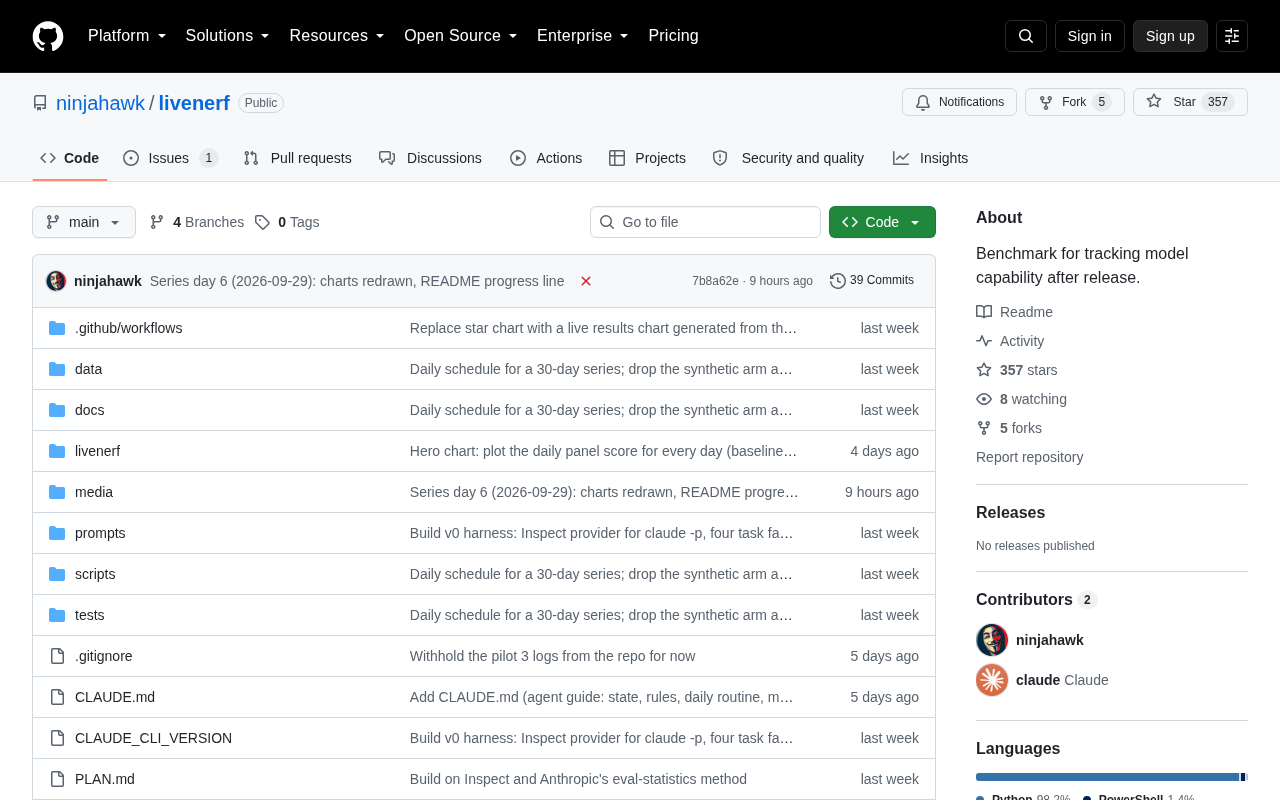
Livenerf continuously benchmarks closed-source LLMs to detect silent performance degradation over time.
Livenerf is an open-source project that gained traction on Hacker News for tracking whether LLMs like Claude Opus are being silently "nerfed." It replaces one-time evaluations with continuous benchmarking, repeatedly running fixed test suites to detect performance drift. The debate around closed-source model degradation is ongoing: proponents cite vendor cost incentives; skeptics point to user psychology and task drift. The project faces challenges including sampling randomness, test set contamination, and attribution difficulty — making its outputs observational signals rather than definitive proof. For developers, the key takeaway is to build regression tests into AI application workflows.
A Project Dedicated to Monitoring AI Model "Nerfs"
Livenerf is an open-source project that recently gained significant traction on Hacker News (315 points, 136 comments), built around a provocative premise: has Claude Opus 4.5 actually been "nerfed"?
The term "nerf" comes from the gaming community, where it refers to developers deliberately weakening a character or tool — usually for balance or cost reasons. Over the past couple of years, AI users have borrowed the word to describe a widespread subjective experience: a model you've been using for a while starts to feel noticeably dumber. Livenerf attempts to transform this vague intuition into continuously trackable, objective data.
Why "Model Degradation" Has Become an Unavoidable Controversy
Whether closed-source LLMs get quietly weakened after release has been a persistent debate in developer communities. Those who believe in "stealth nerfs" argue that model vendors, facing enormous inference cost pressures, have strong incentives to cut per-call expenses through techniques like quantization, distillation, routing requests to smaller models, or reducing context processing — changes that rarely get announced publicly.
Skeptics counter that the perceived "dumbing down" is largely a psychological effect: users are more forgiving of model outputs during the honeymoon period, and it's only as tasks grow more complex that the model's actual capability limits become apparent. Changes in prompting habits and task distribution drift can also create the illusion that things "used to work better."
Because neither side has access to public, continuous quantitative evidence, continuous benchmark monitoring projects like Livenerf fill a genuine gap — they push "I think it got dumber" from an unfalsifiable feeling toward something verifiable.
Livenerf's Approach: Continuous Benchmarking, Not One-Time Evaluation
Traditional LLM evaluations (like the various benchmark leaderboards) are typically run once at model launch, producing a static score. But the core issue with "nerfing" is precisely the time dimension: does a model's real-world performance change over time?
Livenerf's value proposition lives in the word "live." By repeatedly running a fixed test suite against the same model at different points in time, it attempts to capture fluctuations in the performance curve. If a model shows a systematic score decline after a certain point, that at least provides a signal worth investigating.
This "continuous monitoring" methodology is far more aligned with users' actual concerns than point-in-time evaluation. Rather than chasing the highest absolute benchmark score, it focuses on stability and consistency — for developers building production applications on top of APIs, predictable model behavior often matters more than peak capability.
The "silent updates" of closed-source models are the key structural context here. Unlike open-source models, what Anthropic, OpenAI, and similar companies expose to the outside world is an API endpoint. Callers typically access models via aliases (like claude-opus-4-5), while the underlying weights, inference configuration, and system prompts remain opaque. This means vendors can quantize model weights (reducing from 16-bit floats to 8-bit or even 4-bit integers to save VRAM), swap in smaller distilled models for a portion of requests, or adjust safety filter thresholds — all without changing the endpoint name, and all completely invisible to the caller. This structural information asymmetry is precisely why third-party continuous monitoring has become one of the few viable paths for the user community to achieve informational parity.
The Inherent Methodological Challenges
It's worth being clear-eyed about several interference factors that are difficult to fully eliminate in this kind of monitoring:
- Sampling randomness: LLM outputs are inherently stochastic. Even with a fixed temperature, the same question can yield different answers across runs — distinguishing "genuine decline" from "normal variance" requires substantial sample sizes.
- Test set contamination and ossification: Fixed test sets enable longitudinal comparison, but models may have "memorized" them or vendors may optimize against them specifically, causing their representativeness to decay over time.
- Attribution difficulty: Even if a score drop is observed, it's hard to conclude the model was weakened versus changes in the API gateway, system prompt adjustments, or tightened safety filters.
These challenges don't negate the project's value, but they remind users: Livenerf provides observational signals, not definitive verdicts. Treating it as a community oversight tool is more appropriate than treating it as the final word.
It's worth noting that temperature is the core parameter controlling output randomness in LLMs, typically ranging from 0 to 1 (some implementations allow higher values). The closer temperature is to 0, the more deterministic each output; the closer to 1, the more varied. Even with temperature fixed at 0, differences in floating-point computation and hardware batching can still produce inconsistent results — which is why rigorous benchmarking typically runs the same prompt dozens or even hundreds of times, averaging results or measuring pass rates rather than relying on a single output. Additionally, "test set contamination" refers to the possibility that a model has already seen the answers to certain benchmark questions during training, inflating its apparent performance in ways that don't reflect genuine generalization ability — a long-standing concern with static leaderboards that applies equally to long-running continuous benchmarks.
Implications for Developers and the Industry
The fact that Livenerf attracted hundreds of points on Hacker News is itself a signal: as more and more products are built on top of closed-source LLMs, users' demand for transparency around model behavior is rising fast.
For developers, the practical takeaway is: don't rely on intuition alone to assess model health. Build your own regression tests. For critical business workflows, run a fixed set of evaluation cases on a regular schedule — if a vendor update causes behavioral drift, you'll catch it immediately and can adapt. This is essentially bringing the software engineering concept of "regression testing" into AI application operations.
For the industry as a whole, third-party continuous monitoring projects like this play the role of "community watchdogs." Their existence creates pressure for model vendors to be more careful about silent updates, and gradually transforms "nerfing" — a debate that has long existed at the level of rumors and anecdote — into a public infrastructure that is data-driven and discussable.
Conclusion
Livenerf addresses more than just the specific question of "has Opus 4.5 been nerfed" — it represents a stance: faced with closed-source, black-box, frequently updated LLMs, the user community is using open-source tools to fight for the right to be informed. Whatever the data ultimately shows, the effort to convert subjective complaints into continuous quantitative monitoring is an indispensable part of AI applications maturing as a field.
Related articles

M&M's Spent Millions Replacing Artificial Blue Dye — Why Is It So Hard?
Mars spent millions trying to replace artificial blue dye in M&M's with spirulina, but thick material clogs pipes and residue risks mold, forcing a full production-line rebuild. Here's the engineering behind the reformulation.
Teammate Wanted for Meta Global AI Developer Hackathon: Computer Vision & Medical AI
A Reddit developer seeks teammates for the Meta Global AI Developer Hackathon, focusing on computer vision and medical AI. This article analyzes the track logic, skills-complementarity needs, and topic selection strategy behind this teaming signal.
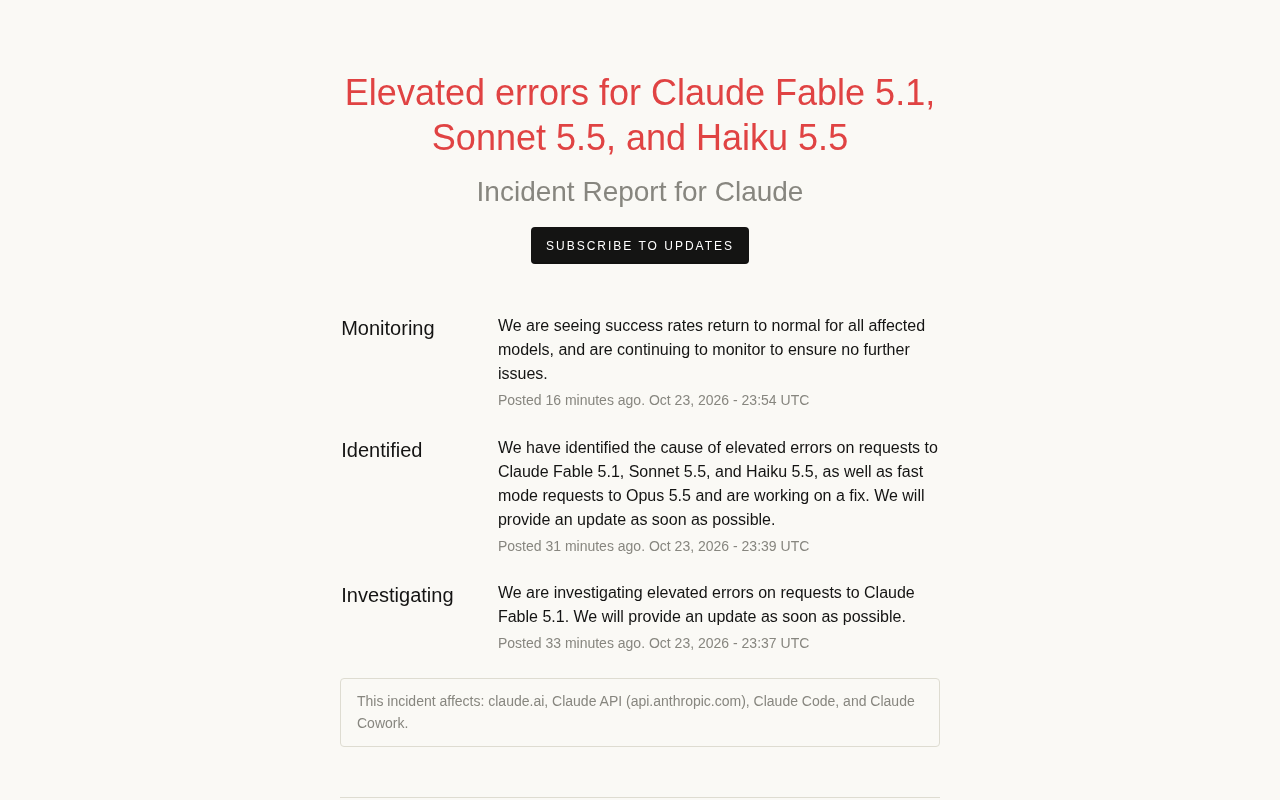
Multiple Claude Models Hit by Errors: A Postmortem of Fable 5.1, Sonnet 5.5, and Haiku 5.5
Claude Fable 5.1, Sonnet 5.5, Haiku 5.5, and Opus 5.5 fast mode saw elevated errors; Anthropic identified and resolved the issue in 17 minutes. This postmortem covers the timeline, the technical reasons for the multi-model cascading failure, and practical lessons for retry and degradation strategies.