llama.cpp Adds GLM-5.3-Flash Support: Run Zhipu's New Model Locally

llama.cpp receives a PR adding GLM-5.3-Flash support, enabling local inference on consumer hardware.
The open-source inference framework llama.cpp received PR #27773 from community developer timkhronos, adding support for Zhipu's GLM-5.3-Flash (codenamed GLM5-Next). Through quantization and CPU/GPU hybrid inference, llama.cpp brings LLM inference within reach of consumer hardware. The lightweight Flash variant is a natural fit for local deployment. Once merged, the model can be packaged in GGUF format and used in tools like Ollama and LM Studio. The PR is still in the merge process, so stable availability awaits an official release.
llama.cpp Gets GLM-5.3-Flash Support
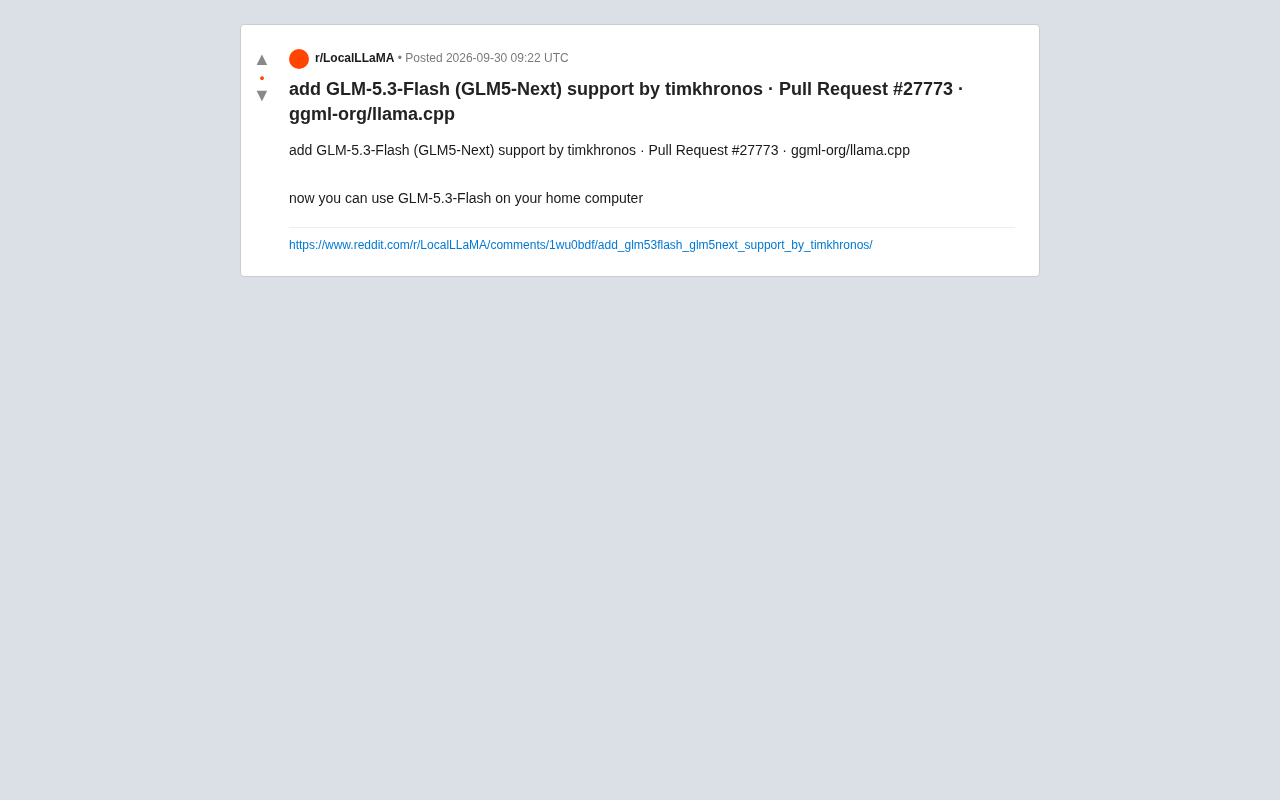
The open-source inference framework llama.cpp recently received a noteworthy Pull Request (#27773), submitted by developer timkhronos, adding support for GLM-5.3-Flash (internally codenamed GLM5-Next). This means users will be able to run this model directly on their home computers without relying on cloud-based APIs.
For the community focused on local LLM deployment, this is a genuinely valuable development. As one of the most widely adopted lightweight LLM inference engines available, llama.cpp's native support for a new model architecture is often the critical step that brings that model into mainstream local deployment.
Why This PR Is Worth Paying Attention To
The Significance of Moving from Cloud to Local
Historically, running models from the Zhipu GLM family required most users to rely on official APIs or cloud services. The core value of llama.cpp lies in bringing the cost of LLM inference down to a level that consumer-grade hardware can handle — through quantization, memory mapping, CPU/GPU hybrid inference, and a host of other optimizations, it enables models that once required data-center-class GPUs to run on ordinary desktops or even laptops.
Once support for GLM-5.3-Flash is officially merged into the main branch, the community can quantize and package the model in GGUF format, then load and use it in local environments. The contributor summed up the significance of this change in one line: "now you can use GLM-5.3-Flash on your home computer."
GGUF (GPT-Generated Unified Format) is the standard file format used within the llama.cpp ecosystem for storing and distributing quantized models. Designed by llama.cpp project maintainer Georgi Gerganov, it has become the de facto standard in the local LLM community. It packages model weights, hyperparameters, tokenizer vocabulary, and all other necessary information into a single file, and supports multiple quantization precisions (such as Q4_K_M and Q8_0), allowing users to choose the appropriate compression level based on their available VRAM. Quantization works by compressing weights originally stored in float16 or bfloat16 down to fewer bits (such as 4-bit), dramatically reducing memory footprint and inference latency at the cost of a small amount of precision. Local AI clients aimed at general users — including Ollama, LM Studio, and Jan — all use llama.cpp as their underlying inference engine and consume model files in GGUF format directly. This makes llama.cpp's native support a prerequisite for these tools to be able to use any given model.
The Role of the Flash Variant
Naming-wise, "Flash" typically denotes a lighter, faster-responding variant within a model family — one that trades off some parameter count in exchange for inference speed. These models are naturally better suited for local deployment scenarios, as they impose lower demands on VRAM and compute, and can deliver acceptable response speeds on modest consumer hardware. This is precisely why Flash variants tend to be the community's priority target when pushing for local support.
A Textbook Example of Open-Source Community Collaboration
This model support wasn't pushed by the official team — it was contributed by a community developer via a Pull Request. This is a testament to the vitality of the llama.cpp project ecosystem: new model architectures emerge constantly, and much of the framework-level adaptation work is driven by enthusiastic contributors.
From submission to final merge, a PR typically goes through code review by maintainers, architectural compatibility verification, and inference correctness testing. For new models, the implementation work often involves multiple technical details: tensor name mapping, attention mechanism adaptation, tokenizer handling, and more. Whether a PR gets merged smoothly depends on code quality and how well it integrates with the existing architecture.
Tensor name mapping is one of the most common technical hurdles in new model adaptation. Different model training frameworks (such as PyTorch and JAX) use different naming conventions for layer parameters in their exported weight files, while llama.cpp has its own fixed internal layer naming system. Adaptation requires writing conversion scripts that map each key in the original weights to the name expected by the framework. In addition, the GLM family has historically used its own unique RoPE (Rotary Position Embedding) variant and multi-query attention mechanism — these differences need to be implemented at the C++ level rather than simply reusing existing architecture code paths. Tokenizer handling is equally important: the GLM series uses a SentencePiece-based tokenizer that includes several special control tokens (such as
[gMASK]and<sop>). Correctly handling these details within llama.cpp's tokenizer abstraction layer directly affects the correctness of the model's output.
What This Means for Local Deployment Users
For users who want to run large models locally, this news carries two signals:
First, new models from the GLM family are being integrated into the mainstream open-source inference ecosystem. The possibility of obtaining a GGUF-quantized version and calling it from llama.cpp-based tools like Ollama or LM Studio is now opening up.
Second, the pool of locally available model options continues to grow. As more vendor models gain llama.cpp support, users' needs around privacy protection, offline availability, and zero usage cost can be better met.
It's worth noting that a PR being in the merge process does not mean the feature is already stable and ready for use. Interested users should keep an eye on the PR's merge status, and once it makes it into an official release, experiment with the appropriate quantization precision for their hardware.
Summary
GLM-5.3-Flash landing in llama.cpp represents another expansion of the local LLM ecosystem. It reflects the continued iteration of the Zhipu GLM series, and once again demonstrates the key role the open-source community plays in driving models toward local deployment. For developers and enthusiasts who prioritize local deployment and data privacy, this is definitely a development worth watching.
Related articles

Free Unlimited Claude Code Solution: Agnes AI + CC Switch Setup Guide
No paid subscription needed — pair the free AI platform Agnes AI with the open-source tool CC Switch to provide a backend for Claude Code, enabling unlimited free calls to text, image, and video models. This guide covers the full setup, test results, and usage boundaries.

A Complete Zero-Cost Guide to Getting Started with Claude Code for Beginners in China
A beginner's guide to Claude Code for users in China: two installation methods (command line and IDE plugin), full configuration steps for replacing the official API with the free domestic LongCat model, and a hands-on demo of building a small tool with natural language, plus tips.

When the NSA Gets Involved: The AI Supply Chain Crisis Behind Open-Source CVEs and API Key Hijacking
Multiple open-source projects disclosed severe CVEs in one day, PHP flaws alarmed the FBI, and Railway and OpenCode were breached with API keys stolen. This article breaks down the vulnerability window, AI-accelerated exploitation, and the AI supply chain crisis behind the API key black market, with a developer defense checklist.