LLM Agents Replace Teleoperation: Robot Data Collection Costs Plummet

LLM coding agents reconstruct tasks in simulation and generate real-ready data, cheaper than teleoperation and with better generalization.
PyRUA-DataFarm proposes replacing teleoperators with coding agents to reconstruct tasks in simulation and generate data directly usable for real robot training. The agent writes the scene, expert controller, and success predicate; the simulator provides precise actions; a video model conditioned on real images renders photorealistic multi-view videos; and an independent reviewer certifies quality. On five real tasks, policies trained on DataFarm data achieved success rates comparable to teleoperation data (93 vs 84/100) and generalized better under unseen perturbations (87 vs 46). Cost-wise, task adaptation averages $21 in API fees plus $5 in rendering contract fees, with each additional episode costing only $0.80, for a total of $107 for one hour of three-view data—below China teleoperation quotes and North America labor costs. The research demonstrates the cost-reduction potential of LLM agents in robot data collection.
Robot demonstration data collection has long relied on teleoperation, but every demonstration episode consumes both robot and operator time, and new tasks often require starting from scratch. A study titled "PyRUA-DataFarm: LLM Agent as a Cost-Efficient Teleoperator for Real-Ready Robot Data" proposes a new approach: let a coding agent take over the teleoperator's job, reconstruct tasks in simulation, and generate data that can be used directly for real robot training.
Core Idea: Reconstructing Tasks with a Coding Agent
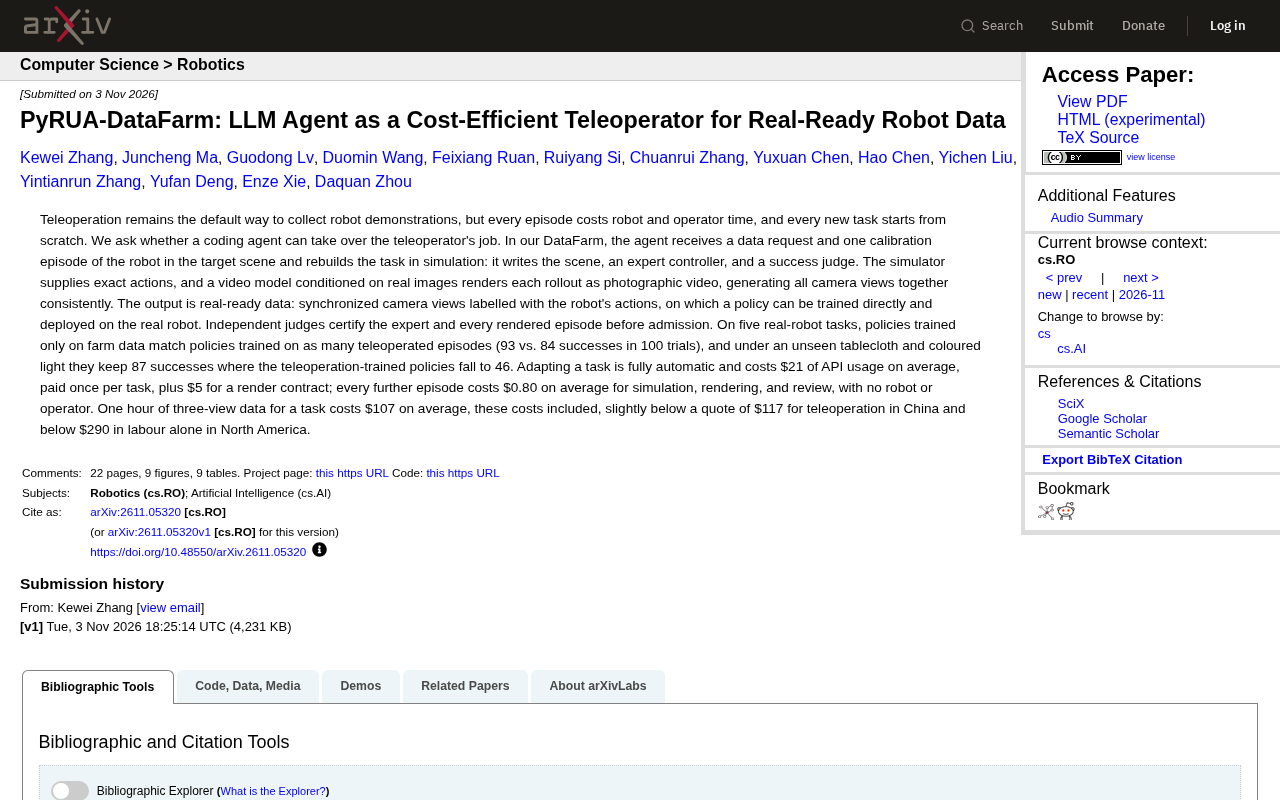
The DataFarm workflow is as follows: the agent receives a data request along with a calibration clip of the robot in the target scene, then reconstructs the task in simulation—it writes the scene, the expert controller, and the success predicate. The simulator provides precise actions, while a video model conditioned on real images renders each rollout as a photorealistic video and consistently generates all camera views. The output is "real-ready" data: synchronized camera views annotated with the robot's actions, on which a policy can be trained directly and deployed to the real robot. An independent reviewer certifies the expert and each rendered clip before acceptance.
According to the paper, this process is fully automatic and requires no human intervention. The agent essentially plays the role of a teleoperator, but produces simulated data, avoiding real robot wear and operator time consumption.
Teleoperation is the traditional method of collecting robot demonstration data, in which an operator uses a controller, VR device, or master-slave manipulator to control the robot in real time to complete a task, while recording joint angles, end-effector poses, and camera images. Its core advantage is that data comes directly from the real robot, with actions and observations strictly synchronized, so policies can be trained on it directly. However, teleoperation has clear bottlenecks: each demonstration episode requires both the robot and the operator to be online simultaneously, and collection speed is limited by operator skill; running a real robot for long periods wears down hardware; and new tasks often require redesigning the scene and demonstration workflow, making it hard to scale. It is against this backdrop that DataFarm proposes replacing the teleoperator with a coding agent, shifting data collection from the physical world to the simulated world and thereby avoiding hardware wear and labor costs.
The video model renders simulated rollouts conditioned on real images is the key step that enables DataFarm's "real-ready" data. Specifically, the simulator generates action sequences and low-dimensional observations based on the scene and expert controller written by the agent, while the video model uses one or more real images of the target scene as a condition to render the simulated rollout frame by frame into a photorealistic video, ensuring that multiple camera views are temporally consistent. The advantage of this approach is that action annotations come directly from the simulator—precise and requiring no manual labeling—while visual appearance is transferred from real images by the video model, narrowing the visual gap between simulation and reality. This technical route is a hybrid paradigm of "simulation generation + real-image-conditioned rendering," distinct from pure simulation rendering or pure real-data collection, and its fidelity depends on the video model's ability to reconstruct the target scene.
Performance Validation: On Par with or Better Than Teleoperation Data
The study tested on five real robot tasks. Policies trained solely on DataFarm data performed comparably to policies trained on an equal number of teleoperation episodes: in 100 trials, the former succeeded 93 times and the latter 84 times. More importantly, under unseen tablecloths and colored lighting conditions, the DataFarm-trained policy maintained 87 successes, while the teleoperation-trained policy dropped to 46. This suggests that simulated data may yield better generalization.
The paper does not explain in detail the reason for the generalization advantage, but it can be speculated that the diversity of video model rendering and the precise annotations in simulation help the policy learn more robust features.
Policy transfer refers to the degree to which a policy trained in simulation or a source domain retains its performance when deployed to the real robot target domain. The policy trained on DataFarm data achieved a 93/100 success rate on the real robot, indicating that its data has good transferability. Transfer performance is typically affected by visual domain differences (such as lighting, texture, and camera parameters) and action distribution differences. DataFarm renders conditioned on real images via the video model, bringing it visually close to the target domain; meanwhile, the actions provided by the simulator are precise and synchronized with observations, reducing action-observation misalignment. Notably, under unseen tablecloths and colored lighting conditions, the DataFarm policy maintained an 87/100 success rate, while the teleoperation policy dropped to 46/100, suggesting that the diversity of video model rendering may act as data augmentation, making the policy more robust to visual perturbations.
Cost Comparison: Significantly Lower Than Traditional Teleoperation
Cost is a major highlight of this research. Task adaptation is fully automatic, costing an average of $21 in API usage fees, paid once per task, plus a $5 rendering contract fee; thereafter, each additional episode costs an average of $0.80 for simulation, rendering, and review, with no robot or operator needed. The average cost of one hour of three-view data for a task is $107 (including the above fees), slightly below the China teleoperation quote of $117, and also below the North America labor-only cost of $290.
This cost structure means that for tasks requiring large amounts of data, DataFarm can substantially reduce marginal costs. However, the initial API and rendering contract fees are fixed investments, making it suitable for repetitive tasks.
API usage fees and rendering contract fees constitute the two parts of DataFarm's cost structure. API usage fees refer to the inference costs incurred by calling the LLM coding agent to write the scene, expert controller, and success predicate, averaging $21 per task and representing a one-time task adaptation investment. Rendering contract fees refer to the expenditure for calling the video model to render simulated rollouts into photorealistic multi-view videos, at $5 per task, also a one-time fixed cost. Thereafter, each additional episode costs only $0.80, covering the marginal costs of simulation, rendering, and review. This "high fixed cost, low marginal cost" structure means that the more times a task is repeated, the lower the average cost. For tasks requiring large numbers of demonstration episodes, DataFarm's economics are significantly better than teleoperation; but for one-off tasks or tasks with very little data, the initial investment may weaken its cost advantage.
Limitations and Outlook
The paper does not mention the impact of video model rendering fidelity on policy transfer, nor the quality requirements for calibration clips. In addition, the certification standards of the independent reviewer are not described in detail. Nevertheless, this research demonstrates the potential of LLM agents in the field of robot data collection, offering a new path to lowering the data barrier.
In the future, if video models and simulators improve further, DataFarm may be able to cover more complex tasks and scenes. For the robot learning community, this is undoubtedly a direction worth watching.
One-line Summary
LLM coding agents reconstruct tasks in simulation and generate real-ready data, at lower cost than teleoperation and with better generalization.
Paragraph Summary
PyRUA-DataFarm proposes replacing teleoperators with coding agents to reconstruct tasks in simulation and generate data that can be used directly for real robot training. The agent writes the scene, expert controller, and success predicate, the simulator provides precise actions, a video model conditioned on real images renders photorealistic multi-view videos, and an independent reviewer certifies quality. On five real tasks, policies trained on DataFarm data achieved success rates comparable to teleoperation data (93 vs 84/100), and generalized better under unseen perturbations (87 vs 46). In terms of cost, task adaptation averages $21 in API fees plus a $5 rendering contract fee, with each additional episode costing only $0.80, for a total cost of $107 for one hour of three-view data—lower than China teleoperation quotes and North America labor costs. This research demonstrates the cost-reduction potential of LLM agents in robot data collection.
Related articles

9 AI Subscription Plans Compared: The Real Cost Per 100M Tokens Revealed
Bilibili creator tests 9 AI subscription plans from Volcano, Alibaba, Tencent, Baidu, Zhipu, Xiaomi, MiniMax and more, converting them all to real cost per 100M tokens, breaking down fixed-quota vs. three-tier coefficient billing and how caching, time-of-day discounts, and window limits affect actual quota.

Vibe Coding for Beginners: Expressing Intent Instead of Handwriting Code
What is Vibe Coding? A 137-episode Bilibili course defines it: the core is expressing intent, not writing code. This article analyzes Vibe Coding's productivity logic, target audience, and entry expectations to help beginners decide if it's worth learning.

LangChain Beginner's Guide: An Agent Development Roadmap from LangGraph to Deep Agents
Clarify the encapsulation relationship among LangChain, LangGraph, and Deep Agents, and master the learning path and selection logic for agent development frameworks—suitable for beginners in large model development.