LLM Agents Through the Lens of Statistical Physics: How Emergent Potential Shapes Reasoning Behavior
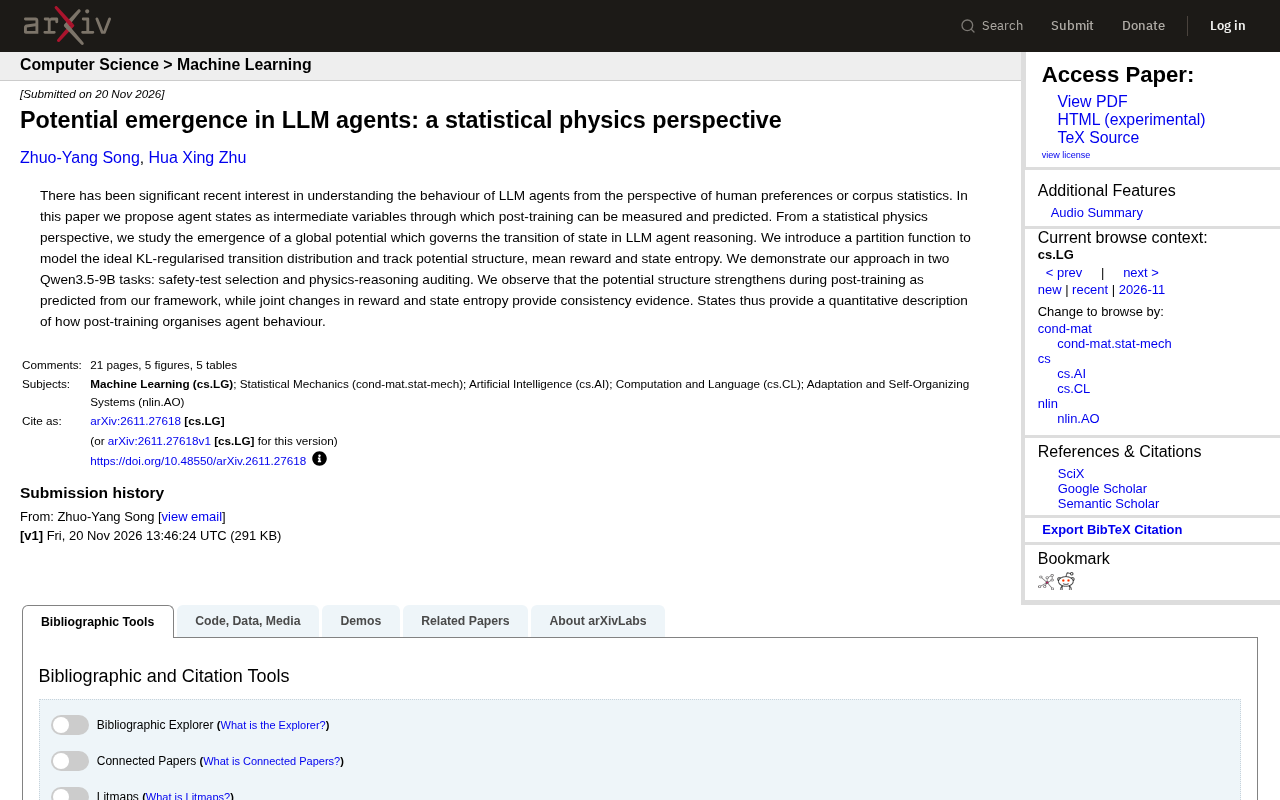
The paper proposes a statistical physics framework using agent states as intermediate variables to quantify how post-training shapes behavior.
This research proposes an interdisciplinary framework that treats LLM agent internal states as intermediate variables and uses statistical physics to measure and predict post-training effects. The core insight is that state transitions during reasoning are governed by a global "potential" that emerges during post-training. Researchers introduce a partition function to model KL-regularized transition distributions and track changes in potential structure, average reward, and state entropy. On Qwen3.5-9B safety test selection and physical reasoning audit tasks, potential structure strengthens during post-training with consistent evidence from joint changes in reward and state entropy. State entropy and potential structure can serve as early warning signals for post-training data or reward design issues. The perspective is still early-stage with limited experimental scale and universality awaiting broader validation.
LLM Agents Through the Lens of Statistical Physics: An Emerging Research Perspective
Recently, researchers have begun trying to understand the behavior of large language model agents from the perspective of human preferences or corpus statistics. A new paper proposes a more ambitious framework: treating agent states as intermediate variables and using the language of statistical physics to measure and predict the effects of post-training.
The core insight of the research is that the state transitions of an agent during reasoning can be governed by a global "potential." This potential is not artificially designed but emerges spontaneously during post-training. By introducing a partition function to model the ideal KL-regularized transition distribution and tracking changes in potential structure, average reward, and state entropy, the researchers quantify how post-training organizes agent behavior.
The significance of this framework lies in the fact that it moves beyond black-box "input-output" evaluation and attempts to find predictable patterns from the statistical regularities of internal states.
How Potential Structure Strengthens During Post-Training
The paper validates the framework on two Qwen3.5-9B tasks: safety test selection and physical reasoning audit. These two tasks represent the agent's capabilities in safety alignment and complex reasoning, respectively.
The experiments reveal a key phenomenon: the potential structure gradually strengthens during post-training, which is consistent with the framework's predictions. On the other hand, the joint changes in reward and state entropy provide additional consistent evidence. In other words, post-training not only improves task performance but also shapes the geometric structure of the agent's internal state space — transitions between states become more "rule-governed."
From the perspective of statistical physics, this is similar to a system gradually forming an energy landscape during annealing. The agent's reasoning path is no longer a random walk but is guided by an emergent potential field toward high-reward regions.
Partition function is a core concept in statistical physics, defined as the sum of Boltzmann factors over all possible microstates of a system, i.e., ( Z = \sum_i e^{-E_i/kT} ). It serves as a normalization constant that makes the probability distribution sum to 1, while also encoding all thermodynamic information of the system — free energy, entropy, average energy, etc., can all be derived from it. In the framework of this paper, the partition function is used to construct the KL-regularized transition distribution: the probability of the agent transitioning from one state to another is modeled in an exponential form related to the "potential," then normalized by dividing by the partition function. In this way, the agent's state transitions are formalized as a statistical ensemble similar to a Boltzmann distribution, and the role of post-training is reflected in the adjustment of the shape of the potential field. Understanding the partition function helps grasp why this framework can simultaneously characterize the trade-off between reward (corresponding to energy) and entropy (corresponding to state diversity).
KL-regularized transition distribution refers to adding the Kullback-Leibler divergence as a penalty term when optimizing state transition probabilities, constraining the new distribution from deviating too far from the reference distribution. KL divergence measures the difference between two probability distributions, and here it acts as a "trust region": post-training allows the agent to adjust its behavioral strategy, but the magnitude of each step's adjustment is constrained to avoid policy collapse or excessive exploration. In the statistical physics analogy, the KL regularization term is similar to an entropy regularization or temperature term, controlling the degree of randomness of the system. The ideal transition distribution modeled by the partition function in this paper is exactly the optimal solution form under this regularization, so the strengthening of the potential structure can be understood as the process of gradually approaching high-reward regions under KL constraints. This assumption is also the theoretical premise of the framework's predictive capability, and its applicability in practical tasks depends on whether the KL constraint approximately holds.
The Value of States as Quantitative Descriptors
The research emphasizes that states provide a quantitative description of how post-training organizes agent behavior. Traditionally, we evaluate post-training effectiveness through final accuracy or loss curves, but these metrics cannot reveal "how" the agent makes decisions.
By tracking state entropy, researchers can determine whether the agent's reasoning tends to converge or diverge; through average reward, they can measure whether the "slope" of the potential field points in the right direction. This multi-dimensional description turns the post-training process from a black box into a dynamic system that can be dissected with statistical physics tools.
Interestingly, the predictive capability of this framework relies on the assumption of the KL-regularized transition distribution. In practical applications, agent behavior may be influenced by more factors, such as prompt engineering, tool invocation, and environmental feedback. Therefore, whether the strengthening of the potential structure is universal still requires validation across more tasks and model scales.
State entropy here refers to the Shannon entropy of the internal state distribution during the agent's reasoning process, used to measure the uncertainty or dispersion of states. High entropy means the agent wanders uniformly among multiple states, with divergent behavior; low entropy means states are concentrated in a few regions, with behavior tending toward determinism. During post-training, a decrease in state entropy is usually accompanied by strengthening of the potential structure, because the potential field directs probability mass toward high-reward states, thereby reducing overall uncertainty. Combined with average reward, researchers can determine whether the "slope" of the potential field is effective: if reward rises while entropy decreases moderately, it indicates the agent is converging to a good policy; if entropy drops sharply while reward does not rise, it may be trapped in a local optimum or overfitting. State entropy thus becomes an internal metric that can monitor post-training health without external labels.
Implications for AI Research and Engineering Practice
The value of this work lies not only in its theoretical elegance but also in the actionable evaluation approach it provides. For engineers engaged in post-training and agent development, state entropy and potential structure can serve as early warning signals: if the potential structure does not strengthen as expected, it may indicate problems with the post-training data or reward design.
Furthermore, this research introduces concepts from statistical physics into LLM agent analysis, opening up an interdisciplinary research direction. In the future, we may see more work using tools such as partition functions and free energy to understand emergent agent behavior. Of course, this perspective is still in its early stages, the experimental scale in the paper is limited, and the universality of the conclusions needs to be tested on a larger scale.
Overall, this paper provides a novel quantitative framework for understanding how post-training shapes agent behavior, and it is worth attention.
One-line Summary
The paper proposes a statistical physics framework that uses agent states as intermediate variables to quantify how post-training shapes behavior.
Paragraph Summary
This research proposes an interdisciplinary framework that treats the internal states of large language model agents as intermediate variables and uses the language of statistical physics to measure and predict post-training effects. The core insight is that state transitions during agent reasoning are governed by a global "potential" that emerges spontaneously during post-training. The researchers introduce a partition function to model the KL-regularized transition distribution and track changes in potential structure, average reward, and state entropy. On the safety test selection and physical reasoning audit tasks of Qwen3.5-9B, experiments observe that the potential structure gradually strengthens during post-training, with joint changes in reward and state entropy providing consistent evidence. State entropy and potential structure can serve as early warning signals to help engineers determine whether there are problems with post-training data or reward design. This perspective is still in its early stages, the experimental scale is limited, and its universality awaits broader validation.
Related articles
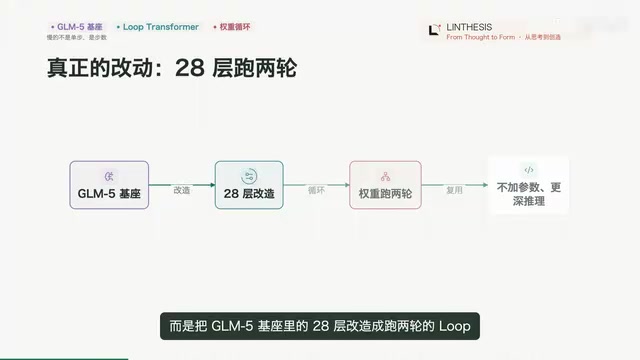
GLM-5.4 Coding Test 4.6x Slower? Unpacking the Loop Transformer Architecture
GLM-5.4 coding test took 431 minutes vs. competitor's 109, 4.6x more steps. We analyze its Loop Transformer architecture, KingBench4 score of 55.3, Max tier's 1.04M token cost, and tier selection advice.

Zhipu GLM-5.4 Quietly Released: A Debut for Loop Transformer Architecture
Zhipu GLM-5.4 quietly lands in coding plans: first Loop Transformer flagship with 750B params, 1M token context, AIM math up from 19.2 to 30.4, and native vision for coding from screenshots.
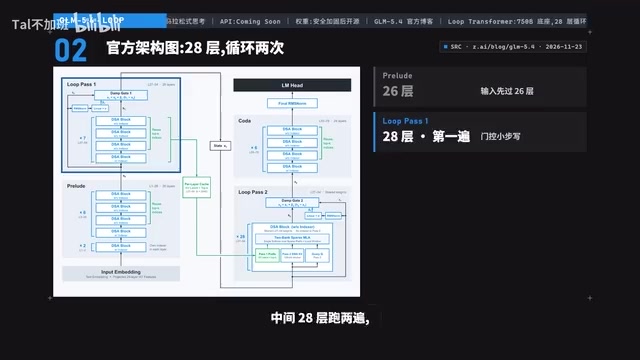
GLM-5.4 Releases 750B Model: Recurrent Transformer Architecture and the 30B Benchmark Controversy
GLM-5.4 releases a 750B model with a recurrent Transformer architecture that runs the same layers twice, claimed to match 2T–3T scale. But the benchmark table tests a 30B small model, not the main model. We break down the architecture changes, benchmark data, four demos, and open-source timeline.