LLM Cyclic Memory Forgetting Challenge: GMR Training Method and STRATA Evaluation Protocol Proposal

Engineering student proposes GMR training method and STRATA evaluation protocol to address state-induced forgetting in long-context LLM cyclic compressed memory, seeking public criticism.
An engineering student proposed a research idea on Reddit targeting the "state-induced forgetting" problem in cyclic compressed memory of long-context LLMs. The proposal defines the problem as information becoming inaccessible after memory updates while model weights remain unchanged, and designs the STRATA evaluation protocol to measure retrieval accuracy stratified by fact age, distinguishing learning failure from forgetting. The GMR training method applies a hinge penalty to degraded facts, mathematically equivalent to selecting replay samples by degree of degradation. Experiments plan fair comparisons with baselines such as ordinary replay, loss-prioritized replay, and output distillation. The author openly seeks technical criticism, with the core question being whether the distinction between GMR and ordinary replay is scientifically meaningful enough.
A engineering student recently proposed a research idea on Reddit, aiming to address the "state-induced forgetting" problem in cyclic compressed memory of long-context LLMs. The proposal includes a training method GMR (Generational Memory Retention) and an evaluation protocol STRATA, and publicly solicits technical criticism. Although experiments have not yet begun, its problem definition and experimental design are noteworthy.
Problem Definition: State-Induced Forgetting
The proposal defines "state-induced forgetting" as: information that can be correctly retrieved when first entering memory, but as subsequent memory states update, that information becomes inaccessible, while the model weights remain unchanged. For example, the model learns in a certain data block that "Project Kestrel uses Python 3.11" and can correctly answer related questions after processing it; but after hundreds of subsequent data block updates, it may no longer be able to answer that question, even if memory capacity is fixed.
This formulation attempts to attribute forgetting to the cyclic memory update process itself, rather than to changes in model parameters. The author believes that existing evaluations typically only report accuracy at specific context lengths or at the end of a conversation, and cannot reflect the decay in retrievability of a single fact as the number of memory updates increases.
Cyclic compressed memory is a mechanism in long-context LLMs that compresses historical information into a fixed-size cyclic state (such as a recurrent neural network hidden state or memory matrix). Unlike Transformer's key-value cache, cyclic memory updates its state with each new data block, and memory usage does not grow with context length, making it suitable for processing ultra-long sequences. However, state updating is a lossy compression process, and subsequent writes may overwrite or interfere with previous information, leading to "state-induced forgetting": early facts, although encoded, gradually decay in retrievability as the memory state iterates, while model weights remain unchanged. This forgetting stems from the dynamic nature of the cyclic architecture, not from failed parameter learning.
STRATA: Stratified Evaluation of Forgetting by "Age"
The core of the STRATA protocol is to measure retrieval accuracy separately according to the "age" of a fact (i.e., the number of memory updates it has experienced). Specifically, facts are introduced in continuous context windows, the immediate retrieval correctness after each fact is introduced is recorded, and then re-evaluated when the fact age is 1, 2, 4, 8, 16... up to a maximum of 1000 updates.
The protocol also distinguishes between "initial learning failure" and "forgetting after learning": if the system initially answers 90/100 questions correctly and drops to 60 after multiple rounds of updates, that is forgetting; if it initially answers only 60 correctly, that is learning failure. In addition, tests cover stable facts, facts whose values are subsequently updated, facts requiring reasoning across multiple earlier statements, and facts mentioned only once.
The author plans to report initial accuracy and age-related retention rates separately, rather than a single final accuracy. This stratified perspective may reveal failure modes overlooked by existing long-context evaluations.
BABILong is a benchmark for evaluating long-context reasoning, scattering facts across extremely long documents and requiring models to reason across multiple statements; LongMemEval focuses on conversational memory, testing the model's ability to remember and utilize early information over long sessions. Both datasets emphasize the dependence of information retrieval on context length, but typically only report final accuracy. The STRATA protocol builds on them by introducing a "fact age" dimension, i.e., the number of memory updates a fact has undergone, thereby stratifying the evaluation of retrieval accuracy decay with age, which can more finely reveal failure modes of cyclic memory.
GMR: Retention Loss Based on Regression Penalty
The GMR training objective attempts to retain the ability to answer facts that have entered memory while absorbing new information. When a fact is first introduced, the model's length-normalized log-likelihood of the correct answer is recorded as the "anchor" for that fact. After subsequent memory updates, the score is recomputed, and if the score falls below the anchor by more than an allowed margin, a penalty is applied. The simplified retention loss is:
L_ret = (1/B) * sum_f max(0, anchor_f - margin - current_score_f)
where anchor_f is the original log-likelihood, current_score_f is the current log-likelihood, margin is the tolerated degradation, and B is the number of sampled facts. The training objective also includes the standard language model loss and an absorption loss that encourages learning new facts.
The author points out a key mathematical observation: for sampled facts whose score falls below the anchor by more than margin, the gradient of this hinge loss is the same as the gradient of replaying the correct answers for those facts; non-degraded facts produce no retention gradient. This raises a question to be tested: under a matched training budget, is selecting replay samples by "degree of degradation relative to their own original score" better than ordinary replay or loss-prioritized replay? The author explicitly states no preconceived conclusion; this is precisely the core question the experiment aims to test.
Hinge loss is commonly used in maximum-margin classification, with the form max(0, margin - score), producing a gradient when a sample's score is below the margin. In GMR, hinge loss is used for the retention objective: using the fact's initial log-likelihood as the anchor, if the current score falls below the anchor by more than the tolerated margin, the model is penalized. The key property is that, for degraded facts, the gradient direction of this loss aligns with the gradient of replaying their correct answers; thus optimizing GMR is equivalent to replaying degraded facts. This explains why GMR can be viewed as a smart replay strategy, but its difference from explicit replay needs to be verified experimentally.
Experimental Design and Fair Comparison
Five configurations are planned for comparison: a baseline without an explicit retention objective, uniform replay, loss-prioritized replay, output distillation from a full-context reference, and the GMR objective. The main comparison will be conducted under matched memory size, training stream, and replay budget. Evaluation metrics include initial fact learning accuracy, retention rate at different fact ages, ability to learn new facts, handling of updated information, and computational cost.
The testbed is an associative cyclic memory on an open-weight backbone, with experiments at multiple fixed memory sizes. Data sources considered include synthetic sequence streams, BABILong-derived data, LongMemEval sessions, and narrative documents with checked QA pairs. The author emphasizes that implementation and experiments have not yet begun, and all performance claims are hypothetical.
Output distillation is a knowledge transfer technique, typically using a teacher model's output distribution to guide the training of a smaller model. In this proposal, output distillation from a full-context reference means using the outputs of a teacher model with access to the full context (such as a long-context Transformer) on the current sample as soft targets to train the cyclic memory model. This provides an informative supervision signal but is computationally expensive and may introduce teacher bias. As a baseline, it measures the upper bound of model performance with sufficient context, helping to fairly compare GMR's retention ability under limited memory.
Core Community Concerns
The author publicly raises five questions for feedback: whether the problem formulation is useful, whether the distinction between GMR and ordinary replay is scientifically meaningful, whether STRATA can reveal failure modes better than existing evaluations, whether the experimental comparison is fair (especially how to avoid unfair computational advantages), and what relevant literature is missing.
The second question is particularly critical: since GMR's hinge loss is mathematically equivalent to replaying degraded facts, its novelty requires more thorough theoretical analysis or experimental evidence. The author acknowledges this and actively seeks criticism—an openness commendable at the pre-experiment stage.
Overall, the proposal is clear in problem definition and evaluation design, but the novelty of the core method still needs verification. For researchers interested in cyclic memory, continual learning, and compressed context, STRATA's stratified evaluation approach may have independent reference value.
One-line Summary
An engineering student proposes the GMR training method and STRATA evaluation protocol to address state-induced forgetting in cyclic compressed memory of long-context LLMs, and openly seeks criticism.
Paragraph Summary
An engineering student proposed a research idea on Reddit targeting the "state-induced forgetting" problem in cyclic compressed memory of long-context LLMs. The proposal defines the problem as information becoming inaccessible after memory updates while model weights remain unchanged, and designs the STRATA evaluation protocol to measure retrieval accuracy stratified by fact age, distinguishing learning failure from forgetting. The GMR training method applies a hinge penalty to degraded facts, mathematically equivalent to selecting replay samples by degree of degradation. Experiments plan fair comparisons with ordinary replay, loss-prioritized replay, and output distillation baselines. The author openly seeks technical criticism, with the core question being whether the distinction between GMR and ordinary replay is scientifically meaningful enough.
Related articles

M&M's Spent Millions Replacing Artificial Blue Dye — Why Is It So Hard?
Mars spent millions trying to replace artificial blue dye in M&M's with spirulina, but thick material clogs pipes and residue risks mold, forcing a full production-line rebuild. Here's the engineering behind the reformulation.

Teammate Wanted for Meta Global AI Developer Hackathon: Computer Vision & Medical AI
A Reddit developer seeks teammates for the Meta Global AI Developer Hackathon, focusing on computer vision and medical AI. This article analyzes the track logic, skills-complementarity needs, and topic selection strategy behind this teaming signal.
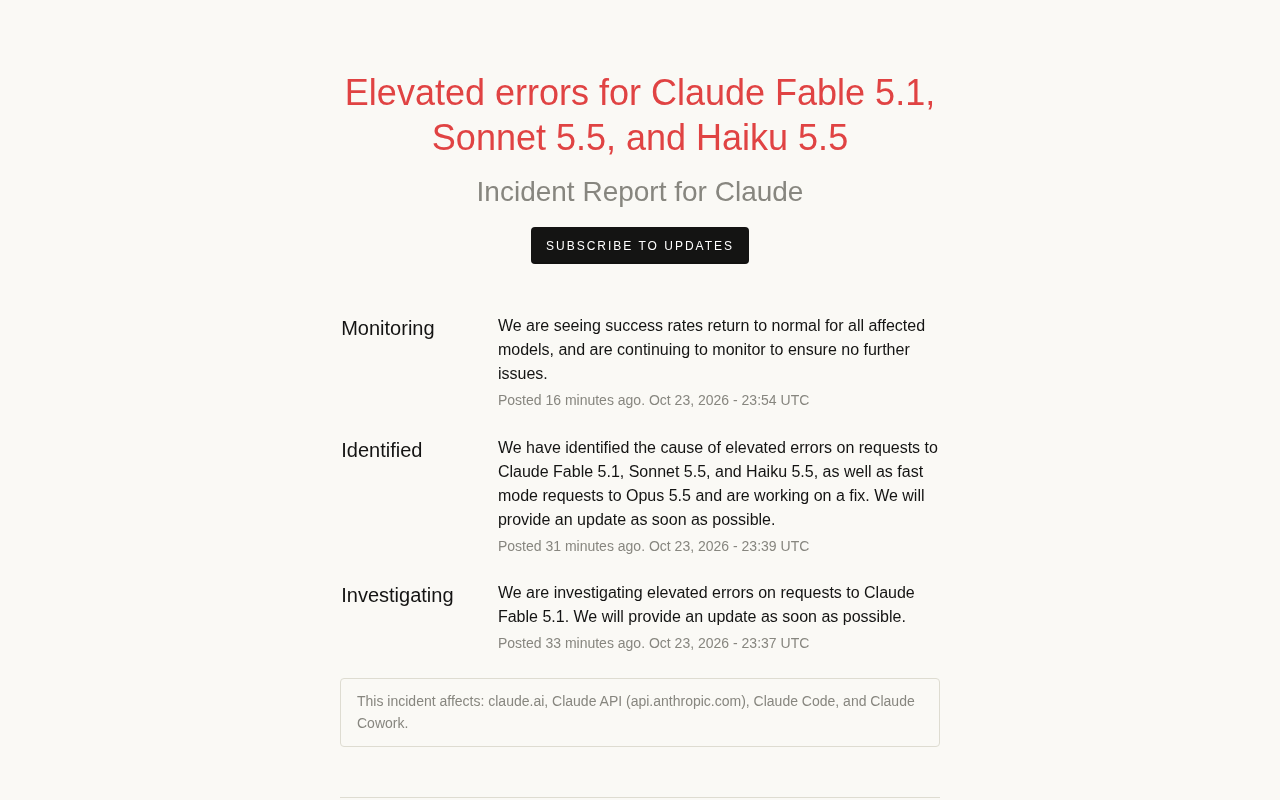
Multiple Claude Models Hit by Errors: A Postmortem of Fable 5.1, Sonnet 5.5, and Haiku 5.5
Claude Fable 5.1, Sonnet 5.5, Haiku 5.5, and Opus 5.5 fast mode saw elevated errors; Anthropic identified and resolved the issue in 17 minutes. This postmortem covers the timeline, the technical reasons for the multi-model cascading failure, and practical lessons for retry and degradation strategies.