LLM Semantic Synthesis: 600x Efficiency Boost in Data Augmentation Search
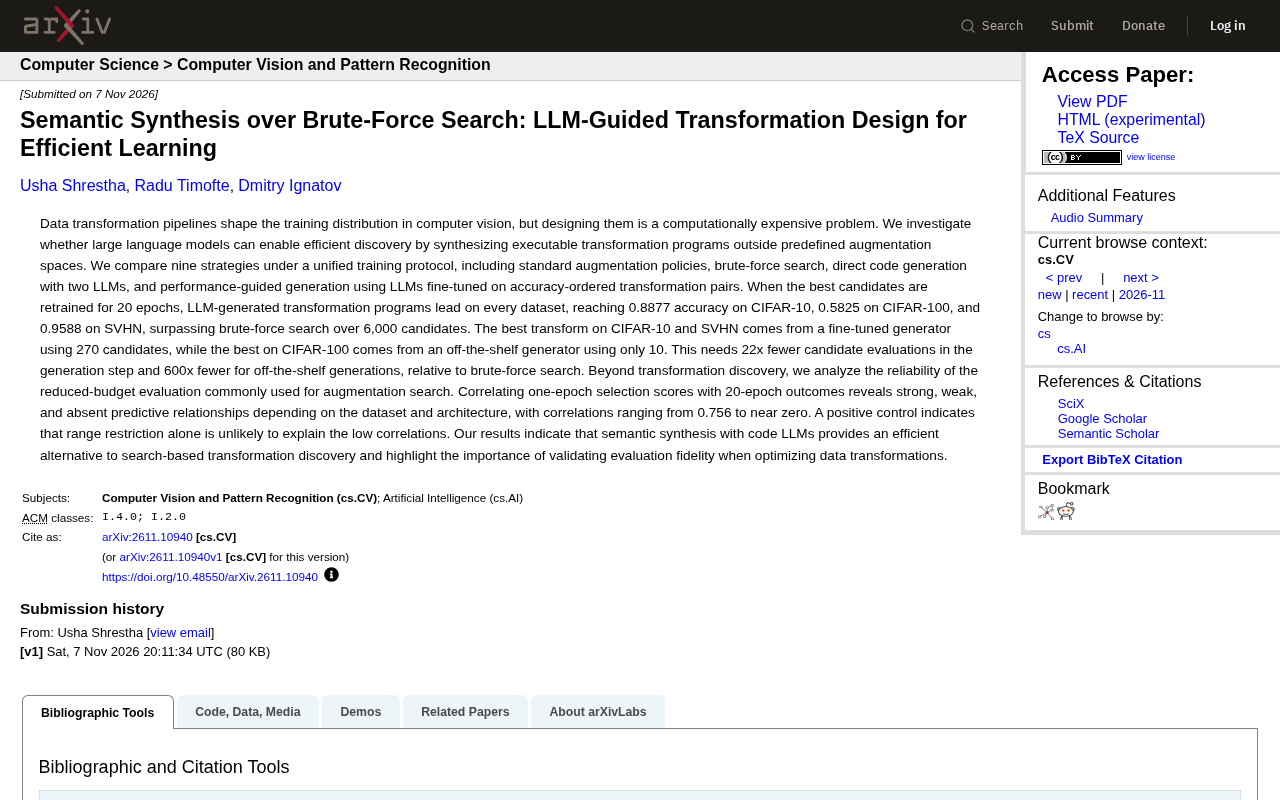
LLMs directly synthesize data transformation code, outperforming brute-force search with dramatically fewer evaluations.
This study explores using LLMs to directly generate executable data transformation programs, breaking free from predefined augmentation spaces. On CIFAR-10, CIFAR-100, and SVHN, LLM-generated transformations outperform 6000-candidate brute-force search after 20-epoch retraining, with 22x to 600x fewer evaluations. The study also warns that reduced-budget evaluation's correlation with final results is unstable (0.756 to near zero), urging practitioners to verify evaluation fidelity.
Data augmentation is a critical component of computer vision model training, but designing efficient transformation pipelines is a computationally intensive task. Traditional approaches either rely on predefined augmentation strategies or use brute-force search to find optimal combinations within a vast candidate space. A recent study explores a new path: leveraging large language models (LLMs) to directly synthesize executable transformation programs, thereby breaking free from predefined augmentation spaces. Experiments show that LLM-generated transformation schemes outperform brute-force search on multiple datasets while dramatically reducing the number of candidate evaluations.

From Brute-Force Search to Semantic Synthesis
Traditional data augmentation design typically follows two paradigms: first, using hand-crafted strategies (such as RandAugment); second, using brute-force search to find optimal combinations within a predefined space of augmentation operations. The former is limited by the designer's prior knowledge, while the latter faces the combinatorial explosion problem—even considering only a small number of operations and parameters, the candidate space can reach thousands or even tens of thousands of possibilities.
This study proposes a new approach: letting LLMs directly generate data transformation code, thereby transcending the constraints of predefined augmentation spaces. The research team compared nine strategies, including standard augmentation strategies, brute-force search, two LLMs performing direct code generation, and performance-guided generation by an LLM fine-tuned on accuracy-ranked transformation pairs. All strategies were evaluated under a unified training protocol to ensure fair comparison.
RandAugment is a classic data augmentation strategy that randomly selects two operations from a set of predefined operations (such as rotation, shearing, color jitter, etc.) and applies them with uniformly sampled magnitudes. Its core idea is to approximate the optimal augmentation strategy through simple random search, avoiding the high cost of complex strategy search. However, RandAugment's operation space and magnitude range are still manually predefined, so its performance ceiling is limited by the designer's prior knowledge. One of the traditional methods mentioned in this article belongs to this category of hand-designed strategies, contrasting with the semantic synthesis path of direct LLM code generation.
Experimental Design and Key Results
The research team tested on three standard datasets: CIFAR-10, CIFAR-100, and SVHN. When the best candidate transformations were retrained for 20 epochs, LLM-generated transformation programs achieved leading results on all datasets. Specifically, accuracy reached 0.8877 on CIFAR-10, 0.5825 on CIFAR-100, and 0.9588 on SVHN, comprehensively surpassing brute-force search over 6000 candidates.
You may not have noticed that the source of the best generator differs across datasets. On CIFAR-10 and SVHN, the best transformations came from the fine-tuned generator, using only 270 candidates; on CIFAR-100, the best transformation came from the off-the-shelf generator, using only 10 candidates. This difference suggests that dataset characteristics influence generation strategies, and also demonstrates that LLM semantic synthesis capability does not depend on large-scale candidate screening.
The efficiency gains are equally significant. Relative to brute-force search, the fine-tuned generator required 22 times fewer candidate evaluations during the generation step, while the off-the-shelf generator required 600 times fewer. This means LLMs can find high-quality transformation schemes with much lower trial-and-error costs.
Reduced-budget evaluation is a commonly used acceleration technique in automated augmentation search: quickly evaluating a large number of candidate transformations with very few training epochs (e.g., 1 epoch), then fully training the top-ranked candidates (e.g., 20 epochs) to determine final performance. This approach assumes that short-cycle validation accuracy is highly correlated with long-cycle final accuracy, thereby enabling low-cost candidate screening. However, the analysis in this article shows that this assumption does not always hold—correlation coefficients can be as low as near zero, meaning that selection based on 1-epoch scores may be disconnected from final performance, leading to suboptimal augmentation strategies. Therefore, researchers need to carefully verify the fidelity of such proxy evaluations.
A Warning About Evaluation Fidelity
Beyond transformation discovery itself, the study also analyzed the reliability of reduced-budget evaluation commonly used in augmentation search. Reduced-budget evaluation refers to using validation accuracy from a small number of epochs (e.g., 1 epoch) to screen candidate transformations, then fully training the winners. While this approach saves computation, how good is its predictive power?
The study analyzed the correlation between 1-epoch selection scores and 20-epoch final results, finding that the predictive relationship varied widely and was even completely absent on certain datasets and architectures. Correlation coefficients ranged from 0.756 to near zero. A positive control experiment showed that range restriction is unlikely to be the sole cause of low correlation. This finding reminds researchers: when optimizing data transformations, the fidelity of evaluation methods must be verified, otherwise selections may be based on unreliable signals.
Range restriction is a statistical phenomenon: when the range of values for a variable in a sample is artificially restricted, the correlation coefficient between that variable and other variables is underestimated. In the context of augmentation search, if the 1-epoch accuracy distribution of candidate transformations is narrow (e.g., all candidates perform similarly), then even if there is a genuine association with 20-epoch accuracy, the observed correlation coefficient may be low. This article rules out range restriction as the sole explanation for low correlation through positive control experiments, thereby emphasizing that low-budget evaluation itself may lack predictive validity, rather than being merely a statistical artifact.
Implications for Data Augmentation Practice
This study conveys two core messages. First, LLM semantic synthesis capability provides an efficient alternative for data transformation design, with advantages particularly evident in scenarios where candidate evaluation costs are high. Second, evaluation protocols in data augmentation search need to be carefully designed, as the predictive validity of low-budget evaluation varies across datasets and architectures, and blind reliance may lead to suboptimal decisions.
From a broader perspective, this work also demonstrates the potential of LLMs in automated machine learning pipeline design—not limited to generative models or text processing, but also capable of contributing to optimization problems that traditionally rely on search. Of course, LLM-generated transformation programs still need to be validated on target datasets, and questions such as the generalization capability of generators and their adaptability to different vision tasks remain to be further studied.
For practitioners, a pragmatic recommendation is: in data augmentation design, consider using LLMs to generate candidate transformations, but be sure to pair this with sufficient validation to avoid missing better solutions due to evaluation bias. At the same time, pay attention to the interpretability and robustness of transformation programs to ensure their stability across different data distributions.
One-line Summary
LLMs directly synthesize data transformation code, outperforming brute-force search with dramatically fewer evaluations.
Paragraph Summary
This study explores using large language models to directly generate executable data transformation programs, breaking free from the constraints of traditional predefined augmentation spaces. On CIFAR-10, CIFAR-100, and SVHN, LLM-generated transformations outperformed brute-force search over 6000 candidates after 20-epoch retraining, with the fine-tuned generator requiring only 270 candidates and the off-the-shelf generator only 10, reducing evaluations by 22x to 600x. Meanwhile, the study warns that the correlation between reduced-budget evaluation (e.g., 1-epoch selection) and final results is unstable, ranging from 0.756 to near zero, reminding practitioners to verify evaluation fidelity and avoid suboptimal decisions based on unreliable signals.
Related articles

FBI-Warned AI Hacking Tool ARTEX: Cost Disruption and Defensive Restructuring
The FBI-warned AI hacking tool ARTEX reduces penetration testing costs to $150-$1,500, causing financial data breaches and supply chain attacks. Learn how it works, real cases, and a five-step defense strategy.
FBI Warns: ARTEX AI Hacking Tool Breaches Systems in Three Hours
FBI warns the open-source AI pentesting framework ARTEX is being abused, with some intrusions gaining privileged access in under three hours, over 1,600 consoles exposed, and links to South Korean financial data breaches and the ConnectWise supply chain attack.

FBI Warns About Artex: AI-Driven Attack Framework Threatens Cloud Identity Security
FBI warns that the AI penetration testing framework Artex is being used for automated attacks: written in Go and driven by AI agents, it covers the full chain from reconnaissance to data exfiltration. This article analyzes its real threat to cloud identity and privilege security and key defense priorities.