Local Wikipedia: Only Featuring Things Within a Half-Hour Walk

Local Wikipedia filters Wikipedia entries by half-hour walking range, exploring localized knowledge consumption and community connection.
Local Wikipedia is an experimental project that earned 370 points and 92 comments on Hacker News. Its core idea is to filter Wikipedia's massive entries by geographic range, keeping only things within a half-hour walk of the user. This design challenges the traditional encyclopedia's assumption of universality, shifting information consumption from global hot topics to the history and stories of nearby streets, buildings, and shops. The article analyzes the technical challenges the project faces, including the difficulty of matching Wikipedia entries to geographic coordinates, the variance in walking distance across different cities and terrains, and the experience design problem of severe content density imbalance between historic urban centers and suburbs. The project also reflects the demand for a return to "nearby" and localized knowledge amid global information overload, aligning with trends such as local journalism and community archive digitization.
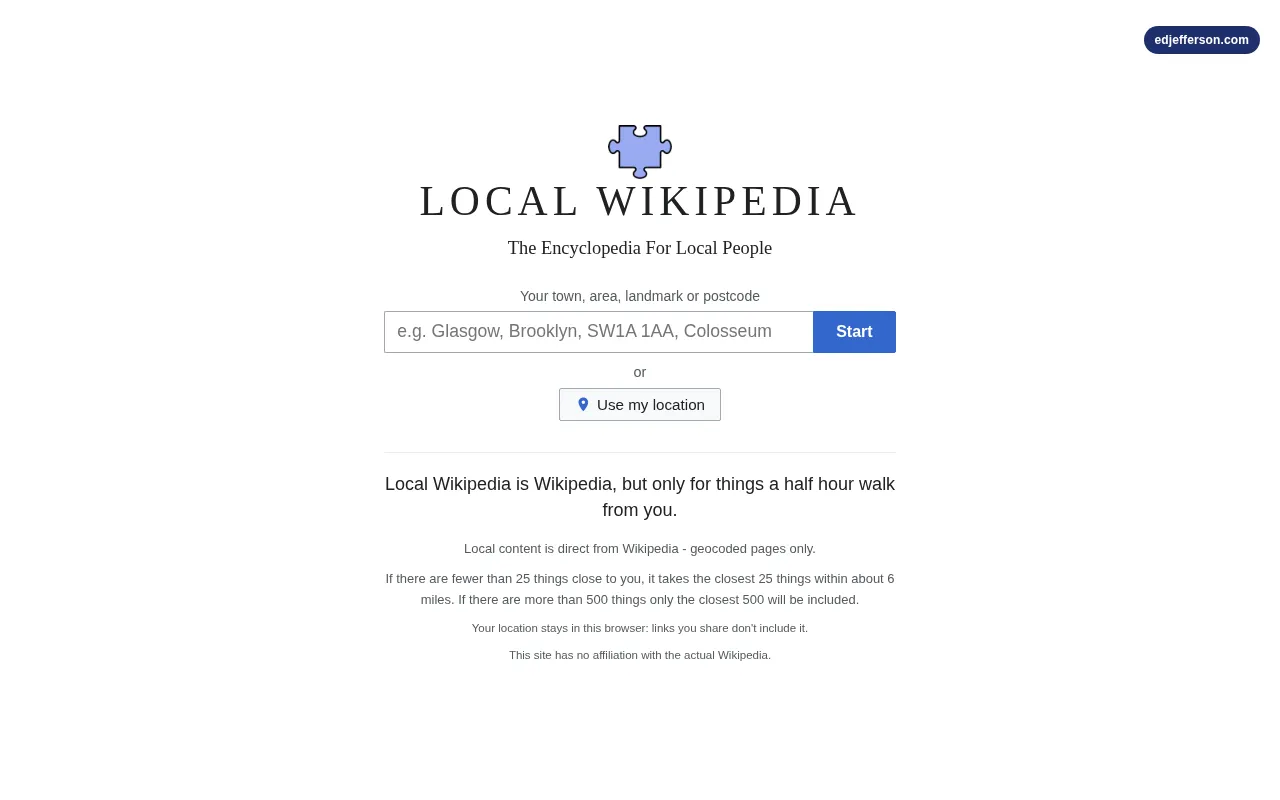
In an age of information overload, a project called Local Wikipedia proposes an intriguing counter-intuitive idea: what would Wikipedia look like if it only covered things within a half-hour walk of you? The project earned 370 points and 92 comments on Hacker News, sparking discussion about localized knowledge, community connection, and technical possibilities.
The Core Concept: Shrinking the Radius of Knowledge
The starting point of Local Wikipedia is simple: filter Wikipedia's massive collection of entries by geographic range, keeping only content within a half-hour walk of the user. This means you no longer see global encyclopedia entries, but rather the history and stories of streets, parks, buildings, and shops near your home.
This design challenges the traditional encyclopedia's assumption of "universality." Wikipedia's success is built on covering all human knowledge, but Local Wikipedia does the opposite—using geographic constraints to create an entirely new information consumption scenario where every piece of content you read is directly tied to your daily footsteps.
The "half-hour walk" constraint is essentially a measure of walkability rather than simple Euclidean distance. In urban planning, walkability typically incorporates factors such as road network density, intersection spacing, sidewalk continuity, and terrain slope. In the same half hour, a grid-like old city district might cover over two kilometers, while in a hilly or sparsely connected suburb, the straight-line radius might be only about one kilometer. Moreover, the half-hour walking range implicitly carries the sociological concept of "a person's daily activity radius"—roughly corresponding to the boundary of one's familiarity with the surrounding environment. Limiting knowledge entries to this range effectively anchors information consumption to an individual's lived-experience map, which is what distinguishes this project from ordinary map applications.
From Global to Local: A Shift in Knowledge Consumption Scenarios
This localized filtering brings not just a change in content scope but also a shift in usage scenarios. When you open Local Wikipedia while walking through your neighborhood, you might discover that the inconspicuous red-brick building on the corner was once the residence of a historical figure, or that the location of your favorite café was a famous bookstore decades ago.
Among the 92 comments the project generated on Hacker News, many users mentioned the joy of "discovering local history." Some shared their own experiences trying similar ideas, while others discussed the potential value of localized knowledge in community building. This resonance suggests that amid the flood of globalized information, people's attention to "what's nearby" is returning.
Technical Implementation and Data Challenges
From a technical perspective, Local Wikipedia needs to solve several key problems. First is geolocation and entry matching: not all Wikipedia entries carry precise coordinate information, and associating entries with geographic locations is a challenge. Second is range calculation: a half-hour walking distance varies greatly across different cities and terrains, so simple radius filtering may not be accurate enough.
Additionally, the content density after filtering is a practical issue. In historic city centers, there might be hundreds of relevant entries within a half-hour walk; in suburbs or newly developed areas, that number could be close to zero. How to handle this imbalance is an experience design problem the project must address.
Wikipedia entries are linked to geographic coordinates mainly through two mechanisms: the {{coord}} template embedded in entries, and the structured "coordinate location" statements for each entry in Wikidata. However, a large number of entries—especially those about historical events, people, and abstract concepts—do not carry coordinates, or their coordinates point to where an event occurred rather than the subject of the entry itself. Therefore, matching entries to geographic locations typically requires indirect inference using Wikidata properties such as "located in the administrative territorial entity" and "adjacent to," which introduces a trade-off between recall and precision. For example, an entry about a writer might have coordinates marking their birthplace rather than their former residence, and direct radius filtering would introduce noise. Understanding the limitations of this data layer helps assess how much genuinely "nearby" knowledge a localized encyclopedia can cover in practice.
The Future of Community and Local Knowledge
Although Local Wikipedia is a small project, it touches on a larger trend: localized knowledge and community connection. In an era where algorithmic recommendation dominates information acquisition, geographic constraint has become a scarce filtering dimension. It doesn't pursue "you might be interested in" but instead tells you "what's around you."
This approach aligns with movements that have emerged in recent years, such as local journalism and the digitization of community archives. As large platforms focus their attention on global hot topics, experiments like Local Wikipedia remind us that knowledge has not only a dimension of breadth but also one of depth—and depth often hides in the places you walk past every day without ever looking closely.
The project's open-source nature also means more people can try similar experiments in their own cities. Whether as an exploration tool for walks or as an entry point for community history education, Local Wikipedia offers a thought-provoking approach: bringing the encyclopedia back to where it was born—the spaces where people actually live.
Related articles

Cursor AI Programming in Practice: Build a Student Management System from Scratch in 30 Minutes
A Bilibili creator demonstrates Cursor AI programming: generating a student management system in 30 minutes with natural language. Details on Agent mode, Claude selection, prompt techniques, and thresholds.

Top 20 AI Coding Tools Ranking: From Rock-Solid to Lackluster, a Scored Matrix
Bilibili creator releases top 20 AI coding tools ranking, tiered T0–T4 from rock-solid to lackluster, with Claude Code and Codex tied at T0. This article details the scoring dimensions (capability, reliability, robustness, durability, cost, domestic availability) and tool performances to help developers choose the right AI coding assistant.

Vibe Coding Systematic Tutorial: Master AI-Assisted Programming from Zero
A three-month Vibe Coding tutorial from a Bilibili creator covering Codex, ClaudeCode, and Cursor, from core logic to commercial project practice for beginners.