Logistic Regression with Missing Covariates: A New Distribution-Free Approach

A distribution-free stochastic approximation algorithm achieves minimax-optimal logistic regression under missing covariates.
This paper addresses logistic regression with missing covariates in an assumption-lean setting that requires no distributional assumptions on covariates beyond boundedness. The key contribution is a stochastic approximation algorithm based on Z-estimation and a novel monotone operator, which under MCAR achieves computationally efficient, parametric-rate signal recovery. The authors precisely characterize the estimation risk as a function of the missingness profile and prove the method uniformly outperforms the complete-case estimator. Critically, they also establish matching information-theoretic lower bounds, showing in the minimax sense that the complex dependence of estimation error on observation probability is fundamental to the problem, not an algorithmic limitation.
A Long-Overlooked Statistical Challenge
Missing covariates (features) are extremely common in supervised learning — skipped survey questions, occasional sensor failures, and empty database fields all contribute to this problem. Traditional approaches fall into two main categories: carefully designed imputation schemes to fill in missing values, or likelihood-based approximations that often lead to non-convex M-estimation problems, dramatically increasing optimization difficulty.
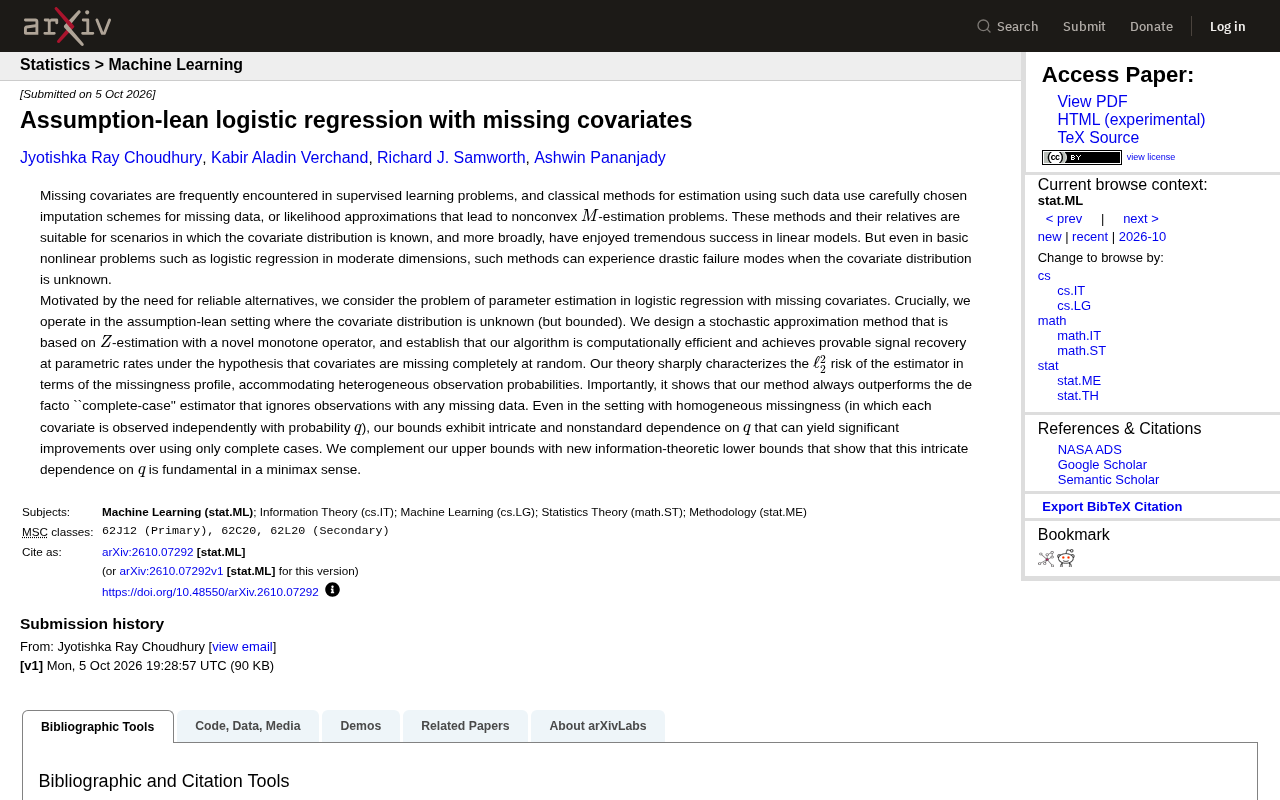
These methods have achieved great success in linear models, provided the covariate distribution is known. However, a new arXiv paper (arXiv:2610.07292v1) identifies a critical weakness: once the covariate distribution is unknown, even something as fundamental as logistic regression can exhibit drastic failure modes in moderate dimensions under traditional approaches.
What Is an "Assumption-Lean" Setting?
The paper's core innovation lies in its assumption-lean setting. This means making no specific assumptions about the distributional form of covariates — only requiring that they be bounded. This stands in sharp contrast to classical methods, which typically require knowing or assuming that covariates follow some known distribution.
Real-world data often fails to satisfy idealized distributional assumptions, and when those assumptions are violated, estimators that rely on them can quickly break down. The authors are motivated by the practical need for reliable alternatives, and revisit the problem of parameter estimation in logistic regression with missing covariates from this angle. Breaking free from strong distributional dependencies makes the method robust across a broader, more realistic range of scenarios.
A Stochastic Approximation Algorithm Based on Z-Estimation
To address this problem, the authors design a stochastic approximation method grounded in Z-estimation, incorporating a novel monotone operator. The introduction of the monotone operator is key — it endows what might otherwise be a non-convex optimization problem with favorable mathematical structure, ensuring the algorithm's computational efficiency.
The paper proves that under the assumption of missing completely at random (MCAR), the algorithm is not only computationally efficient but also achieves provable signal recovery at parametric rates. In other words, it is both fast and accurate in theory — a combination that is far from common in nonlinear models with missing data.
Characterizing Heterogeneity in Missingness Probabilities
The theoretical results precisely characterize the relationship between the estimator's $\ell_2^2$ risk and the missingness profile, and can accommodate heterogeneous observation probabilities — that is, different covariates may be observed with different probabilities. This flexibility brings the theory closer to the complexity of real-world data.
Z-estimation is an important estimation framework in statistics. Its core idea is to reformulate parameter estimation as finding the zero of some "estimating equation" — that is, finding the parameter value at which a vector-valued function equals zero. Classical methods such as maximum likelihood estimation and method of moments can both be cast within this framework. The advantage of Z-estimation is that it does not require the objective function to be globally convex; it only requires appropriate monotonicity or coercivity conditions on the estimating equation to guarantee the existence and uniqueness of a solution. In this paper, by introducing a monotone operator (one satisfying $\langle F(x)-F(y),, x-y\rangle \geq 0$), the logistic regression problem with missing data is transformed into a well-structured monotone equation-solving problem, bypassing the difficulties of non-convex optimization and laying a theoretical foundation for the convergence analysis of the stochastic approximation iterative algorithm (analogous to the Robbins-Monro scheme).
Uniformly Outperforming the "Complete-Case" Estimator
One of the paper's most compelling results is that the proposed method uniformly outperforms the de facto default approach — the complete-case estimator, which simply discards any observation containing a missing value. This is clearly wasteful when data is scarce.
Even in the homogeneous missingness setting (where each covariate is observed independently with probability $q$), the authors show that the error bound exhibits a complex, non-standard dependence on $q$. This dependence implies that, compared to using only complete cases, the new method can achieve significant improvements by making full use of the partially observed information that traditional methods discard.
Information-Theoretic Lower Bounds: The Complexity Is Fundamental
The paper goes beyond upper bounds. The authors also establish new information-theoretic lower bounds, proving in the minimax sense that this complex dependence of the error on $q$ is fundamental — not an artifact of the algorithm design.
The pairing of upper and lower bounds brings the theoretical picture full circle: the work both demonstrates the performance the method can achieve and defines the limits that no method can surpass on this problem. For researchers in statistical learning theory, such "matching upper and lower bounds" results carry high reference value.
The minimax framework is the standard paradigm in statistical estimation theory for measuring the optimality of a method. The basic idea is: for a given parameter class, first take the infimum over all possible estimators of the worst-case risk, then compare this against the upper bound of a specific algorithm. If the algorithm's upper bound matches the information-theoretic lower bound up to constants (in order), the method is said to be "minimax optimal," meaning no essentially better method exists for this problem class. The lower bounds established in this paper show that the complex influence of the observation probability $q$ on the estimation error is not a flaw of any particular algorithm, but rather an inherent statistical difficulty of the problem itself — no estimator, however cleverly designed, can fully eliminate this dependence. This result grants the proposed algorithm theoretical optimality status, while also defining an unbreakable performance boundary for future research.
Implications for Practice and Research
The value of this work lies in providing a distribution-free, computationally feasible, and theoretically guaranteed framework for logistic regression with missing covariates. In fields such as healthcare, finance, and social surveys — where missing data is pervasive and covariate distributions are difficult to accurately model — assumption-lean methods like this one have the potential to reduce estimation bias caused by incorrect distributional assumptions.
It is worth noting that the paper's theoretical guarantees rest on the relatively strong assumption of missing completely at random (MCAR). In practice, missingness is often not completely random, but related to the data itself (e.g., MAR or MNAR). Extending this framework to more general missingness mechanisms is likely an important direction for future research.
Missingness mechanisms are typically classified into three types: Missing Completely At Random (MCAR), where missingness is unrelated to any observed or unobserved variable; Missing At Random (MAR), where the probability of missingness depends only on observed variables; and Missing Not At Random (MNAR), where the probability of missingness also depends on the unobserved variable itself — the most difficult of the three to handle. This paper's theoretical guarantees are built on the MCAR assumption, which tends to be optimistic in practice — for example, in income surveys, higher earners are more likely to leave salary fields blank, a classic instance of MNAR. Extending the assumption-lean framework to MAR or MNAR settings would require additional modeling or identification assumptions about the missingness mechanism, and represents an open problem that is technically more challenging but practically more valuable.
Related articles

Apple HomeView Hands-On Review: Is the $300 Smart Home Hub Worth It?
Apple HomeView hands-on: a $300 smart home hub with facial recognition for quick account switching, but no App Store or voice recognition. Is the wall-mounted version worth it? Should you buy the first generation?

Meta Muse Wonder Launch: What It Means for Meta's Return to the Frontier AI Race
Meta releases Muse Wonder and WonderFull, benchmarks reach the frontier, community feedback is polarized. An in-depth look at Meta's return to the frontier AI race, its personal agent strategy, and Zuckerberg's different path.

Apple Home Smart Home Lineup Leaked: LG and Schneider Team Up, UWB Door Lock on Board
Apple Home ecosystem gains new LG and Schneider devices: UWB smart lock with proximity unlock, 2.5K dual-camera doorbell, privacy indoor camera, and AirPods-like seamless pairing.