Loop Engineering: A Comprehensive Guide to AI Agent Loop Design
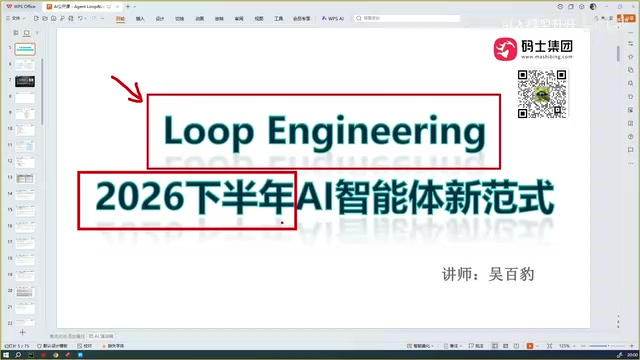
A comprehensive guide to Loop Engineering — the art of designing and optimizing AI Agent execution loops.
Loop Engineering is an emerging methodology focused on designing and optimizing the loop feedback mechanisms in AI Agent systems. This article explores its origins in cybernetics, how it differs from Prompt Engineering and Harness Engineering, the core problems it solves (runaway loops, context management, termination conditions), and provides a three-level practical guide from principles through design patterns like ReAct to production implementation with observability, progressive complexity, and cost-aware design.
What Is Loop Engineering
Loop Engineering is a new concept that has rapidly gained traction in the AI development community. It hasn't been around for long — according to related technical discussions, the term had already quietly permeated the daily practices of large model engineers before entering the public spotlight. Many engineers currently working on AI Agent development may have already encountered Loop-related development patterns without realizing they could be systematically organized into a standalone methodology.
Background on AI Agents: An AI Agent is an AI system capable of autonomously perceiving its environment, making decisions, and executing actions. Unlike traditional single-inference models, Agents typically need to interact continuously across multiple steps. The loop mechanism is the core architecture that enables Agent autonomy — it allows the model to receive feedback after each round of execution and adjust its next action accordingly, forming a cognitive closed loop similar to the human process of "try — reflect — improve." This is precisely why the engineering design and optimization of this closed loop has become the central proposition of Loop Engineering.
The Epistemological Foundation of Loop Engineering: The underlying cognitive model of Loop Engineering shares deep roots with the feedback loop concept from Cybernetics. Norbert Wiener's cybernetics framework, proposed in 1948, uses "perceive — judge — act — feedback" as the fundamental unit of adaptive systems. The loop mechanism in AI Agents essentially transplants this classical cybernetics principle into the execution architecture of large language models, with the only difference being that the "judgment" component is replaced by probabilistic neural network inference instead of deterministic algorithms. This perspective helps explain why many design principles in Loop Engineering — such as termination condition design and state convergence detection — bear striking resemblance to traditional control system engineering. Much of the engineering experience accumulated in the field of automated control can be directly borrowed and reused by Agent system developers.
In simple terms, the core question Loop Engineering addresses is: How to design and optimize the loop feedback mechanism that AI Agents use when executing tasks. It didn't appear out of thin air — it's a natural product of years of continuous evolution in AI application development.
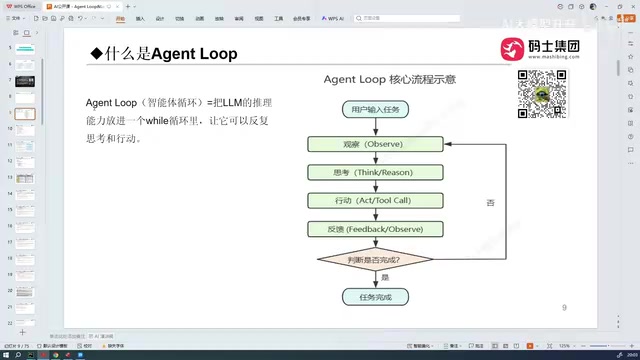
Understanding Loop Engineering in One Sentence
Loop Engineering is about the engineering practice of "letting AI continuously execute, observe, and correct within a loop until the goal is achieved." This is fundamentally different from the traditional "one question, one answer" LLM call pattern — it emphasizes a closed loop of continuous iteration and autonomous decision-making.
If you're new to the Agent concept, you can approach this with a blank slate. If you're already doing AI development, you'll need to step outside your existing mental framework first, because much of the underlying logic has already appeared in practice — it just lacked a unified name.
Why Loop Engineering Is Getting So Much Attention Now
To understand why Loop Engineering is sparking widespread discussion right now, we need to place it within the broader evolution of AI application development.
Over the past few years, AI development has gone through several distinct phases of hot topics: from the early days of Prompt Engineering, to the much-discussed Harness Engineering, and now to Loop Engineering. Each concept's emergence is essentially answering the same question — How can we make large models complete complex tasks more reliably and autonomously?
The Evolution of Prompt Engineering: Prompt Engineering rose to prominence after the release of GPT-3 in 2020, when developers discovered that carefully designing input prompts could significantly improve the quality of model outputs. The core insight of this phase was that a model's capability ceiling is often constrained by how inputs are structured, not by the model itself. Subsequent techniques like Chain-of-Thought and Few-shot Prompting were advanced forms of Prompt Engineering. However, the fundamental limitation of Prompt Engineering is that it remains essentially a "one question, one answer" paradigm, incapable of handling complex tasks that require multi-step reasoning and multi-tool collaboration. This drove the rise of the next phase: Harness Engineering.
The Difference Between Loop Engineering and Harness Engineering
Many developers immediately ask: What exactly is the difference between Loop Engineering and Harness Engineering?
The Core Positioning of Harness Engineering: The core idea of Harness Engineering is to build external execution frameworks for large models — including Tool Use/Function Calling, Memory systems, external API integration, and other infrastructure. Early Agent frameworks like LangChain and AutoGPT are classic embodiments of the Harness Engineering philosophy. But as application complexity grew, developers realized that "having scaffolding" wasn't enough — the key was how to design the execution logic and state transitions within the scaffolding. This is precisely the problem Loop Engineering picks up and solves.
The two are not replacements for each other but rather have different emphases:
- Harness Engineering focuses on building external "support frameworks" and tool-calling systems for large models;
- Loop Engineering focuses on the design of the Agent's internal execution loop — including how to trigger loops, how to determine whether to continue executing, how to set termination conditions, and how to manage state and context within the loop.
Engineering Divergence Across Mainstream Frameworks: Current mainstream Agent development frameworks have already formed clear divergences at the Loop Engineering level: LangGraph uses a directed acyclic graph (DAG) node-edge model to explicitly define loop state machines, allowing developers to precisely control conditional jumps and termination logic at each node; CrewAI uses "multi-Agent collaborative roles" as its abstraction unit, with task feedback and retry mechanisms built into the inter-role communication layer; AutoGen (Microsoft) has moved toward "conversation-driven multi-Agent loops," using message passing as the primary vehicle for state transitions. When choosing a framework, the core considerations should focus on: the framework's expressiveness for loop termination conditions, its state persistence solution, and its support for streaming execution.
Loop Orchestration in Multi-Agent Collaboration: When Loop Engineering extends from single-Agent scenarios to multi-Agent collaboration systems, the complexity of Loop Orchestration increases exponentially. Two core loop structures exist in multi-Agent systems: The first is the "master-slave loop," where an Orchestrator Agent centrally dispatches the execution order and feedback aggregation of multiple Specialist Agents. The second is the "peer-to-peer loop," where multiple Agents collaborate as equals through a message bus, with loop state maintained by a shared state machine. Each pattern has its own applicable scenarios — master-slave is easier to debug and control, while peer-to-peer has natural advantages in parallel task processing. In production practice, loop-level deadlock detection and timeout circuit-breaking mechanisms are critical safeguards for stable multi-Agent system operation.
From Monolithic Loops to Distributed Loop Systems: As AI applications scale up, Loop Engineering is evolving toward "distributed loop systems." Under this architecture, the execution state of a single Agent loop needs to be persistently stored in external state stores (such as Redis or PostgreSQL) to support loop pausing, resumption, and even cross-node migration — this is the core engineering capability that distinguishes production-grade Agent systems from demo prototypes. Workflow orchestration engines like Temporal.io have already been adopted by some teams for Agent Loop state management, leveraging their built-in Durable Execution capabilities to achieve reliable orchestration of ultra-long task loops. This direction signals that Loop Engineering will deeply converge with traditional workflow engineering in the future, spawning a new infrastructure layer that elevates the loop stability of Agents to reliability levels comparable to banking-grade transaction systems.
How Significant Is Its Impact
Objectively speaking, Loop Engineering is more of a conceptual distillation and systematization of existing development paradigms, rather than a disruptive technological revolution. But this is precisely where its value lies — it helps developers organize scattered practical experience into a reusable, teachable methodology, making team collaboration and knowledge accumulation far more efficient.
What Core Problems Does Loop Engineering Solve
The key to understanding any technology is first clarifying what problems it actually solves.
In real-world AI Agent development, engineers frequently face the following challenges:
- Tasks can't be completed in a single pass: Complex tasks often require multi-step reasoning and multiple tool calls — a single call rarely produces ideal results.
- Lack of feedback correction mechanisms: How to make a model self-detect and correct errors after execution failures is a classic engineering challenge.
- Runaway loops or infinite loops: Agents may fall into meaningless repetition during autonomous execution, or terminate tasks prematurely.
- Chaotic state and context management: How to effectively pass and compress context across multiple loop iterations directly impacts both operational costs and final outcomes.
The Engineering Challenge of Context Management: In multi-iteration Agent systems, Context Management is a severely underestimated engineering challenge. Although the context window of large models has expanded from the early 4K tokens to 128K or even longer, as loop iterations increase, accumulated historical information rapidly consumes the token quota, directly driving up API call costs. Context compression strategies in Loop Engineering — including Rolling Summary, selective retention of key states, and vector database-backed external memory — are the core engineering practices for addressing this challenge. Proper context management isn't just about cost; it directly affects the Agent's performance stability during long tasks. It's worth noting that even with ultra-long context window models, the "Lost in the Middle" phenomenon persists — models pay significantly more attention to information at the beginning and end of the context than to the middle. This means context compression strategies need to be designed with position awareness, rather than simply truncating chronologically.
Engineering Design of Loop Termination Conditions: Termination Condition design is one of the most easily underestimated engineering decisions in Loop Engineering. Common termination strategies include: semantic judgment based on goal achievement (self-assessed by the LLM, costly but flexible), hard cutoff based on maximum iteration count (prevents runaway loops but may terminate tasks prematurely), event-driven termination based on external signals (e.g., a Tool returning a specific status code), and combinations of the above. In production environments, it's recommended to configure both "semantic termination" and "iteration cap" as dual safeguards, and to log the complete execution trace for every abnormal termination to facilitate subsequent Loop tuning analysis.
Loop Engineering addresses these pain points by providing a set of design principles and practice patterns that make Agent execution loops more stable, controllable, and efficient.
What Posture Should Developers Adopt
For enterprises and developers, the real question isn't "should we chase the trend" but rather "what posture should future Agent development take."

As Agent applications gradually move into production environments, capabilities like loop control, error recovery, and cost optimization will become core competitive advantages. Mastering the thinking behind Loop Engineering means developers can build more robust Agent systems in the coming wave of AI applications.
How to Put Loop Engineering Into Practice
From getting started to production deployment, the learning path for Loop Engineering can be roughly divided into three levels:
Level 1: Understanding the Principles
Build a holistic understanding of the Agent loop mechanism. Understand the operational logic of the "execute — observe — decide — correct" closed loop, and how it fundamentally differs from traditional single-call LLM usage.
Level 2: Mastering Common Loop Design Patterns
Learn mainstream loop design patterns, such as:
-
ReAct-style Reasoning-Action Loops: ReAct (Reasoning + Acting) is an Agent reasoning paradigm proposed by Google Research in 2022, published in the paper ReAct: Synergizing Reasoning and Acting in Language Models. Its core breakthrough lies in merging two previously independent research tracks — "chain-of-thought reasoning" and "external tool calling" — into a unified interaction protocol. Each loop iteration consists of three standardized outputs: Thought (current reasoning state), Action (instruction to call a tool or execute an operation), and Observation (feedback returned from the environment). This structured output not only makes the debugging process highly observable but also provides clear execution traces for error localization, dramatically improving model accuracy and interpretability in complex tasks.
Academic Origins and Engineering Value of the ReAct Paradigm: The academic value of the ReAct framework lies in being the first to systematically prove that a structured protocol of "think first, then act" can significantly outperform pure Chain-of-Thought (CoT) methods on multi-hop reasoning benchmarks like HotpotQA and Fever. Its engineering value is that the Thought-Action-Observation three-part output naturally constitutes a structured execution log format, making every step of the Agent's decision process auditable — which is particularly critical for enterprise applications requiring compliance reviews. Notably, the Observation step in ReAct introduces a crucial signal: "real-world feedback." It is this component that upgrades the loop from "internal reasoning where the model talks to itself" to "a closed-loop system that genuinely interacts with the external environment." Currently, ReAct has become the core design foundation for mainstream Agent frameworks like LangGraph and CrewAI, and its three-part protocol has been extended to action-perception loop design in multimodal Agents.
-
Self-correction Loops with Reflection Mechanisms: Introducing error detection and self-evaluation to improve robustness. A representative of this pattern is the Reflexion framework (Shinn et al., 2023), which adds a "linguistic reflection" layer on top of the standard ReAct loop — after each task failure, the Agent generates a natural language failure analysis and injects it as "experiential memory" into the next loop iteration's context, enabling continuous improvement across loops without updating model weights.
-
Well-designed Termination Conditions: Preventing infinite loops and ensuring tasks converge at the appropriate time.
Level 3: Engineering Implementation in Practice
Integrate loop mechanisms into existing development frameworks through real projects. Whether connecting to mainstream Agent development tools or building custom Agent systems, the barrier to implementation isn't high once you understand the core concepts. The key is to incorporate loop design into system architecture considerations from the very beginning, rather than retrofitting it later.
During the engineering implementation phase, several practical principles deserve special attention:
First, observability first — add structured logging for every loop iteration, recording the complete chain of Thought, Action, and Observation. This is the foundational data source for tuning Loop behavior. Drawing from the three pillars of distributed systems engineering — Logs, Metrics, and Traces — Agent loop systems likewise need a comprehensive observability stack: the execution chain of each loop iteration should be persistently stored in a structured format, combined with key metrics like iteration count, token consumption, and tool call latency, to enable rapid root cause analysis during production incidents or performance degradation.
The Observability Stack for Loop Engineering: The concept of Observability originated in distributed systems engineering and was systematically popularized for production environment debugging by Twitter engineer Charity Majors and others. In the Loop Engineering context, the observability challenge is more complex than with traditional microservices — because Agent loop "failures" are often not hard errors but rather "soft deviations" where outputs appear reasonable but drift away from the target. These issues are virtually invisible on traditional monitoring dashboards. Therefore, Loop-level observability requires an additional "semantic monitoring layer": by comparing the semantic similarity between the model's Thought output in each loop iteration and the expected reasoning path, you can detect "hidden drift" early as the Agent progresses through its loops. LangSmith's Trace feature and Arize Phoenix's Span analysis are purpose-built solutions for this pain point, capable of visualizing loop execution trajectories and dramatically lowering the barrier to Loop behavior analysis. It's recommended to integrate such tools early in the project, rather than scrambling to add them after a production incident.
Second, progressive complexity — start with a single Agent and a single loop. Only after validating basic Loop stability should you introduce multi-Agent collaboration or nested loops, to avoid exponential growth in debugging complexity.
Third, cost-aware design — introduce token consumption estimation at the architecture stage. Pre-set context compression strategies for high-frequency loop scenarios to prevent cost blowouts in production. A practical engineering tip: during stress testing, simulate the longest possible loop path (Worst-case Loop Path) and use it as the baseline for cost ceiling estimation, rather than estimating based on average paths. This provides sufficient safety margin for budget planning.
Conclusion
The value of Loop Engineering lies in distilling the most critical loop design challenges in AI Agent development into a clear, actionable methodology. It may not deliver earth-shattering impact, but for developers aiming to build reliable applications in the Agent era, understanding and mastering it is undoubtedly a core competency worth building in advance. As AI applications continue moving into deeper waters, engineers who can harness loop mechanisms will gain a significant edge in real-world competition.
Related articles

OpenAI Researcher Leaves to Build Brain-Computer Interfaces: Why Top AI Talent Is Betting on Telepathy Technology
An OpenAI researcher leaves to build brain-computer interface telepathy technology. Deep analysis of why top AI talent is betting on BCI, technical feasibility, ethics, and industry trends.

AI Agent Deems Open Source Maintainer 'Not Authoritative': A Collaborative Trust Crisis
An AI agent deemed a pygame-ce maintainer 'not an authoritative source,' sparking debate about trust, accountability, and governance when AI enters open source collaboration.

Kiro Crew: An Open-Source Agentic Development Workspace with Persistent Memory
Kiro Crew is an open-source agentic development workspace that solves AI coding assistants' cold start problem through persistent memory, multi-agent collaboration, and purpose-built Apps.