Lost in the AI Frenzy: A Tech Blog That Sparked a Moment of Industry Reflection
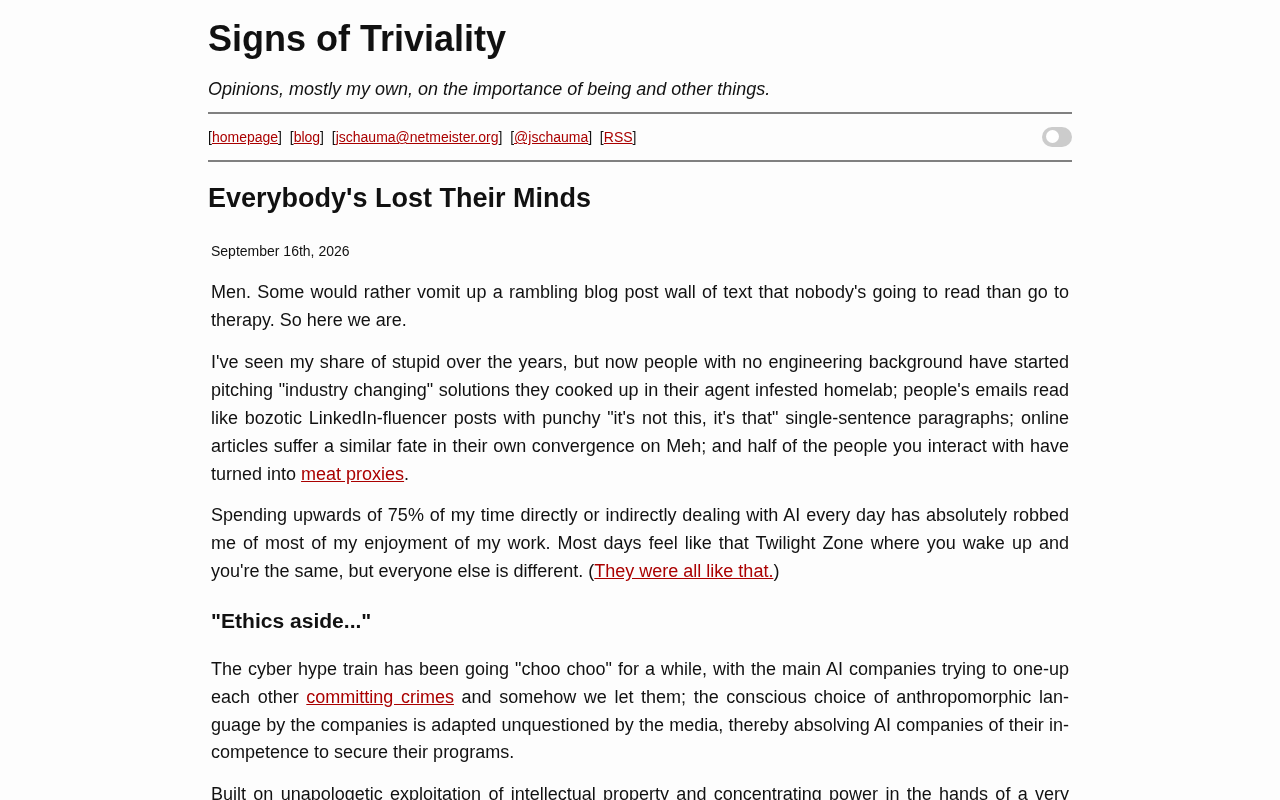
A blunt tech blog critiquing AI industry hype went viral on Hacker News, resonating deeply with engineers.
A blog post titled 'Everybody's Lost Their Minds' earned 251 upvotes and 168 comments on Hacker News, sparking widespread debate. The post bluntly critiques the tech industry's collective AI mania, reflecting engineers' frustration that hype has far outpaced technical maturity. Developers face pressure to ship AI features while grappling with over-promised and under-delivered outcomes. The author argues that such critical discourse is a healthy self-correction mechanism — the industry finding its balance between bubble and reason — and urges practitioners to treat AI as a tool for solving real problems, not a marketing label.
A tech blog titled Everybody's Lost Their Minds recently went viral on Hacker News, racking up 251 upvotes and over 168 comments. Published on netmeister.org, the post takes a blunt, critical look at the collective AI mania sweeping the tech industry — and it clearly struck a nerve.
A Critique That Resonated
The high engagement numbers speak for themselves. With 251 points and 168 comments, this post falls squarely into the "high-heat controversy" category for technical communities — drawing both strong agreement and heated pushback.
The title alone is an emotional statement: Everybody's Lost Their Minds. This kind of language has become increasingly common in tech commentary, reflecting a growing unease among seasoned practitioners about the state of the industry. When every company is rushing to slap an "AI" label on its products, every funding pitch must mention large language models, and every job posting is hunting for "prompt engineers," some people are starting to ask: Is this a genuine technological revolution, or a collective irrational exuberance?
The Industry Anxiety Behind the Hype
The reason articles like this resonate so widely is that they tap into a pervasive anxiety in today's tech industry. On one hand, AI has delivered real, tangible capability breakthroughs. On the other, the market hype, capital influx, and media amplification surrounding it have clearly outpaced the actual maturity of the technology.
For engineers working on the front lines, this disconnect is especially acute. They're caught between management mandates to "add AI features" and the technical reality of over-promised, under-delivered outcomes. When the business narrative races too far ahead of technical reality, practitioner frustration naturally crystallizes into a collective question: Has the whole industry lost its mind?
This gap between hype and reality is nothing new. The dot-com bubble around 2000 and the blockchain craze around 2017 followed eerily similar patterns: a genuine technological breakthrough → massive capital inflows → narratives that wildly outpace the technology → difficult real-world deployment leading to disillusionment → industry shakeout that ultimately surfaces genuinely valuable applications. Gartner describes this cycle as the Hype Cycle, with five stages: Technology Trigger, Peak of Inflated Expectations, Trough of Disillusionment, Slope of Enlightenment, and Plateau of Productivity. Much of today's debate about AI is essentially a disagreement about where we currently sit on that curve — optimists believe we've already passed the trough and are climbing the slope, while skeptics argue the peak hasn't even arrived yet and the biggest bubble burst is still ahead.
The Tech Community's Self-Correction Mechanism
What's worth noting is that the very spread of articles like this represents a healthy form of self-correction within technical communities. Amid the relentless wave of optimistic promotion, someone always needs to stand up and offer a cooler-headed perspective. Hacker News, as a hub for engineers, has long served as an important forum for exactly this kind of "temperature-lowering" discussion.
168 comments means this topic sparked genuine debate. You can expect the comment section to contain both strong agreement from those equally exhausted by the industry's frenetic pace, and dissenting voices from those who view the critics as overly pessimistic and blind to AI's real value. That back-and-forth is precisely how a technical community navigates its way between bubble and reason.
Hacker News was founded and is operated by Y Combinator, making it one of the most influential technology and startup communities in the world. Its unique voting and comment mechanics allow high-quality critical content to surface: a post's score isn't just based on upvotes but also a time-decay algorithm, meaning posts that sustain high engagement over a longer period tend to touch on genuine shared concerns. The HN user base skews heavily toward engineers, founders, and investors — people with high technical literacy and generally low tolerance for overblown marketing and empty hype. For that reason, a critical post scoring 250+ on HN carries far more representative weight than a trending post on mainstream social media. It's closer to authentic emotional feedback from industry insiders.
How to Think Rationally About the AI Boom
For everyday developers and technical decision-makers, the takeaway from this article is perhaps the importance of maintaining independent judgment. Tech booms aren't inherently bad — they accelerate resource allocation and innovation. But blindly following the herd and piling on "AI features" disconnected from actual user needs can waste resources and degrade product experience.
The mature approach is to treat AI as a tool for solving specific problems, not a marketing label. A technology's value is only real when it genuinely improves efficiency or user experience. Complexity introduced merely to "look cutting-edge," on the other hand, almost always costs more than it's worth.
Closing Thoughts
The viral spread of Everybody's Lost Their Minds is less a rejection of AI technology than a collective moment of reflection on the industry's feverish atmosphere. In an era of rapid technological change, enthusiasm and sobriety must coexist — the former drives progress, the latter prevents disaster.
For every technology practitioner, what matters most isn't picking a side between "true believer" and "skeptic." It's maintaining clear, independent thinking — the ability to pick out genuinely valuable signals from the noise.
(Note: This article is based on analysis of Hacker News discussion metrics and the blog's title and framing. Readers interested in the full argument are encouraged to read the original post.)
Related articles

NVIDIA cuML Accelerates Spectral Clustering: 100x+ Speedup Over Scikit-Learn Benchmarked
NVIDIA cuML lets Scikit-Learn spectral clustering run on GPU without code changes, delivering 200x+ speedups on large datasets. Learn how it works and how to use it.
Google DeepMind Launches New Institute to Bring the AGI Debate into the Open
Google DeepMind has launched a new institute to bring AGI debate into the public sphere. We analyze what this signals about the shift from technical competition to AI governance.
How Cooley Is Reinventing IPO Legal Workflows with ChatGPT: A Look at the GO Public Tool
Cooley built GO Public on ChatGPT Work to accelerate IPO legal workflows, helping lawyers catch issues earlier and focus judgment where it matters most.