LTT Finally Completes 2004 Flagship PC Build After Seven Years: Classic Hardware Meets Modern Water Cooling

LTT finally fulfills a 7-year promise, rigging a 2004 flagship PC with modern custom water cooling.
The Linus Tech Tips team spent seven years finally completing a shelved project: a full custom water cooling overhaul of a 2004-era flagship PC featuring an Intel 875 chipset motherboard, Northwood C 2.4GHz CPU, and GeForce 6800 Ultra. EK fabricated dedicated waterblocks for the CPU, GPU, memory, and even the southbridge, while fitting old hardware into a modern chassis exposed a wave of compatibility challenges — USB generation gaps, IDE storage, and a failed AGP riser attempt. The build was topped off with tuner car "rice out" aesthetics including BMW badges, an air freshener, and a cardboard spoiler, before successfully POSTing into Windows XP as a heartfelt tribute to the golden era of early 2000s PC hardware.
A promise made seven years ago has finally been kept. The Linus Tech Tips team revisited a project that had been shelved for more than half a decade in their latest video — a full "rice out" of a top-tier PC from around 2004, breathing new life into the old machine with modern water cooling and custom components.
The project had a rocky road: a dead motherboard, missing parts, the custom waterblock manufacturer running into business difficulties, and the departure of the original partner who was supposed to co-lead it. But as the video opens, "When something is important enough, you find a way to push through the obstacles."
A Flagship Build Frozen in 2004
At the heart of this build is a high-end motherboard based on the Intel 875 chipset, supporting Northwood-series CPUs — some of which could crack 5GHz with aggressive overclocking. DDR 400 memory, a dedicated AGP slot — at the time, this was the stuff of dreams.
The CPU chosen is a C-Revision Northwood at 2.4GHz. The video walks through the technical characteristics of this platform in detail: the Northwood C's signature feature was its 800MHz Front Side Bus (FSB), the link between the CPU and the northbridge. Back then, the memory controller hadn't yet been integrated into the CPU — it lived in the northbridge — so this bus speed directly determined how efficiently the CPU could access memory. AMD would later be the first to move the memory controller into the CPU itself, fundamentally changing this architectural approach.
One fun piece of trivia: the reason it's called a "chipset" is because it literally used to be a set of chips — northbridge and southbridge as separate dies. Most modern designs have consolidated these into one. The old Intel Socket 478 had just 478 pins, looking almost quaintly tiny compared to modern sockets with their thousands of contacts.
For memory, the team originally wanted period-correct OCZ Platinum but ended up substituting Kingston Value RAM. DDR1 is famously overclockable with enough voltage — and since this machine only needs to "live for a day or two," longevity wasn't much of a concern.
Historical Context: The Front Side Bus (FSB) and Northbridge Architecture
The Front Side Bus was one of the central bottlenecks of early 2000s Intel platforms. In this architecture, the CPU exchanged data with the northbridge over the FSB, and the northbridge in turn handled memory (via the DRAM controller) and the high-speed graphics interface (AGP/PCIe). An 800MHz FSB was top-of-the-line at the time, but the limited bus bandwidth meant significant latency whenever the CPU had to wait on memory. AMD integrated the memory controller directly into the CPU with the Athlon 64 (2003), bypassing the northbridge entirely and dramatically reducing memory access latency — a key reason AMD frequently beat same-clock Intel processors in benchmarks of that era. Intel didn't follow suit until the Core i7 (Nehalem architecture) in 2008, integrating the memory controller and replacing the FSB with the QPI interconnect, officially ending the FSB era.
Stacking Modern Water Cooling on Ancient Hardware
The most striking part of the whole project is the custom water cooling solution EK built for these vintage components. EK has gone through a business restructuring in recent years, and the video notes that the new operating structure allows it to continue taking care of old partners and staff — "I think having a strong EK is better for the whole industry."
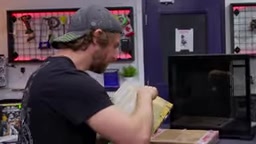
Fitting the custom waterblocks onto this old motherboard was a genuine challenge — there was simply no standardized mounting system for CPU waterblocks back then, since water cooling was still a niche pursuit cobbled together in small garages and workshops. To secure the hefty CPU block, the team ended up using the motherboard's existing mounting holes — and the board visibly bowed under the weight of the block. "You've barely even tightened it."
The GPU is a 6800 Ultra fitted with an Arctic Cooling Silencer series cooler — a card famous in its day for its massive dual-slot heatsink, impressive overclocking headroom, and two four-pin Molex power connectors. EK fabricated custom waterblocks for the GPU, memory, and even the southbridge. The southbridge block was purely "because we can, not because we need to."
The team also attempted to vertically mount the GPU using a 3D-printed AGP riser card, but ran into issues with it simply not working and ultimately abandoned the idea in favor of a conventional installation.
The AGP Interface and the Evolution of Discrete Graphics Connectors
AGP (Accelerated Graphics Port) was a dedicated graphics interface standard Intel derived from the PCI bus in 1996, offering far greater bandwidth than standard PCI of the time. As GPU performance demands exploded, AGP went through multiple revisions — 1x, 2x, 4x, and 8x — with AGP 8x reaching a theoretical peak bandwidth of 2.1 GB/s. The 6800 Ultra was one of the premier products of the AGP 8x era. However, AGP was fundamentally a point-to-point dedicated interface with limited flexibility. Around 2004, PCI Express (PCIe) began to take hold, and its scalable serial lane design with higher bidirectional bandwidth rapidly displaced AGP as the standard graphics interface — a role it holds to this day. The "AGP vertical riser" the team attempted faced not only mechanical mounting challenges but also signal integrity concerns, making its ultimate failure entirely unsurprising.
Compatibility Headaches Where Old Meets New
Shoehorning old hardware into a modern case (Lian Li O11) surfaced compatibility issues at every turn.

Surprisingly, a modern Seasonic Prime 1600W flagship PSU still includes every connector the old motherboard needs — the 20-pin main power connector is even designed to detach as a 4-pin section, making it straightforward to plug into this old board. EK's new distribution block also features bleed valves that can be connected to an air compressor to blow out coolant, sparing everyone the indignity of blowing into tubes by mouth.
But there were plenty of headaches too. The front panel I/O uses modern USB 3.0, while the old motherboard only has internal USB 2.0 headers — buried in the top corner of the board, naturally — requiring a dedicated adapter. Storage was a full nostalgia trip: this machine runs an IDE interface, and the team tracked down a round IDE cable. Linus quipped that he'd "thrown away hundreds of these things and now I'm paying $10 for one." The hard drive selected is a 60GB model.
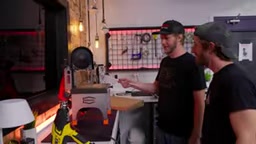
First boot didn't go off without a hitch either — a loose GPU power connector triggered a piercing alarm, the classic behavior of old graphics cards that loudly protest missing external power. Eventually the POST screen lit up on an OLED monitor, prompting the team to joke it was "the best-looking POST screen I've ever seen."
IDE Interfaces and the Generational Shift in Storage Technology
IDE (Integrated Drive Electronics, also known as PATA or Parallel ATA) was a hard drive interface standard established in the late 1980s, instantly recognizable by its wide 40- or 80-wire ribbon cables. It transmitted data in parallel, with the highest spec — ATA/133 — achieving a theoretical bandwidth of around 133 MB/s. As the 2000s progressed, parallel data transmission at higher frequencies ran into severe signal interference problems that made further speed increases impractical. SATA (Serial ATA) began displacing IDE from 2003 onward, winning out with thinner cables, higher bandwidth (even first-gen SATA hit 150 MB/s), and hot-swap support. The "round IDE cable" the team specifically sourced was a popular accessory among overclockers of that era — twisting the flat ribbon into a round bundle improved airflow inside the case, and became a signature aesthetic of that era's modding culture.
Finishing Touches: From "Rice Out" to Full Tuner Car Aesthetics
Calling it a "rice out" naturally demanded some over-the-top decorative flourishes borrowed from car tuning culture. Guest Alex, who runs the dual automotive/tech channels ZipTieTuning and ZipTieTech, spends 85% of his time "taking apart cars."
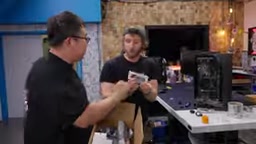
The two slapped on BMW M3 badges sourced from Taobao and Amazon (claiming to be "Made in Germany"), hung a car air freshener, added red air vent trim pieces, and hand-built a "spoiler" from cardboard, zip ties, and tape — ostensibly to generate "downforce." Unused ports on the distribution block were filled with the audience-voted green coolant, while the main loop runs a vibrant pinkish-purple.
Final numbers: CPU at 23°C, GPU around 50°C under load (hitting 71°C at full load, suggesting the thermal interface may not be making ideal contact), and the hard drive at 27°C. On the display output side, dual-link DVI theoretically supports 2560×1600 at 60Hz, though real-world refresh rate behavior under Windows XP is limited by drivers from a very different era.
Beyond all the memes and jokes, the team agreed: "This is the best I've ever seen Bliss look" — the iconic Windows XP wallpaper. As the video points out, this machine "would have blown a PS2 out of the water."
A Hardware Culture Document Built on Nostalgia and Perseverance
The value of this video isn't in the machine it produced — the goal was simply "good parts on an old PC." It's more of a tribute to the golden age of early 2000s PC hardware: the era when overclocking genuinely mattered, when chipsets still had separate northbridge and southbridge chips, and when water cooling was still the domain of basement hobbyists.
From a technical standpoint, the video strings together FSB, Socket 478, AGP, IDE, Molex power, and other concepts that have long since exited the mainstream — a vivid archaeology lesson for the younger generation of hardware enthusiasts. Emotionally, it fulfills a seven-year-old promise and reunites a pair of old collaborators. As the closing line puts it: "See you in another 14 years for the V2 with underglow."
Related articles

Cursor AI Programming in Practice: Build a Student Management System from Scratch in 30 Minutes
A Bilibili creator demonstrates Cursor AI programming: generating a student management system in 30 minutes with natural language. Details on Agent mode, Claude selection, prompt techniques, and thresholds.

Top 20 AI Coding Tools Ranking: From Rock-Solid to Lackluster, a Scored Matrix
Bilibili creator releases top 20 AI coding tools ranking, tiered T0–T4 from rock-solid to lackluster, with Claude Code and Codex tied at T0. This article details the scoring dimensions (capability, reliability, robustness, durability, cost, domestic availability) and tool performances to help developers choose the right AI coding assistant.

Vibe Coding Systematic Tutorial: Master AI-Assisted Programming from Zero
A three-month Vibe Coding tutorial from a Bilibili creator covering Codex, ClaudeCode, and Cursor, from core logic to commercial project practice for beginners.