Luce: How Relightable Gaussian Clouds Are Revolutionizing 3D Asset Generation
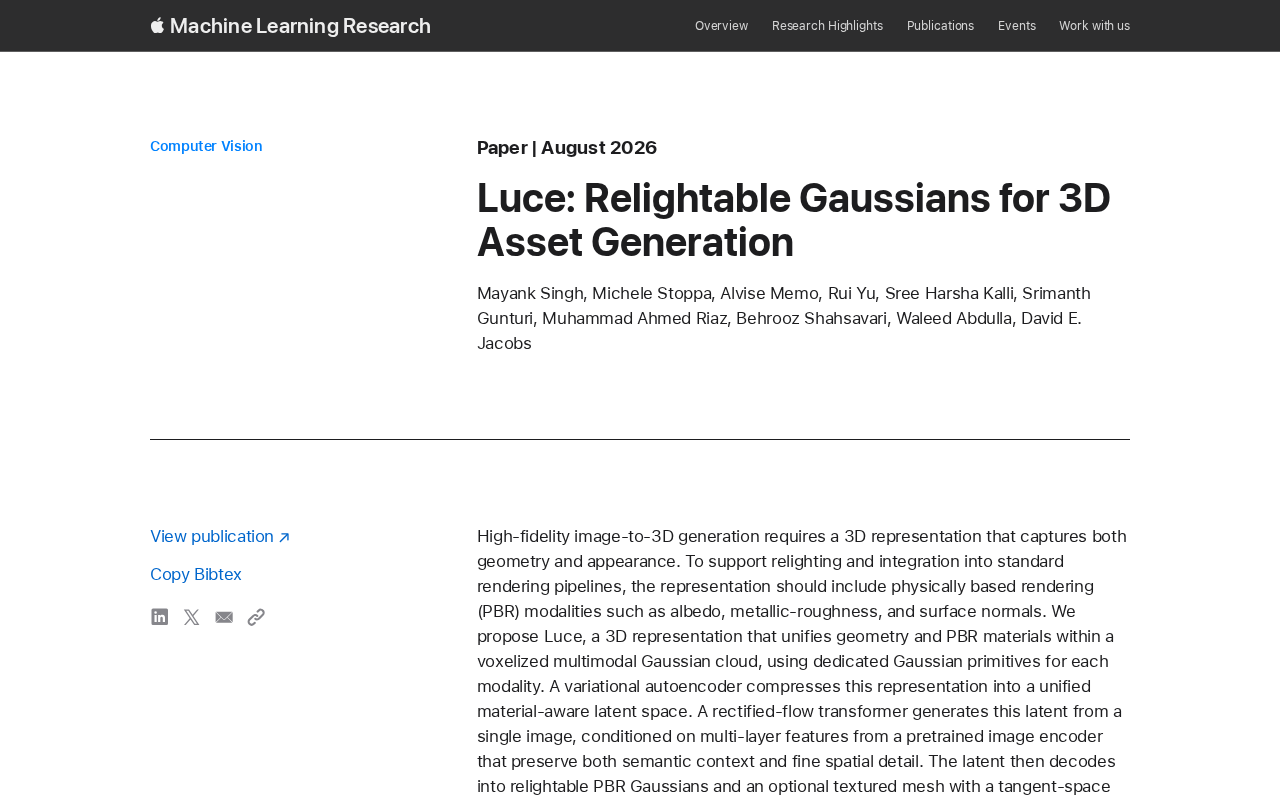
Luce unifies geometry and PBR materials in multimodal Gaussian clouds for relightable 3D generation
Luce introduces voxelized multimodal Gaussian clouds with dedicated primitives for geometry, albedo, metallic-roughness, and normals, compressed via VAE into a unified material-aware latent space. This enables high-fidelity, relightable 3D asset generation compatible with standard rendering pipelines.
A New Breakthrough in 3D Generation: Unified Representation from Geometry to Materials
As AIGC technology evolves from 2D images into three-dimensional space, image-to-3D generation is becoming a focal point at the intersection of computer vision and graphics. AIGC in 2D imaging has already undergone a paradigm shift from GANs to diffusion models, with text-to-image models like Stable Diffusion, DALL·E, and Midjourney reaching commercial maturity. However, 3D content generation faces challenges far beyond 2D: it must handle not only multi-view consistency but also model topology, surface materials, and lighting interactions. From NeRF (Neural Radiance Fields) to 3D Gaussian Splatting, and now to unified representations incorporating PBR materials, 3D generation is rapidly advancing along the path of "visualizable → editable → production-ready." High-fidelity 3D generation requires not just reconstructing an object's geometric structure, but precisely capturing its appearance and materials—precisely where existing methods fall short.
A research project named Luce proposes an innovative 3D representation method that unifies geometry and physical materials within a single framework, opening a new path for 3D asset generation. The core value of this work lies in enabling generated 3D models to be "relit" and seamlessly integrated into industry-standard rendering pipelines.
Why Is Relightability So Critical for 3D Assets?
Core Pain Points of Existing 3D Generation Methods
Traditional image-to-3D generation methods often "bake" lighting information into the object's surface color. Light baking is a common optimization technique in traditional real-time rendering—pre-storing lighting calculation results in texture maps for direct runtime lookup rather than real-time computation. In 3D generation scenarios, this problem manifests in a more subtle form: most NeRF or 3D Gaussian-based methods learn a "radiance field," directly fitting the color values observed from specific viewpoints. These color values are essentially mixed results of material properties and ambient lighting. Since the model never explicitly models the separation of lighting and materials, generated 3D assets severely distort in appearance once placed in new scenes facing different light sources—the lighting "ghost" from the original training scene emerges, causing misaligned shadows, distorted highlights, and completely lost material texture. For example, an object trained under outdoor sunlight may still retain unnatural blue skylight reflections when placed in an indoor warm-light scene.
For practical applications in gaming, film, industrial design, and similar fields, this is a fatal flaw. Truly usable 3D assets must adapt to arbitrary lighting environments, requiring the representation method itself to include Physically-Based Rendering (PBR) properties.
Key Elements of PBR Materials
Physically-Based Rendering (PBR) is not a single technology but a rendering framework that follows physical laws such as energy conservation and microfacet theory. Its core concept originates from BRDF (Bidirectional Reflectance Distribution Function) theory in the 1960s, developed through models like Cook-Torrance, and ultimately standardized through Disney's "Principled BRDF" proposed around 2012. Today, glTF 2.0 (the 3D asset transmission standard by Khronos Group) explicitly adopts the metallic-roughness workflow as the standard parameterization for PBR materials, meaning any 3D asset claiming PBR support should output material maps conforming to this standard for seamless loading by mainstream tools.
Luce explicitly states that a qualified relightable 3D representation should include the following PBR modalities:
- Albedo: The object surface's intrinsic base color, completely stripped of lighting influence
- Metallic-Roughness: Determines whether the object has metallic or non-metallic texture and the surface smoothness level
- Surface Normals: Precisely describes surface orientation, directly affecting the accuracy of lighting calculations
These properties collectively form the "universal language" modern rendering engines (like Unreal Engine, Unity) use to understand materials. Only with complete PBR modalities can generated 3D assets truly integrate into standard rendering workflows.
Luce's Core Technology: Multimodal Gaussian Clouds Explained
Voxelized Multimodal Gaussian Representation
The technical core of Luce is a voxelized multimodal Gaussian cloud. Understanding this innovation requires first grasping its foundation—3D Gaussian Splatting (3DGS). 3DGS was introduced by Kerbl et al. at SIGGRAPH 2023 and quickly became a powerful alternative to NeRF. Its core idea is to explicitly represent scenes using numerous 3D Gaussian ellipsoids: each Gaussian primitive contains position (mean), covariance matrix (determining shape and orientation), opacity, and spherical harmonic (SH) coefficients (encoding view-dependent color). During rendering, these 3D Gaussians are "splatted" into 2D screen space, generating the final image through alpha blending. Compared to NeRF's implicit volumetric rendering, 3DGS's explicit representation makes rendering tens of times faster, achieving real-time frame rates with more intuitive gradient propagation. However, the original 3DGS's spherical harmonics encode view-dependent radiance rather than intrinsic material properties—precisely the core limitation Luce needs to address.
Luce makes a critical extension to 3DGS. Its ingenuity lies in configuring dedicated Gaussian primitives for each modality. Specifically, geometry, albedo, metallic-roughness, normals, and other properties each have independent Gaussian representations, rather than mixing all information in the same parameter set. This decoupled design brings two significant advantages:
- Each modality receives sufficient and precise modeling
- Effective avoidance of mutual interference and coupling between different properties
VAE-Based Unified Material-Aware Latent Space
Multimodal Gaussian clouds alone are insufficient—raw Gaussian representations have massive data volumes, difficult to use directly for generation tasks. To address this, Luce introduces a Variational Autoencoder (VAE), compressing this complex representation into a unified, material-aware latent space.
The Variational Autoencoder is a generative probabilistic model proposed by Kingma and Welling in 2013. Its core mechanism uses an encoder to map high-dimensional input to a low-dimensional latent distribution (typically assumed Gaussian), then a decoder reconstructs the original input from sampled latent variables. VAE's KL divergence regularization ensures continuity and smoothness of the latent space, making interpolation and sampling in latent space produce meaningful outputs. In modern generative AI architectures, VAE often serves as a "compression frontend"—for example, Stable Diffusion's VAE compresses 512×512 images into 64×64 latent representations, enabling efficient diffusion processes in low-dimensional space. Luce extends this approach to 3D: compressing tens of thousands of multimodal Gaussian primitives into compact latent encodings, providing an operable input space for subsequent diffusion generative models.
This step is crucial. Through VAE compression, geometry and material information are encoded into a compact and continuous latent space. This not only dramatically reduces data dimensionality but, more importantly, provides an operable latent variable foundation for subsequent generative models. In this latent space, geometry and PBR materials are unified, enabling the generation process to simultaneously coordinate object structure and surface appearance.
Significance and Industry Outlook of Luce's Technical Approach
The Leap from "Viewable" to "Usable"
Luce represents a critical shift in 3D generation from "visualization" to "production-readiness." Past 3D generation often remained at the "viewable" stage—generating a model that looks decent at specific viewpoints under specific lighting. Luce pursues "usability"—generated assets can directly enter professional content creation pipelines, be re-edited by artists and engineers, relit, and placed in different scenes.
This emphasis on PBR materials and standard rendering pipeline compatibility reflects how 3D generation research is rapidly aligning with real industrial needs.
Continued Evolution of 3D Gaussian Splatting Representation
From a technical evolution perspective, Luce demonstrates another important evolutionary direction for 3D Gaussian Splatting methods. Original 3D Gaussians primarily focused on geometry and view-dependent appearance, while Luce extends them into multimodal carriers bearing complete physical material information. This "one primitive, multiple modalities" design philosophy may inspire more follow-up research, driving Gaussian representations toward richer, more physically-grounded directions.
Technical Challenges Still to Face
Of course, such methods still face open questions worth attention:
- Training Stability: Joint training of multimodal Gaussians may face convergence difficulties
- Ill-posedness of PBR Decomposition: The same image may correspond to multiple material-lighting combinations, with ambiguous decomposition results
- Information Loss: VAE compression inevitably loses some details
Decomposing PBR material parameters from single or few images is known in computer vision as the "inverse rendering" problem. Its fundamental difficulty lies in the forward rendering equation being a many-to-one mapping: a dark red pixel could come from countless combinations like "red material + white light," "white material + red light," "deep red metallic material + strong ambient light," etc. This ill-posedness means that theoretically, material parameters cannot be uniquely determined from observed images alone. Existing methods typically rely on prior knowledge to constrain the solution space—for example, assuming statistical patterns of natural lighting, leveraging large-scale material databases to learn material distribution priors, or using multi-view information for additional constraints. Luce faces particularly prominent challenges: it needs to complete this decomposition in single-pass feed-forward generation inference rather than through iterative optimization and gradual convergence, placing extremely high demands on the implicit priors learned by the model.
Ensuring the physical plausibility of generated results will be a key measure of such methods' maturity.
Conclusion: Luce Points the Way for 3D Asset Generation
Luce provides a clear technical path for high-fidelity, relightable 3D asset generation through unified multimodal Gaussian cloud representation of geometry and PBR materials, combined with material-aware VAE latent space compression. Its value lies not only in improved generation quality but in bridging the "last mile" from AI generation to industrial rendering pipelines.
As demand for 3D content explodes in gaming, metaverse, digital twins, and other fields, technologies capable of generating "plug-and-play" high-quality relightable 3D assets will become increasingly valuable. The multimodal Gaussian cloud direction represented by Luce deserves continued attention from practitioners and researchers.
Related articles

Uber Deploys ChatGPT Work Company-Wide: AI in the Workplace Enters the Scaled Implementation Phase
Uber deploys ChatGPT Work to 30,000+ employees, extending it from engineering to all roles. We analyze its expert-engineer pairing, end-to-end automation, and questions of AI control and power concentration—insights for scaling AI in the workplace.

Shift at Midnight Hands-On: When "ID Verification" Becomes Alien Hunting
Shift at Midnight blends ID verification with horror survival in a four-player co-op game. We break down its inspection mechanics and chaotic humor.

Zelensky Recounts the Outbreak of War: I Need Ammunition, Not a Ride
Zelensky recalls the first day of war in a YouTube interview: farewell to family, rejecting Biden's evacuation offer with "I need ammunition, not a ride," and how Bucha shaped his stance on compromise and peace talks.