Lune: An Academic Search Engine Built for Scientific AI Agents

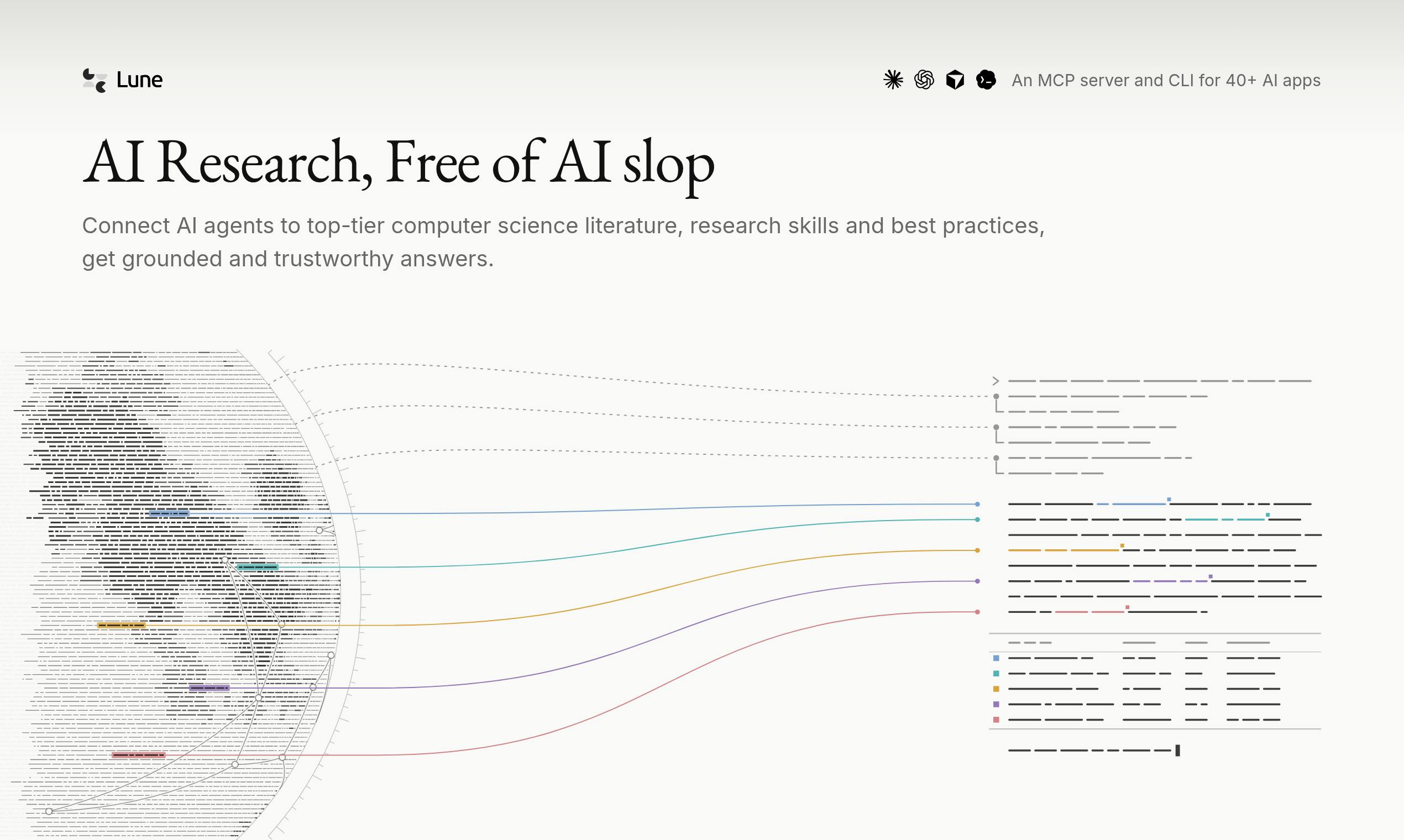
Lune is an academic search engine for scientific AI agents, grounding research in top-conference papers.
Lune is an early-stage product that debuted on ProductHunt, positioning itself as the "Exa.ai of scientific research" — applying the AI-agent-focused search engine concept to the academic vertical. Its core value proposition is solving the credibility problem AI agents face in research contexts by grounding outputs in papers from top academic conferences. Lune claims 10x efficiency gains across literature review, experimental design, writing, and peer review, covering the full pipeline from early ideas to formal publication. It's betting on "scientific AI agent infrastructure" as an emerging space, though its coverage and differentiation from tools like Semantic Scholar and Elicit remain to be validated.
When AI Agents Meet Scientific Research: What Lune Is Building
On ProductHunt, a product called Lune debuted at #15 for the day with 66 upvotes. Its positioning is straightforward — "a search engine built for scientific AI agents." Developer Tony He gave it a recognizable tagline: Lune is the Exa.ai of scientific research.
If Exa.ai aims to reinvent general-purpose web search for AI agents, Lune takes that same philosophy and narrows it to the vertical of academic research. The core problem it's trying to solve: when AI agents get involved in the research process, how do you ensure they access high-quality, traceable, and verifiable knowledge — rather than getting dragged down by low-signal content and hallucinations from the broader internet?
Exa.ai (formerly Metaphor) is a search engine company designed specifically for AI agents and developers. Its core idea is to upgrade the underlying logic of web search from "keyword matching" to "semantic intent understanding," returning structured content directly via API rather than a list of webpage links. Traditional search engine results pages are designed for human visual scanning, whereas AI agents need text data they can process directly. Exa.ai validated the viability of the "search engine built for machines, not humans" business model, and has become a go-to data source for AI agent frameworks like LangChain. Lune transplants this logic into academia — essentially replicating Exa.ai's product paradigm while replacing the general internet with an academic paper corpus as its data source.
Core Value: High-Quality Knowledge Grounding
Lune's key concept is "knowledge grounding." It claims its knowledge base draws from papers published at top academic conferences, rather than generic web crawl results. In a scientific research context, this distinction matters enormously.
Researchers have far higher standards for source quality and credibility than general users. A single incorrect citation or an unreviewed preprint can throw off downstream experimental design or writing. Lune's emphasis on "traceable sources" and "evidence-backed decisions" speaks directly to this pain point.
In other words, Lune isn't just surfacing papers — it's trying to give AI agents a curated, trustworthy knowledge foundation, so that when an agent answers a question or executes a task, it can produce a reasoning chain with verifiable backing.
Knowledge Grounding is a core concept in natural language processing. It refers to anchoring a language model's outputs to verifiable external knowledge sources, thereby reducing "hallucinations" — instances where a model generates content that sounds plausible but is factually wrong or fabricated. The parameter weights of large language models are essentially compressed statistical representations of training data; they cannot precisely trace specific sources or guarantee real-time accuracy. Through Retrieval-Augmented Generation (RAG) architecture, a model can retrieve relevant documents from an external database before generating a response, injecting them as context into the prompt so that outputs become traceable. What Lune provides is a high-quality retrieval layer for scientific RAG pipelines. Its value lies in the credibility of its data source — top-conference papers have a structural advantage over ordinary web pages in terms of factual density and domain depth.
Envisioning 10x Efficiency Across the Full Research Workflow
According to its official description, Lune aims to improve efficiency across multiple stages of scientific research, claiming to deliver 10x improvements in literature review, experimental design, writing, and peer review. The workflow it covers stretches from "early-stage ideas" all the way to "formal publication":
- Literature review: Helps researchers quickly locate relevant work, reducing needle-in-a-haystack searching
- Experimental design: Provides evidence-based support for design decisions, grounded in existing research
- Paper writing: Supplies citable, traceable supporting materials throughout the writing process
- Peer review: Offers more rigorous evidence references for reviewers
Claims like "10x efficiency" are common in product marketing, and real-world improvements would need to be validated through actual use cases. But these claims clearly signal Lune's target user profile — not general information consumers, but researchers and technical teams.
Why This Direction Is Worth Watching
Lune sits at the intersection of three tags — developer tools, artificial intelligence, and science — which itself speaks to its positioning. As AI agents move from concept to real-world deployment, "what data you feed the agent" has become a key determinant of its capability ceiling.
General-purpose search engines are optimized for human users, returning webpage links and summaries. Search engines built for AI agents, by contrast, need to deliver structured, high signal-to-noise, machine-consumable knowledge. Exa.ai validated this approach in the general domain; Lune is betting on scientific research as a vertical that is both extremely sensitive to information quality and highly structured by nature — papers, citations, conferences.
Academic data has a natural structural advantage: papers have explicit citation relationships, publication venues have clear quality tiers, and scholarly consensus has traceable evolutionary trajectories. These characteristics make "building a dedicated search engine for research" more feasible here than in many other verticals.
Early-Stage Observations and Caveats
As a product that just launched on ProductHunt, Lune's publicly available information still leans heavily toward the vision side. A few questions worth watching going forward:
- How broad is its coverage of "top academic conference papers," and does it span multiple disciplines?
- What are its differentiated advantages compared to existing tools (such as Semantic Scholar, Elicit, Consensus, and other scientific AI tools)?
- Is the API design agent-friendly enough to genuinely integrate into agent workflows?
With only 3 comments and 66 upvotes, Lune is clearly at a very early stage. But the direction it's targeting — "infrastructure for scientific AI agents" — lands squarely on an important inflection point in AI development. For developers building AI applications in research contexts, this is a new tool worth adding to the watchlist.
The scientific AI tool space already has several mature competitors: Semantic Scholar, launched by Allen AI, is a free academic search engine indexing over 200 million papers with semantic search capabilities; Elicit focuses on using AI to assist with literature reviews, automatically extracting key variables and conclusions from papers; Consensus specializes in directly answering research questions based on evidence from papers. Most of these tools are also exploring API interfaces and agent integration. For Lune to establish meaningful differentiation, it will need to clearly surpass competitors in data coverage breadth, retrieval quality, API design, or depth within specific disciplines — otherwise it enters a market where incumbents have already established strong mindshare.
Related articles

Free Unlimited Claude Code Solution: Agnes AI + CC Switch Setup Guide
No paid subscription needed — pair the free AI platform Agnes AI with the open-source tool CC Switch to provide a backend for Claude Code, enabling unlimited free calls to text, image, and video models. This guide covers the full setup, test results, and usage boundaries.

A Complete Zero-Cost Guide to Getting Started with Claude Code for Beginners in China
A beginner's guide to Claude Code for users in China: two installation methods (command line and IDE plugin), full configuration steps for replacing the official API with the free domestic LongCat model, and a hands-on demo of building a small tool with natural language, plus tips.

When the NSA Gets Involved: The AI Supply Chain Crisis Behind Open-Source CVEs and API Key Hijacking
Multiple open-source projects disclosed severe CVEs in one day, PHP flaws alarmed the FBI, and Railway and OpenCode were breached with API keys stolen. This article breaks down the vulnerability window, AI-accelerated exploitation, and the AI supply chain crisis behind the API key black market, with a developer defense checklist.