Lynqo: Zero Cloud, Zero Fees — Turn Your Computer into a Local P2P Collaboration Server

Lynqo turns your computer into a local P2P collaboration server with zero cloud dependency and zero fees.
Lynqo is a local-first collaboration tool built on P2P architecture that transforms your Mac or PC into a high-speed server. It offers three core features — large video file sharing, frame-accurate client feedback, and cross-device clipboard sync — all without cloud uploads or subscription fees. Targeting video creators and small teams, it addresses speed, privacy, and cost concerns, though cross-network collaboration remains a technical challenge.
A Local Collaboration Tool That Bucks the Cloud Trend
In an era of ever-rising SaaS subscription costs and growing data privacy concerns, a tool called Lynqo has chosen a radically different path: no cloud uploads, no subscription fees — it simply turns your Mac or PC into a high-speed local server. The product recently launched on Product Hunt, earning 68 upvotes and landing at #19 on the daily leaderboard.
The SaaS (Software as a Service) subscription model has dominated the software industry over the past decade, but "subscription fatigue" has become increasingly pronounced in recent years. According to Gartner, the average enterprise uses over 130 SaaS applications, making software spending the second-largest cost item after personnel. For small creative teams, the combined monthly fees for core tools like Adobe Creative Cloud, Figma, Slack, Frame.io, and Dropbox can easily exceed several hundred dollars per person. Against this backdrop, movements for "buy-once licensing" and "local-first" software have been gaining momentum, and Lynqo is a representative product of this trend.
Its positioning is remarkably clear — a three-in-one local collaboration suite: video file sharing, clipboard syncing, and frame-accurate client feedback. Developer Mahesh Chambhare sums up the core value proposition in one line: "Zero cloud. Zero fees."
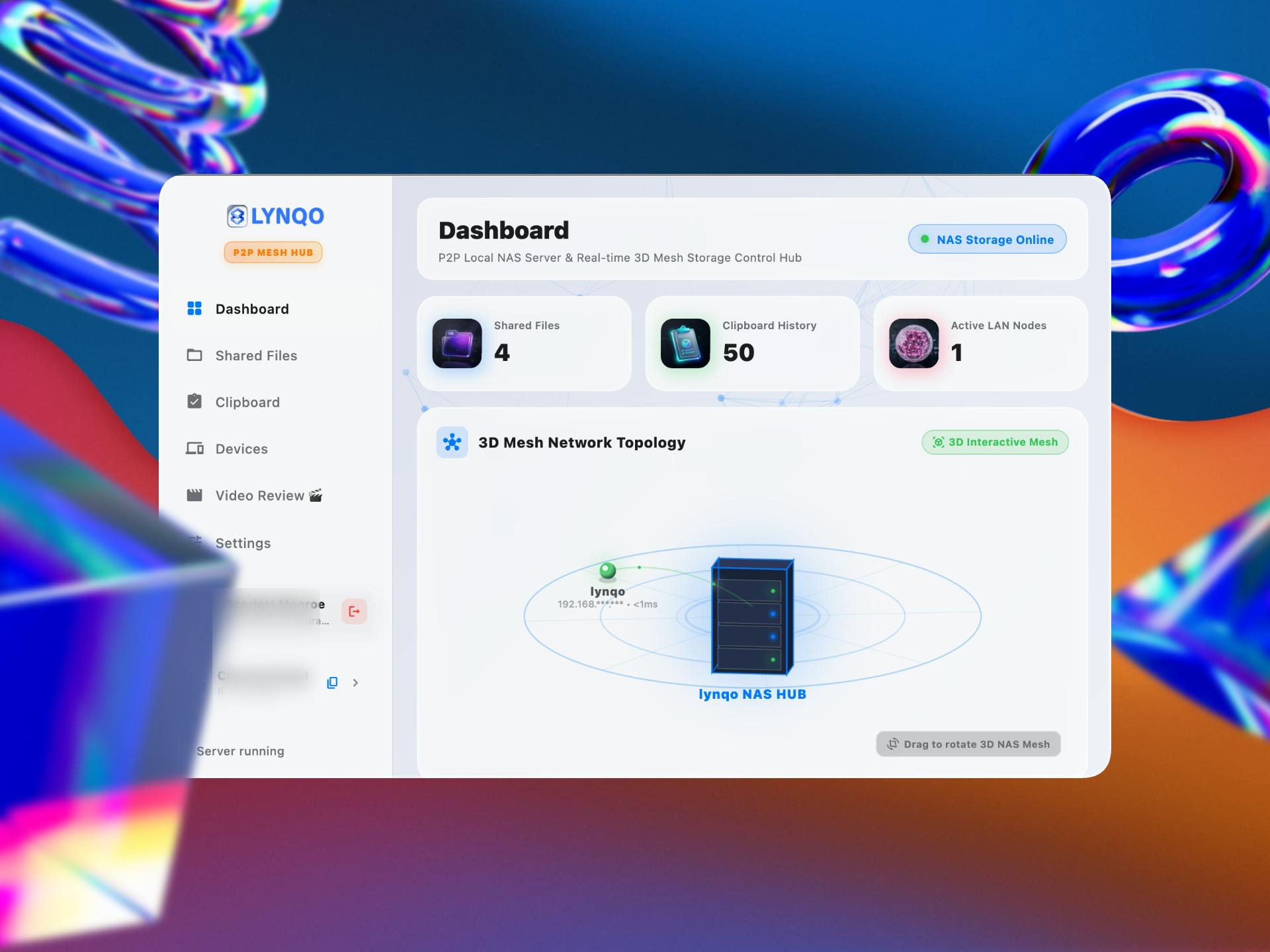
P2P Architecture: Lynqo's Core Competitive Advantage
Why Peer-to-Peer Transfer?
Lynqo's technical foundation is a P2P (peer-to-peer) architecture. P2P is a decentralized network communication model that first gained widespread recognition through file-sharing protocols like BitTorrent and Napster. In a P2P network, every participating node acts as both client and server, eliminating the need for a central server to relay data. In local network environments, this architecture can fully leverage local bandwidth (typically gigabit or even 10-gigabit speeds), delivering transfer speeds far beyond those achievable through internet-based upload and download. In recent years, the maturation of browser-native P2P protocols like WebRTC has significantly lowered the barrier to implementing peer-to-peer communication at the application level, spawning a wave of local-first tools such as Syncthing and LocalSend.
Traditional file-sharing and collaboration tools typically require uploading content to a cloud server first, then having the recipient download it — which not only incurs bandwidth and storage costs but also introduces transfer latency and data leakage risks.
Lynqo takes the opposite approach: your device itself is the server. When you need to share a video or sync clipboard content, data transfers directly between devices without passing through any third party. The team describes it as a "blazing-fast local server," and for LAN or direct peer-to-peer scenarios, this approach does hold an inherent advantage in transfer speed.
Privacy Protection and Cost Advantages
This architecture delivers two immediate benefits. First, data privacy: video assets and sensitive clipboard information never leave your device ecosystem, which is particularly appealing for creative teams working on confidential projects or freelancers handling sensitive material. Second, zero operational costs: with no cloud storage fees, there's no monthly subscription burden — a stark contrast to the per-seat pricing models common among today's collaboration tools.
This philosophy aligns closely with the local-first software movement that has gained traction in recent years. Local-first is a software design philosophy systematically proposed by the Ink & Switch lab in their 2019 paper of the same name. Its core thesis is that user data should be stored primarily on local devices, software should maintain full functionality offline, and collaboration should be achieved through direct device-to-device synchronization rather than reliance on cloud servers. This philosophy has inspired products like Obsidian and Anytype, as well as the development of underlying collaboration technologies such as CRDTs (Conflict-free Replicated Data Types). Local-first doesn't entirely reject networking — rather, it treats the network as an optional enhancement layer, ensuring users always retain full ownership and control of their data.
Three Core Features in Detail
Large Video File Sharing
Designed for video creators and marketing teams, Lynqo supports direct video file sharing. Compared to the cumbersome workflow of compressing, uploading to cloud storage, and generating share links, the local server model makes transferring large video files far more direct and efficient — addressing a real pain point for post-production professionals who frequently deliver high-bitrate final cuts. Take a 10GB 4K ProRes video file as an example: uploading via the cloud could take tens of minutes or longer (depending on upload bandwidth), whereas direct P2P transfer over a gigabit LAN could theoretically complete in under two minutes.
Frame-Accurate Client Feedback System
This is Lynqo's most industry-specific feature. During video review, vague verbal feedback ("somewhere around the middle part") frequently leads to back-and-forth communication. Lynqo provides a frame-accurate feedback mechanism, allowing clients or team members to leave annotations on specific frames of a video, pinpointing revision notes to exact timestamps.
This type of functionality has long been established in professional review platforms. Frame.io is the benchmark product in the video collaboration review space, acquired by Adobe in 2021 for $1.275 billion and integrated into the Creative Cloud ecosystem. Its core capability is precisely frame-accurate annotation — reviewers can add text and drawing annotations at exact frame positions on the video timeline, and even circle specific areas directly on the image. This fundamentally transformed the traditional video review process, which relied on inefficient email and phone descriptions of revisions. Before this, post-production teams frequently faced the "where exactly do you mean?" communication dilemma, and frame-level feedback converted vague subjective descriptions into precise timecode coordinates. Lynqo aims to deliver a similar experience in a localized, free package — making it particularly attractive for small teams with limited budgets who still need precise communication.
Cross-Device Clipboard Sync
The third feature is cross-device clipboard synchronization. Seamlessly copying and pasting text, links, and even files across multiple devices is a small but elegant capability that boosts daily workflow efficiency. Also built on P2P transfer, it eliminates privacy concerns about clipboard content being routed through the cloud. Apple's Universal Clipboard already provides a similar experience for Mac and iPhone users, but Lynqo's cross-platform nature means it can bridge the clipboard gap between Mac and PC, and across different operating systems.
Target Users and Market Positioning
Lynqo is categorized under Productivity, Video Streaming, and Marketing, reflecting the core audience it aims to serve: video creators, marketing teams, and efficiency-minded individual users.
From a product strategy perspective, it's entering a mature market carved up by Frame.io, Dropbox, and various clipboard tools, but seeking differentiation through the "local-first + zero fees" combination. For budget-constrained small teams or users sensitive about data sovereignty, this model does hold genuine appeal.
However, the local P2P architecture also has inherent limitations: collaboration across networks (such as remote teams spread across different regions) often requires more complex connection solutions, and cloud tools still offer irreplaceable convenience in terms of "access from anywhere." From a technical standpoint, P2P performs excellently within a LAN, but establishing direct connections across different networks — especially for devices behind NAT firewalls — is a classic networking challenge. Common solutions include NAT traversal (STUN/TURN protocols), hole punching techniques, and relay server fallback mechanisms. Modern networking tools like Tailscale and ZeroTier address this by creating virtual LANs through the WireGuard protocol, but all introduce additional complexity. For Lynqo, how to support remote team collaboration while maintaining its "zero cloud" promise will be the key technical challenge in expanding beyond local scenarios to broader use cases.
Lynqo currently has zero comments, with community discussion yet to develop. Its real-world stability, cross-platform experience, and connection reliability await validation from more users.
Conclusion: Is Local-First Worth Trying?
Lynqo represents a product philosophy worth watching: stepping outside the mainstream "everything in the cloud" narrative to reassess the value of local computing resources. It transforms personal computers into collaboration nodes, using P2P architecture to simultaneously address speed, privacy, and cost.
For creators who frequently work with video in local or peer-to-peer scenarios, need precise feedback, and are tired of subscription fees, Lynqo offers a novel alternative. Whether it can carve out a foothold amid cloud giants depends on how well it polishes its connection experience and builds user word-of-mouth — but at the very least, it raises the right question: do you really need to hand everything over to the cloud?
Related articles

Uber Deploys ChatGPT Work Company-Wide: AI in the Workplace Enters the Scaled Implementation Phase
Uber deploys ChatGPT Work to 30,000+ employees, extending it from engineering to all roles. We analyze its expert-engineer pairing, end-to-end automation, and questions of AI control and power concentration—insights for scaling AI in the workplace.

Shift at Midnight Hands-On: When "ID Verification" Becomes Alien Hunting
Shift at Midnight blends ID verification with horror survival in a four-player co-op game. We break down its inspection mechanics and chaotic humor.

Zelensky Recounts the Outbreak of War: I Need Ammunition, Not a Ride
Zelensky recalls the first day of war in a YouTube interview: farewell to family, rejecting Biden's evacuation offer with "I need ammunition, not a ride," and how Bucha shaped his stance on compromise and peace talks.