Lyra: Instantly Understand the True Meaning Behind Any Song with AI
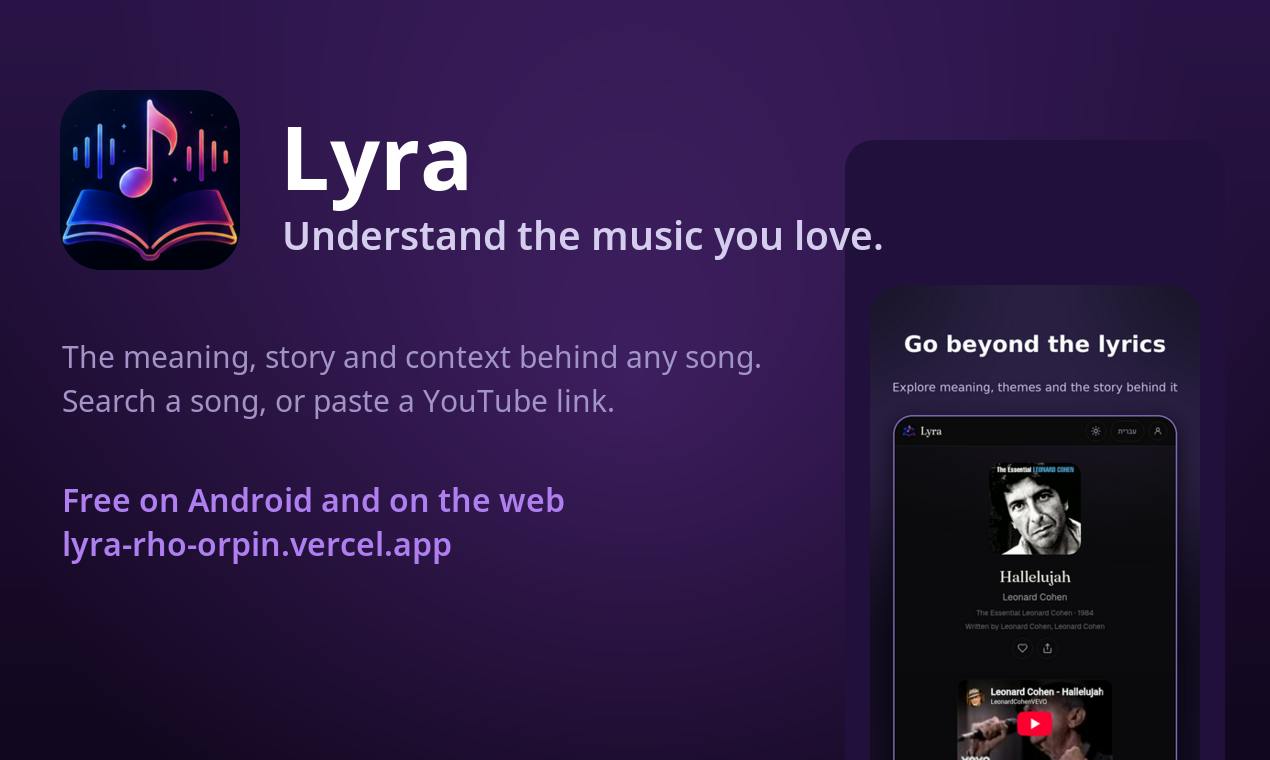
Lyra uses AI to instantly decode song lyrics, metaphors, and creative backstories for any track.
Lyra is an AI song interpretation tool built by an indie developer. Users can search a song title or paste a YouTube link to get a breakdown of literal meaning, metaphors, cultural references, creative context, and emotional tone — with translation support and conversational Q&A. It's free, supports English and Hebrew, and runs on Android and the web. Conceptually, Lyra is a focused application of LLMs to niche cultural content understanding, addressing the uneven coverage of crowdsourced platforms like Genius. The product is still at a very early stage, with interpretation accuracy, multilingual expansion, and lyric copyright compliance as its main challenges ahead.
You've Been Singing These Songs for Years — But Have You Ever Really Listened?
Many people have had this experience: a song you've hummed for years, the chorus rolling off your tongue on autopilot, yet you've never stopped to think about what it's actually saying. The metaphors in the lyrics, the story behind its creation, the emotions the artist was trying to convey — all of it buried under the muscle memory of the melody. Lyra targets exactly this gap between familiarity and understanding — an AI-powered app designed to decode the deeper meaning of songs.
Its core logic is straightforward: search for any song or artist, or paste a YouTube link, and Lyra returns a clear breakdown covering the song's true meaning, the story behind its creation, themes, metaphors, cultural references, and the overall emotional tone. Built by Or Delevski, the app is currently free, supports English and Hebrew, and is available on Android and the web.
What It Actually Does
Based on the product description, Lyra offers more than a Wikipedia-style song summary — it provides a multi-dimensional analysis built around a single track.
Deep Lyric Analysis and Creative Context
Lyra breaks a song down into several layers: what the lyrics literally say, the hidden metaphors and cultural references embedded in the words, and the circumstances the artist was in when writing it. For iconic tracks like Hallelujah, Bohemian Rhapsody, and Hotel California — songs that have been covered endlessly and interpreted in countless ways — this kind of structured breakdown is especially valuable. Their lyrics are packed with religious allusions, narrative metaphors, and emotional tension that most casual listeners never fully unpack.
Translation and Interactive Q&A
Beyond analysis, Lyra lets you read lyrics with translations and ask the AI follow-up questions about the song. This is what sets it apart from traditional lyrics sites (which typically just display plain text) — it functions more like a musically literate conversational assistant than a static database. If a particular line's meaning leaves you uncertain, you can ask directly, instead of hunting through forum threads for answers.
Why This Direction Is Worth Watching
Lyra is a textbook example of how large language models can be applied to deep understanding of niche content. Song interpretation is fundamentally a combined task of text comprehension, cultural context, and emotional analysis — precisely the kind of problem LLMs excel at. It requires parsing metaphors, connecting creative background, identifying emotional arcs, and then re-expressing everything in plain language.
Historically, this kind of content has relied on crowdsourced platforms like Genius, where fans manually write annotations with wildly inconsistent coverage and quality. An AI-driven approach can generate interpretations for virtually any song on demand, at near-zero marginal cost. That's both its appeal and its risk — the accuracy of generated content and hallucination issues are harder to spot in a subjective domain like music interpretation. The "true meaning" of a song is often something even the artist leaves ambiguous; whether an AI's interpretation qualifies as "truth" is a legitimate question.
Founded in 2009 as Rap Genius, Genius is currently the world's largest crowdsourced lyrics annotation platform. Users can add annotations to individual lines, explaining cultural references, slang, and creative context. The platform has accumulated annotations for millions of songs, but coverage quality depends heavily on community activity — popular hip-hop and pop songs may have dozens of detailed annotations, while obscure tracks or non-English songs are often left nearly blank. This structural "long-tail coverage gap" is precisely the space that AI solutions can theoretically fill. At the same time, LLM hallucination risks have a unique dimension in lyric interpretation: the inherent ambiguity of lyrics provides natural cover for misreadings, making it nearly impossible for users to tell whether the AI's metaphor explanations are grounded in documented creative history or are plausible-sounding fabrications.
Current State and Limitations of an Early-Stage Product
By Product Hunt's metrics, Lyra is still at a very early stage: 9 upvotes, 2 comments, ranked 19th on launch day, and deployed on a Vercel free-tier domain. All of this signals it's a new indie developer project, not yet validated at scale.
Its strength lies in a sharply focused entry point — rather than building a generalist music tool, it solves one specific problem: "what is this song actually about?" This kind of small, clear positioning is a smart move for an independent product. But to go the distance, it faces several real challenges: ensuring the accuracy of its interpretations, expanding multilingual support to reach a broader audience, and navigating legally sensitive territory around song lyrics and copyright compliance.
For listeners who love digging into musical meaning, language learners, or anyone wanting to quickly understand the background of a foreign-language song, Lyra offers a low-friction way to explore. It may not be a mature product yet, but it represents an interesting direction for how AI content understanding can land in everyday cultural consumption.
Lyric copyright is a long-standing legal minefield for music tech products. Unlike audio rights, lyrics are typically owned by publishers or songwriters, and displaying full lyrics without authorization can constitute infringement. Platforms like Genius have battled record labels over copyright issues for years, while LyricFind and Musixmatch operate legally by paying licensing fees to rights holders. For early-stage indie projects like Lyra, if they directly display complete lyric text rather than focusing purely on interpretation and analysis, copyright compliance will become an unavoidable hurdle as they scale. This partly explains why the product currently emphasizes "interpretation" and "interactive Q&A" rather than positioning itself as a lyrics library.
Takeaway
Lyra hands over the deceptively simple — but genuinely difficult — task of truly understanding a song to AI. It's free, multilingual, works on both web and Android, and has a clever entry point. As an early-stage project, its value lies more in demonstrating what LLMs can do in vertical cultural content interpretation than in being an indispensable tool right now. If you're curious, try it on a few classics — see whether AI's reading of Hotel California lines up with the version you've carried in your head all these years.
Related articles
AI Agent Fundamentals: The Three Core Components — Brain, Memory, and Tools
A beginner's guide to AI Agents: covering the three core components (brain, memory, tools), four stages of LLM deployment, and why Agents matter for real business use cases.
Boycotting Software That Doesn't Support Linux: One Developer's Philosophy of Choice
A Linux-only developer shares his philosophy of boycotting non-Linux software — without sacrificing productivity — and explains how coding agents like Claude Code are closing the gap with commercial tools.
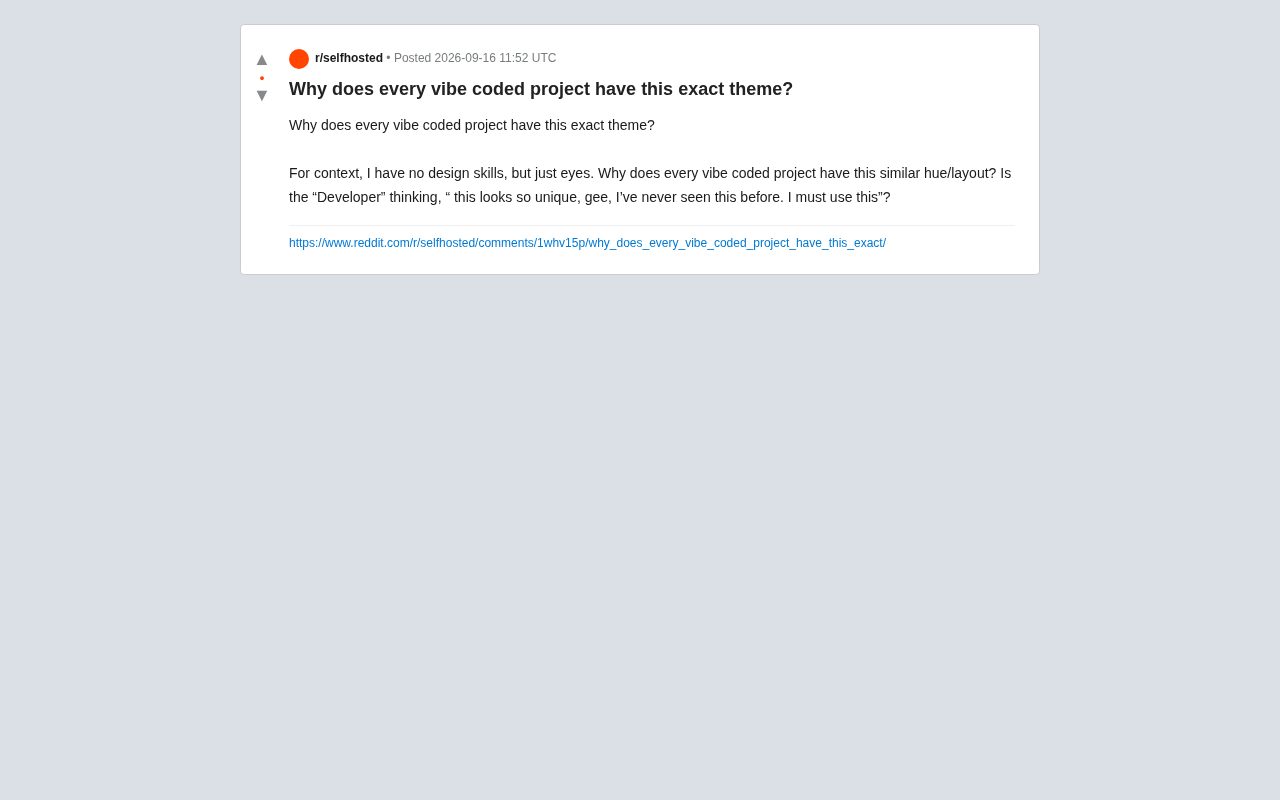
Why Do All AI-Generated Projects Look the Same? The Aesthetic Homogenization Problem in Vibe Coding
Why do vibe coding projects all use purple gradients and dark glassmorphism? We break down the technical roots of AI aesthetic homogenization and how to escape it.