Mac Developer Bridge: An Open-Source MCP Tool That Lets ChatGPT Directly Control Your Mac Terminal

An open-source MCP tool giving ChatGPT direct, unsandboxed access to your Mac terminal.
Mac Developer Bridge is an open-source tool that connects ChatGPT to your Mac's local environment via the MCP protocol, enabling direct shell command execution, file operations, PTY sessions, and background tasks. Its intentionally unsandboxed design maximizes efficiency for developers but shifts security responsibility to users. The project reflects the broader AI trend of moving from conversational assistants to autonomous agents capable of real-world execution.
When AI Truly Has a Terminal
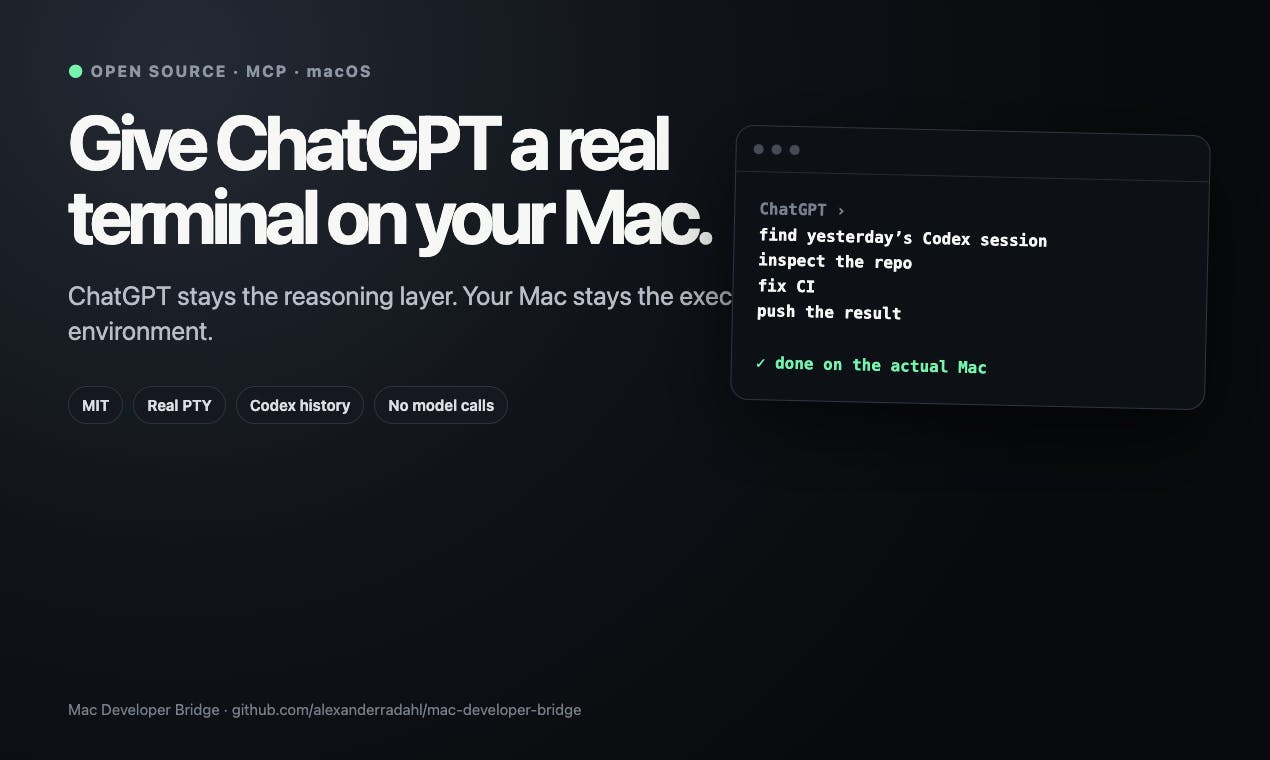
Recently, an open-source tool called Mac Developer Bridge launched on Product Hunt, attracting developer attention with its positioning of "giving ChatGPT a real terminal on your Mac." Built by developer Alexander Benz, the tool is released under the MIT open-source license.
Its core concept isn't complicated, yet it touches on a critical proposition in today's AI agent development: How to transform large models from armchair reasoners into operators that can actually execute tasks.
Core Functionality of Mac Developer Bridge
Mac Developer Bridge is essentially a bridging layer based on MCP (Model Context Protocol). MCP is an open protocol officially released by Anthropic in late 2024, designed to solve the fragmentation problem of connecting large language models with external tools and data sources. Before MCP, every AI application that needed to integrate with external tools (such as databases, file systems, or API services) required custom integration code, creating a massive "M×N" connection problem—M models connecting to N tools required M×N sets of adapter code. MCP simplifies this to "M+N" by defining a unified client-server architecture: the model side implements one MCP client, the tool side implements one MCP server, and the connection is complete. The protocol supports multiple primitives including tool invocation, resource reading, and prompt templates. It has been adopted by products like Cursor and Claude Desktop, and is becoming the de facto standard for the AI tool ecosystem.
Mac Developer Bridge leverages this protocol to connect ChatGPT with the user's local Mac environment, enabling the model to directly invoke a series of system-level capabilities:
- Shell command execution: Run commands directly in the terminal;
- File operations: Read and modify local files;
- Real PTY sessions: Support interactive pseudo-terminals, not just one-off commands;
- Background tasks: Run long-running background jobs;
- Read-only Codex history access: Let the model reference historical context.
The PTY (Pseudo-Terminal) support deserves special mention. A PTY is a virtual terminal device in Unix/Linux systems that emulates physical terminal behavior. It consists of a master and slave pair: the master end is held by the controlling program, while the slave end serves as standard input/output for child processes. Many command-line tools (such as vim, top, ssh, and interactive installation scripts) need to detect a terminal environment to function properly—simple pipe-based command execution cannot meet these requirements. With PTY, AI can handle complex operational workflows requiring multiple interactive confirmations, just like a human developer sitting at a terminal, rather than merely issuing single commands and waiting for results.
In other words, ChatGPT is no longer just an assistant that pastes code snippets for you to manually copy into the terminal—it can directly take over the execution step.
Architecture Design: Separation of Reasoning and Execution
One statement in the project description crystallizes its architectural philosophy: "ChatGPT stays the reasoning layer; your Mac stays the execution environment."
This "separation of reasoning and execution" design represents a mainstream approach in current AI Agent architecture. The large model handles thinking about "what to do," while the actual "how to do it" is delegated to a controllable local execution layer. This philosophy aligns with the classic software engineering principle of "separation of concerns"—the reasoning layer focuses on understanding intent, formulating plans, and handling exceptions, while the execution layer focuses on reliably completing specific operations. The two communicate through standardized protocols. MCP is precisely designed for this type of connection, making such separation standardized and reusable.
No Sandbox: More Powerful and More Dangerous
The most discussion-worthy aspect of this tool is its explicit statement: "intentionally not sandboxed."
This is a bold and controversial choice.
Efficiency Advantages of No Sandbox
A sandbox is a security isolation mechanism typically used to restrict a program's access to system resources, preventing malicious or erroneous operations from damaging the host environment. From a technical implementation perspective, sandboxes come in multiple levels: macOS's built-in App Sandbox is based on the TrustedBSD mandatory access control framework, limiting accessible resources through permission declarations; Docker containers in Linux use Namespaces and cgroups for process-level isolation; higher-security solutions like Google's gVisor or AWS's Firecracker provide complete isolation through virtualization. In AI code execution scenarios, OpenAI's Code Interpreter runs in an isolated container without access to the user's real file system or network—this guarantees security but also means many operations dependent on the real environment cannot be completed.
Mac Developer Bridge takes the opposite approach—it lets ChatGPT directly operate on your real, unisolated Mac system. The benefits are obvious:
- The model can access your real files, real development environment, real dependencies and configurations;
- Execution results are final results, with no need to shuttle between isolated and real environments;
- Extremely efficient for scenarios like automated operations, batch file processing, and development debugging.
Potential Security Risks
However, the risks cannot be ignored. If the model hallucinates (Hallucination—generating content that seems reasonable but is actually incorrect), misinterprets instructions, or if the instructions themselves are ambiguous, it could execute destructive operations like deleting files or modifying system configurations. Deeper risks include Prompt Injection attacks—malicious content could be read by the model through file contents, web data, or other channels, manipulating it to execute unintended operations. When this manipulated model has full system privileges, the consequences can be far more severe than within a sandbox. This is why such "full-permission" AI tools currently target primarily developers who understand the risks.
Transfer of Responsibility to Developers
This design effectively shifts security responsibility from the tool itself to the user. It's more like a sharp Swiss Army knife—powerful enough, but requiring users to exercise judgment and understand what permissions they're granting to AI. For advanced developers willing to accept risk in exchange for efficiency, this may be precisely its appeal. Notably, this "trust the user's judgment" philosophy has deep roots in Unix/Linux culture—rm -rf won't ask "are you sure?", and sudo doesn't add extra barriers when granting full root privileges. Mac Developer Bridge continues this tradition, treating AI as another powerful tool trusted by the user.
MCP Ecosystem and AI Agent Trends
Mac Developer Bridge is not an isolated case—it reflects a clear trend in AI: the transition from conversational assistants to autonomous agents.
AI Agent development has gone through several key stages. Early ReAct (Reasoning + Acting) frameworks taught models the "think-act-observe" cycle; subsequently, autonomous planning agents like AutoGPT and BabyAGI attempted to let AI independently decompose goals, formulate plans, and execute step by step; the current mainstream trend is tool-augmented agents, where models call external tools through standardized protocols to expand their capability boundaries, rather than trying to implement all functionality within the model itself.
An increasing number of tools are attempting to push AI beyond the chat window—OpenAI's Operator automates web interactions through browser automation, Anthropic's Computer Use lets Claude directly control desktop GUIs (understanding interfaces through screenshots and simulating mouse/keyboard operations), and Mac Developer Bridge focuses on command-line automation. Their shared goal is to shorten the distance between "AI gives advice" and "task actually completed"—eliminating the so-called "last mile" of human intervention, enabling models to directly operate real software, systems, and data.
The value of MCP becomes evident here. As an open standard, it makes "connecting a tool to AI" standardized and reusable. Developers no longer need to reinvent the wheel for each model and application—instead, they connect through a unified protocol. The MCP ecosystem has already spawned hundreds of community-contributed server implementations covering database queries, cloud service management, code repository operations, and more. Mac Developer Bridge is a concrete practice within this ecosystem—it implements an MCP server for the macOS local environment, allowing any AI application with MCP client support to gain local system operation capabilities through it.
Target Audience and Usage Recommendations
Overall, Mac Developer Bridge has a clear positioning:
Suitable for:
- Experienced developers familiar with the command line who understand permission risks;
- Technical users looking to automate local development and operations tasks;
- Geeks interested in the MCP ecosystem who enjoy tinkering with open-source tools.
Should exercise caution:
- General users unfamiliar with system operations;
- Anyone trying this on a primary machine with important data and no backups;
- Users expecting an "out-of-the-box, absolutely secure" experience.
As an MIT-licensed open-source project, its transparency is a plus—you can audit the code to understand exactly what it does. But the "no sandbox" design also means that before handing shell permissions to AI, making backups and understanding every command being executed is always wise. Recommended security practices include: running under a restricted user account rather than an admin account, setting up file system snapshots for critical directories, and requiring the model to output its plan for human confirmation before executing high-risk operations.
Conclusion
Mac Developer Bridge is a highly representative experiment. It answers the question "how to let AI actually do things" in the most direct way—no isolation, full delegation, maximum efficiency. This both showcases the enormous productivity potential of AI agents and reminds us once again: when models begin touching the real world, capability and risk always go hand in hand.
For the developer community, the significance of such tools may lie not just in themselves, but in how they push us to think: between "reasoning" and "execution," where exactly should the safety boundary be drawn? As the MCP ecosystem matures and AI Agent capabilities grow stronger, this question will become increasingly urgent—we need to find a precise balance point between efficiency and security, and that balance point is likely not a fixed line, but rather a permission management mechanism that dynamically adjusts based on context.
Related articles

Uber Deploys ChatGPT Work Company-Wide: AI in the Workplace Enters the Scaled Implementation Phase
Uber deploys ChatGPT Work to 30,000+ employees, extending it from engineering to all roles. We analyze its expert-engineer pairing, end-to-end automation, and questions of AI control and power concentration—insights for scaling AI in the workplace.

Shift at Midnight Hands-On: When "ID Verification" Becomes Alien Hunting
Shift at Midnight blends ID verification with horror survival in a four-player co-op game. We break down its inspection mechanics and chaotic humor.

Zelensky Recounts the Outbreak of War: I Need Ammunition, Not a Ride
Zelensky recalls the first day of war in a YouTube interview: farewell to family, rejecting Biden's evacuation offer with "I need ammunition, not a ride," and how Bucha shaped his stance on compromise and peace talks.