Mac mini M6/M5 Pro Review: Workstation-Class Performance in a 5-Inch Body

Apple's new Mac mini packs M6/M5 Pro chips and on-device AI into a 5-inch workstation-class desktop.
Apple's latest Mac mini features M6 and M5 Pro chip options, delivering workstation-level performance in a 5-inch square chassis. Key upgrades include full Apple Intelligence support for on-device AI processing, Wi-Fi 7 connectivity, and faster NVMe storage. The unified memory architecture makes it ideal for developers running local LLMs, while creators benefit from pro-grade compute power in a minimal footprint.
Apple has once again raised the bar for its most compact desktop product line. The latest Mac mini, powered by M6 and M5 Pro chips, packs stronger processing performance, Apple Intelligence support, Wi-Fi 7, and faster storage into a body measuring just 5 inches square. The product earned 83 upvotes on Product Hunt, landing at #10 on the daily leaderboard, and was categorized under Productivity, Developer Tools, and Apple.
For those who've been following Apple's desktop lineup over the years, the Mac mini has always set the standard for balancing value and form factor. Originally introduced by Steve Jobs in 2005 as a "BYODKM" (Bring Your Own Display, Keyboard, and Mouse) entry-level Mac, the product line reached a critical turning point in 2020 with the M1 version, which proved for the first time that an ARM-based desktop could comprehensively outperform contemporary Intel solutions. The 2024 M4 version shrank the chassis from 7.7 inches to 5 inches square (approximately 12.7cm × 12.7cm), reducing volume by nearly 60%. This latest chip upgrade further strengthens its competitiveness across development, content creation, and everyday productivity scenarios.
Mac mini's Dual-Chip Strategy: M6 and M5 Pro, Each Serving Its Purpose
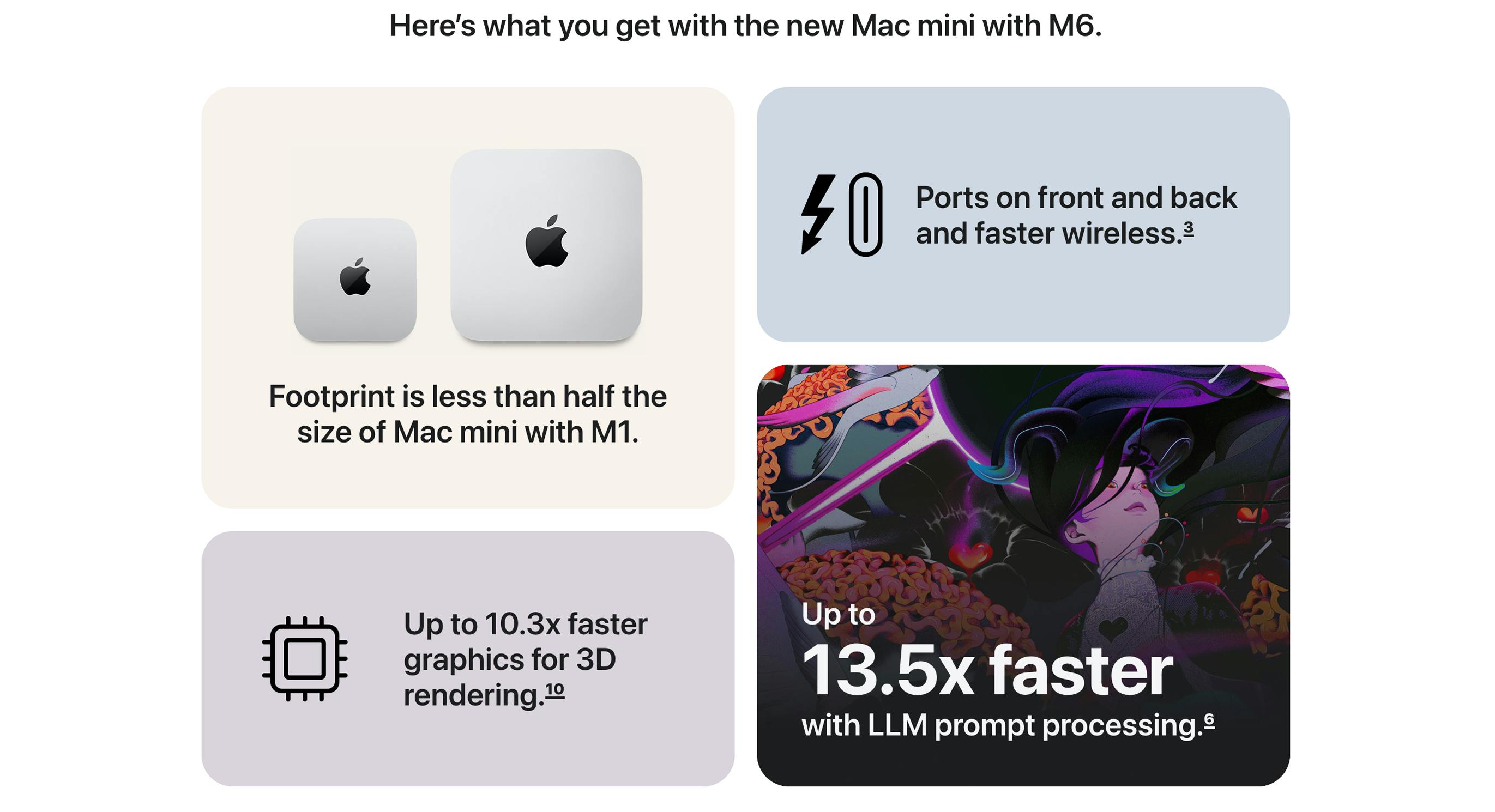
This Mac mini comes in two chip options — M6 and M5 Pro — continuing Apple's established product tiering approach. The standard M6 targets most everyday users, striking an excellent balance between efficiency and performance. The M5 Pro, on the other hand, is aimed at professional scenarios demanding higher compute power, including heavy multitasking, large-scale code compilation, and running AI models locally.
To understand the technical context behind this chip strategy, it helps to look back at the architectural evolution of Apple's M-series. Since launching the M1 in 2020, Apple has completed a full transition from Intel's x86 architecture to its custom ARM-based design. M-series chips are manufactured using TSMC's advanced process nodes (the M6 is expected to use 3nm or the more advanced N3E/N2 nodes), integrating CPU, GPU, Neural Engine, and unified memory controller into a single package. This SoC (System on Chip) design eliminates the data-transfer bottleneck between CPU and GPU found in traditional discrete architectures, allowing all compute units to share a single memory pool — dramatically reducing latency and improving performance per watt. Pro-series chips typically add more CPU/GPU cores, greater memory bandwidth, and higher unified memory ceilings on top of the standard version to handle professional workloads.
By housing both chips in the same compact chassis, Apple means users don't have to make significant compromises between size and performance. Compared to traditional desktops that consume substantial desk space, the 5-inch Mac mini delivers near-workstation-level processing power while maintaining an extraordinarily small footprint.
According to Apple's official positioning, this product is explicitly aimed at "coding, creating, and getting work done," which is why it falls under both the Productivity and Developer Tools categories.
Apple Intelligence: A Deep Dive into Mac mini's On-Device AI Capabilities
One of the headline features of this upgrade is full support for Apple Intelligence. As Apple deeply integrates AI capabilities at the system level, the Mac mini — as an always-on desktop device — is uniquely positioned to take full advantage of on-device AI processing.
Apple Intelligence is the system-level AI framework Apple first unveiled at WWDC 2024. Its core design philosophy is "on-device processing first." The framework is built on Apple's proprietary Foundation Models and encompasses language understanding, image generation, text summarization, and more. The technical implementation relies on the Neural Engine in M-series chips (the latest generation delivers over 30 TOPS of compute) along with the unified memory architecture — the latter allows AI models to be loaded directly into memory space accessible by both the GPU and Neural Engine, eliminating the need to copy data between different hardware components. For complex requests that exceed on-device capabilities, Apple Intelligence routes tasks to Apple's own Apple Silicon server clusters via Private Cloud Compute, with end-to-end encryption and zero data retention.
The Value of On-Device AI for Developers and Creators
For developers and creators, running AI models locally offers three key advantages: lower inference latency, stronger privacy protection, and long-term cost savings from not relying on cloud subscriptions. The unified memory architecture of M-series chips provides an inherent advantage for AI inference tasks, while the M5 Pro's more generous compute headroom creates the conditions for running larger local models.
To explain this advantage in more technical detail: in traditional PC architectures, the CPU uses system memory (DDR5) while the GPU uses dedicated VRAM (GDDR6/HBM). Running an AI model requires copying model parameters from system memory to VRAM — a process constrained by PCIe bus bandwidth, with VRAM capacity typically far smaller than system memory. Apple's unified memory architecture makes all memory a shared resource, directly accessible by CPU, GPU, and Neural Engine alike, eliminating the overhead of data copying. This means that when running large language models (such as open-source models like Llama or Mistral) on a Mac mini, model parameters can be loaded directly into unified memory for all compute units to access. The M5 Pro is expected to support up to 48GB or more of unified memory, theoretically enabling local execution of quantized models with 7 billion parameters or even larger — an advantage that similarly priced Windows PCs struggle to match.
In an era of explosive AI application growth, more and more developers want to test, fine-tune, and deploy models in local environments. A Mac mini equipped with Apple Intelligence is perfectly suited to this need, serving as a high-value local AI development platform.
Wi-Fi 7 and High-Speed Storage: Comprehensive Connectivity and Throughput Upgrades
Beyond the core chip iteration, the new Mac mini also introduces Wi-Fi 7 wireless connectivity. Wi-Fi 7 (IEEE 802.11be) is the latest wireless LAN standard officially certified by the Wi-Fi Alliance in 2024. Compared to its predecessor Wi-Fi 6E, it introduces three key technological breakthroughs: MLO (Multi-Link Operation) allows devices to simultaneously establish connections across the 2.4GHz, 5GHz, and 6GHz bands and aggregate bandwidth; 4096-QAM modulation increases the data carried per symbol by 20% over Wi-Fi 6's 1024-QAM; and 320MHz ultra-wide channels double single-channel bandwidth. Combined, these technologies push Wi-Fi 7's theoretical peak rate to 46Gbps, with real-world single-device throughput exceeding 5Gbps and end-to-end latency dropping to the millisecond range.
For users who frequently transfer large files, collaborate remotely, or create streaming content, this is an upgrade that directly improves daily experience. In studios or offices where multiple people share the same network, Wi-Fi 7's MLO multi-link aggregation capability can significantly reduce the impact of network congestion on individual devices.
Faster storage configurations are equally noteworthy, further shortening system response times and wait times for loading large projects. For developers, higher read/write speeds directly impact the efficiency of cloning code repositories, building container images, and processing large-scale datasets. Apple's NVMe SSD solutions in the Mac mini typically use a custom storage controller, which — combined with macOS's APFS file system optimizations — delivers superior performance in small random read/write scenarios compared to third-party solutions of similar specifications.
These seemingly "supporting cast" spec upgrades actually work in concert with the chip upgrade to form the Mac mini's complete experience as an efficient workstation. The chip determines the performance ceiling, but connectivity speed and storage throughput are the key factors affecting day-to-day fluidity.
Mac mini's Market Positioning and Target Audience
Within the broader desktop computer market, the Mac mini has always played a unique role. It's not an all-in-one, nor a freely expandable tower — it wins through extreme volume efficiency and deep integration with the Apple ecosystem. Notably, the Mac mini also serves many non-traditional desktop roles within Apple's product lineup — it's widely used in CI/CD build farms (continuous integration/continuous deployment automated build clusters), home media servers, and small server cluster scenarios. Its low power consumption (under 10W at idle) and minimal footprint make it an exceptionally cost-effective compute node for these use cases.
The addition of M6 and M5 Pro pushes the Mac mini further along its "small size, high performance" product trajectory:
- Entry-level users: Those who already own a display and peripherals can get a cost-effective desktop solution with a clear upgrade path via the M6 version
- Professional users: The M5 Pro version can handle medium-to-heavy workloads including video editing, 3D rendering, and software development
- Developers: With Apple Intelligence backing, the Mac mini becomes an ideal platform for local AI model testing and deployment
Judging by the Product Hunt community response, 83 upvotes indicate that this product maintains steady appeal among developers and productivity tool users. As the most accessible member of Apple's desktop lineup, every chip iteration of the Mac mini redefines the performance boundaries of compact desktop computing.
Conclusion: Who Should Pay Attention to This Mac mini
The new Mac mini with M6 and M5 Pro continues Apple's core strategy in the compact desktop space: delivering sustained performance leaps within an extremely small form factor through more powerful chips, better wireless connectivity, and faster storage. Whether you're a developer who needs an efficient build environment, a creator seeking on-device AI processing capabilities, or a productivity-focused user who wants a smooth work experience, this is a desktop choice that deserves serious consideration in today's market.
Related articles

Free Unlimited Claude Code Solution: Agnes AI + CC Switch Setup Guide
No paid subscription needed — pair the free AI platform Agnes AI with the open-source tool CC Switch to provide a backend for Claude Code, enabling unlimited free calls to text, image, and video models. This guide covers the full setup, test results, and usage boundaries.

A Complete Zero-Cost Guide to Getting Started with Claude Code for Beginners in China
A beginner's guide to Claude Code for users in China: two installation methods (command line and IDE plugin), full configuration steps for replacing the official API with the free domestic LongCat model, and a hands-on demo of building a small tool with natural language, plus tips.

When the NSA Gets Involved: The AI Supply Chain Crisis Behind Open-Source CVEs and API Key Hijacking
Multiple open-source projects disclosed severe CVEs in one day, PHP flaws alarmed the FBI, and Railway and OpenCode were breached with API keys stolen. This article breaks down the vulnerability window, AI-accelerated exploitation, and the AI supply chain crisis behind the API key black market, with a developer defense checklist.