Machine Learning Project Portfolio: A Complete Guide to Building Resume-Worthy ML Projects

A complete guide to building ML portfolio projects that stand out on your resume and impress interviewers.
This guide helps ML learners transition from beginner to intermediate by building resume-worthy projects. It covers three core criteria (solving real problems, end-to-end pipelines, and uniqueness), provides tiered project recommendations from EDA reports to LLM fine-tuning, and shares practical tips on documentation, technical writing, and iterative development.
From Beginner to Intermediate: Why Machine Learning Project Selection Matters So Much
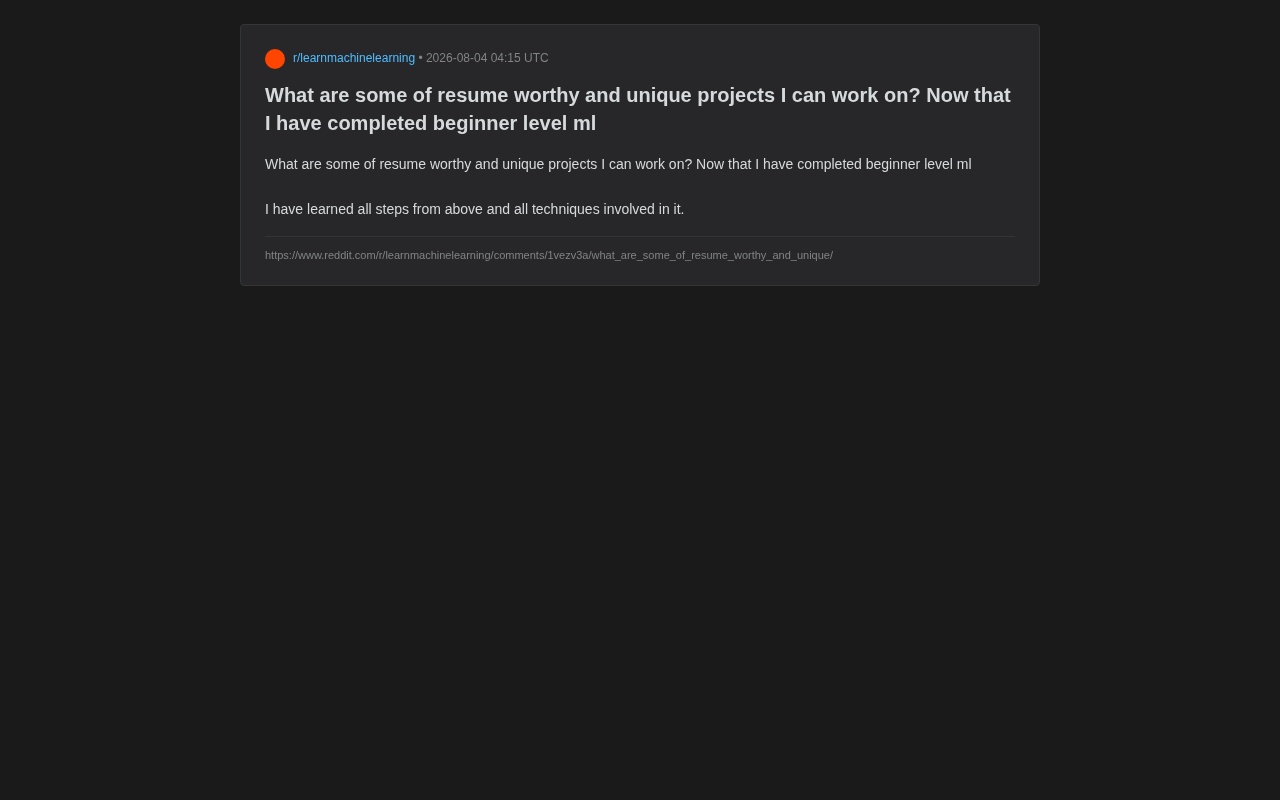
After completing your introductory machine learning studies—mastering the fundamentals of data preprocessing, feature engineering, model training, and evaluation—you often hit a wall: what should you do next? In Reddit's machine learning community, a developer who had just finished beginner-level ML learning posed this classic question: "What projects are worth putting on a resume and unique enough to invest time in?"
This question reflects a common anxiety among learners: the cookie-cutter Titanic survival predictions, house price regressions, and Iris flower classifications on Kaggle—these "textbook projects" create virtually zero differentiation in a recruiter's eyes. Kaggle, the world's largest data science competition platform with over 15 million registered users, features the Titanic survival prediction as its most classic beginner challenge—something nearly every ML learner has done. These projects use meticulously cleaned data, clearly defined features, and single evaluation metrics, making them essentially optimization problems in a closed environment. However, real-world ML work is far more complex—data quality varies wildly, business requirements are ambiguous, and evaluation criteria are multidimensional. The fundamental reason recruiters experience "aesthetic fatigue" with these projects is that they cannot distinguish between "a learner who follows tutorials" and "an engineer who can independently solve problems."
What truly impresses interviewers are machine learning projects that demonstrate your ability to solve real problems and capacity for independent thinking.
This article starts from project selection methodology, combines industry practices, and provides a practical project planning framework for ML learners transitioning from beginner to intermediate level.
Three Core Criteria for Resume-Worthy Machine Learning Projects
Criterion 1: Solve Real Problems, Not Repeat Exercises
Recruiters see countless resumes containing "MNIST Handwritten Digit Recognition" every day. The problem with these projects: the dataset is clean, the problem is pre-defined, and the answer is already known. They prove you can use an API but cannot prove you can handle real-world messiness.
Truly valuable machine learning projects should stem from a problem you genuinely care about or have observed. For example: analyzing public transit delay patterns in your city, predicting fair prices for local second-hand goods, or building a recommendation system for a niche interest community. When a project has a real application context, the story you tell in interviews becomes far more convincing. The key point is that real problems often have no standard answers—you need to define success criteria yourself, balance multiple objectives, and handle imperfect data—these are exactly the challenges that industry ML engineers face every day.
Criterion 2: A Complete End-to-End Machine Learning Pipeline
A project demonstrating comprehensive capability should cover the full chain from data acquisition to deployment:
- Data Collection: Scraping data yourself or calling APIs to obtain raw data, rather than directly downloading ready-made datasets
- Data Cleaning & Exploration: Handling missing values and outliers, conducting Exploratory Data Analysis (EDA). EDA is a methodology proposed by statistician John Tukey in 1977, emphasizing deep understanding of data distribution, relationships, and anomalies through visualization and statistical summaries before modeling. A high-quality EDA process typically includes univariate distribution analysis, bivariate correlation exploration, missing value pattern identification, outlier detection, and discovery of interaction effects between features. In practice, EDA often occupies 40%-60% of total project time, because a deep understanding of data directly determines the direction of feature engineering and the appropriateness of model selection.
- Modeling & Tuning: Trying multiple algorithms and comparing them, documenting the hyperparameter tuning process
- Deployment & Presentation: Wrapping the model as an API or building a simple web application
Pushing an ML model from a Jupyter Notebook to production involves a series of engineering practices. Common deployment paths include: wrapping the model as a REST API using Flask or FastAPI, ensuring environment consistency through Docker containerization, and achieving elastic scaling with cloud services (AWS SageMaker, Google Cloud AI Platform, Azure ML). For the frontend presentation layer, you can use Streamlit or Gradio to quickly build interactive interfaces. The MLOps (Machine Learning Operations) concept has emerged in recent years, encompassing model version management (MLflow), data pipeline orchestration (Airflow), model monitoring, and drift detection—all indispensable components in production environments.
An end-to-end machine learning project proves you haven't just "run a notebook successfully" but possess engineering deployment capability—exactly what employers value most.
Criterion 3: Demonstrate Uniqueness and Personal Thinking
Uniqueness can come from data sources, problem definition, or technical approach. Using unique data you collected yourself, modeling for niche domains, or combining two seemingly unrelated technologies can all make your project stand out among countless resumes.
The essence of uniqueness is information asymmetry—when you choose a problem domain the recruiter has never seen, or adopt an unconventional technical combination, you automatically gain the initiative in the conversation. The interviewer cannot judge your project against "standard answers" and can only listen to your reasoning logic—which happens to be the best scenario for demonstrating depth of capability.
Tiered ML Project Recommendation List
Foundation-Building Projects (1-2 Weeks)
If you've just completed basic learning, start with one or two consolidation projects to build confidence:
- Personalized Data Analysis Report: Select a public dataset you're interested in (such as Spotify listening history or personal fitness data), conduct deep EDA, and draw insightful conclusions
- Text Sentiment Analysis Tool: Scrape social media comments on a specific topic, train a sentiment classification model, and visualize trends
The focus of these projects isn't technical difficulty but rather analytical depth and presentation quality. A well-crafted data visualization report with clear narrative logic often impresses non-technical hiring managers more than a complex but poorly explained deep learning project.
Comprehensive Capability Projects (3-4 Weeks)
At the intermediate stage, challenge yourself with more complete systems:
-
End-to-End Recommendation System: Build a recommendation engine for a specific scenario (books, movies, restaurants), implement collaborative filtering or content-based recommendations, and deploy as an interactive application. Recommendation systems are one of ML's most successful industrial applications—the core competitiveness of platforms like Netflix, Amazon, and TikTok all depends on them. Collaborative filtering splits into User-based CF and Item-based CF paradigms: the former recommends by finding similar users, while the latter recommends through co-occurrence relationships between items. Matrix factorization techniques (such as SVD, ALS) effectively handle sparse rating matrices. Modern recommendation systems typically adopt hybrid architectures, combining collaborative filtering, content-based recommendations, and deep learning models (such as Wide & Deep, DeepFM) while considering real-time features and contextual information. The cold start problem (new users or items lacking interaction data) is a classic challenge—if you can demonstrate a cold start solution in your project, it will be a highlight.
-
Real-Time Data Prediction Service: Combine public APIs (weather, stocks, traffic) to build a service that continuously updates data and provides predictions. The technical challenges here lie in data pipeline stability, inference latency control, and handling data distribution drift over time (Data Drift).
-
Computer Vision Application: Train object detection or image classification models for specific needs, such as identifying plant diseases or waste classification. Transfer Learning is the core technique for such projects—using models pre-trained on ImageNet (such as ResNet, EfficientNet) as feature extractors and fine-tuning on small custom datasets can achieve excellent results with less data and computational resources.
Cutting-Edge Exploration Projects (1+ Months)
To truly build competitive advantage on your resume, try projects close to the frontier:
-
Fine-Tuning Open-Source Large Language Models: Use techniques like LoRA to fine-tune open-source LLMs on domain-specific data to build vertical domain assistants. LoRA (Low-Rank Adaptation) is a parameter-efficient fine-tuning technique proposed by Microsoft Research in 2021. Its core idea is to inject low-rank decomposition matrices alongside the pre-trained model's weight matrices, freezing the original parameters during training and only updating these newly added small-scale parameters. For a d×d weight matrix, LoRA only needs to train two matrices of dimensions d×r and r×d (where r is much smaller than d, typically 4-64), reducing trainable parameters from billions to millions. This makes it possible to fine-tune 7B or even 13B parameter LLMs on consumer-grade GPUs (like a single RTX 3090/4090). QLoRA further combines 4-bit quantization to reduce VRAM requirements even lower. Hugging Face's PEFT library provides a standardized LoRA implementation, significantly lowering the barrier to entry.
-
Multimodal Applications: Build applications combining multiple modalities such as text and images. Multimodal learning is a hot research direction in current AI, with representative works including OpenAI's CLIP (contrastive learning connecting vision and language), GPT-4V (visual understanding), and various text-to-image models. A practical multimodal project could be: building an intelligent search system that understands both product images and text descriptions, or developing a sentiment analysis tool combining voice, text, and facial expressions.
-
Contributing to Open Source Projects: Submitting contributions to well-known ML open-source libraries carries significant weight on a resume. Contributing code to projects like scikit-learn, PyTorch, Hugging Face Transformers, or LangChain means your code has undergone rigorous Code Review and meets industrial coding standards. This proves you can read and understand large-scale codebases, your code quality meets community maintainer standards, and you're capable of collaborating with developers worldwide. Contributions don't have to be core features—fixing bugs, improving documentation, and adding test cases are all valuable starting points. Your GitHub contribution history (commit records, PR discussions) itself serves as a transparent proof of capability.
Practical Tips to Make Your Machine Learning Projects Stand Out
Documentation and Code Quality Are Equally Important
Even the best project loses impact if the GitHub repository contains only a messy notebook. Be sure to write a clear README explaining the project motivation, technical approach, how to run it, and results. Good code organization, comments, and version control are themselves demonstrations of professionalism.
An excellent README should include: a project overview (one sentence describing what problem it solves), a technical architecture diagram, a quick start guide, data description, model performance metrics, and future improvement directions. Using a clear project directory structure (such as src/, data/, models/, notebooks/, tests/) makes the codebase immediately comprehensible. Additionally, adding a requirements.txt or environment.yml ensures others can reproduce your results with one click—this attention to reproducibility itself demonstrates engineering maturity.
Document Your Thinking Process
You can record the challenges you encountered, the technical choices you made, and your reasoning through blog posts or project documentation. Recruiters don't just want to see results—they want to understand how you think about problems. A high-quality technical write-up often impresses people more than the project itself.
Effective technical writing should answer these questions: Why did you choose this problem? What approaches did you try, and what were their pros and cons? What unexpected difficulties did you encounter? How did you make trade-off decisions? How did the final results differ from expectations? This structured reflection not only helps interviewers understand your capability boundaries but also demonstrates a growth mindset—acknowledging failures and limitations is actually more convincing than perfect results.
Start Small, Iterate Continuously
Don't aim for grand goals from the start. First build a working Minimum Viable Product (MVP), then gradually add features and optimize performance. This methodology originates from Lean Startup principles, with the core idea of reducing risk through rapid hypothesis validation. In ML projects, an MVP could be a prototype using a simple baseline model—first verify the correctness of the data pipeline and evaluation framework, then gradually introduce more complex models and features. The ability to iterate continuously is what distinguishes an engineer from a "tutorial copier." Git commit history itself records your iteration trajectory—frequent small commits demonstrate more professional development habits than a single massive code dump.
Conclusion
Advancing from a beginner ML learner to a competitive candidate requires projects as the most powerful bridge. Truly resume-worthy machine learning projects aren't about using the most sophisticated algorithms—they're about whether the project solves a real problem, demonstrates comprehensive capability, and reflects independent thinking.
Rather than repeating exercises on cookie-cutter classic datasets, start from real needs around you and build a project that may be imperfect but is genuine enough. When you can passionately narrate the story behind your project in an interview, you've already won at the starting line.
Key Takeaways
Related articles

Apple HomeView Hands-On Review: Is the $300 Smart Home Hub Worth It?
Apple HomeView hands-on: a $300 smart home hub with facial recognition for quick account switching, but no App Store or voice recognition. Is the wall-mounted version worth it? Should you buy the first generation?

Meta Muse Wonder Launch: What It Means for Meta's Return to the Frontier AI Race
Meta releases Muse Wonder and WonderFull, benchmarks reach the frontier, community feedback is polarized. An in-depth look at Meta's return to the frontier AI race, its personal agent strategy, and Zuckerberg's different path.

Apple Home Smart Home Lineup Leaked: LG and Schneider Team Up, UWB Door Lock on Board
Apple Home ecosystem gains new LG and Schneider devices: UWB smart lock with proximity unlock, 2.5K dual-camera doorbell, privacy indoor camera, and AirPods-like seamless pairing.