Make0 Brain: A Cross-AI-Agent Memory Bank That Breaks Down Conversation Silos

Make0 Brain gives multiple AI agents a shared cross-tool personal memory layer via MCP.
Make0 Brain is a personal memory bank for AI agents, positioned as a memory storage layer independent of specific AI tools. It supports ChatGPT, Claude, Cursor, and other MCP-compatible tools in reading and writing the same personal context, aiming to solve "context fragmentation" when users switch between AI tools. Users can import historical chats and Markdown docs, with initialization claimed to take two minutes. It is most valuable to heavy multi-tool users, creators, and developers, but remains early-stage with only 64 votes and 1 comment on Product Hunt. Its bet on open protocols reflects AI infrastructure expanding from the model layer to the memory layer.
When AI Agents Start "Losing Their Memory"
If you use ChatGPT to draft proposals, Claude to read papers, and Cursor to write code at the same time, you've probably run into this scenario: every time you switch tools, you have to re-paste the background information, re-explain the project requirements, and even restate the conclusions from the previous round of conversation. Each AI agent is like an isolated information island, unable to share your personal context with the others.
A new product on Product Hunt called Make0 Brain is trying to solve this problem. Its positioning is clear: a personal memory bank that spans all AI agents. In the words of founder Saurabh Singh, "It's like Dropbox, but for memories — built specifically for agents to use."
What Is Make0 Brain?
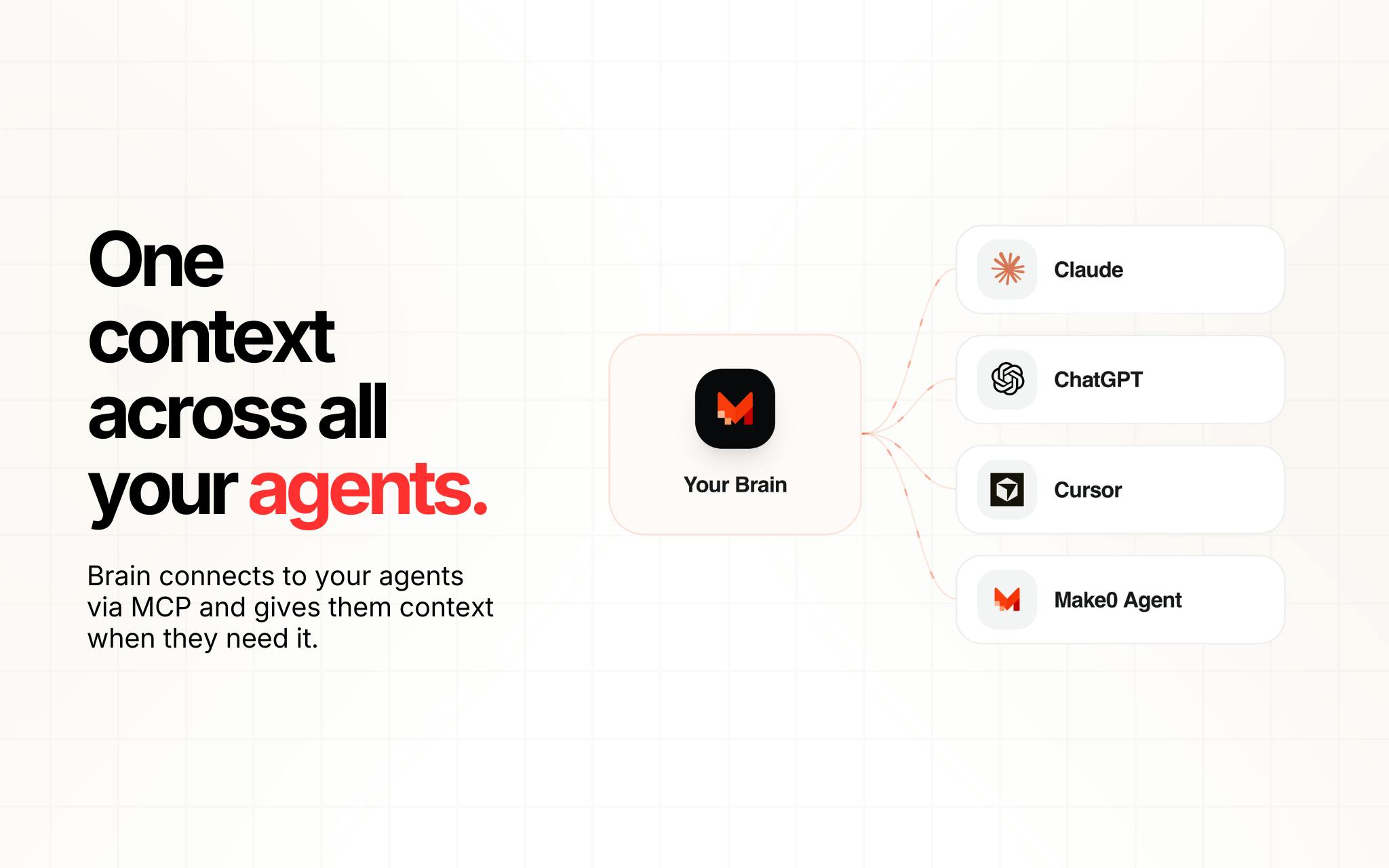
Make0 Brain is a memory storage layer that is independent of any specific AI tool. It supports ChatGPT, Claude, Cursor, and other AI tools compatible with the MCP (Model Context Protocol). These agents can read from and write to the same memory, staying in sync with your personal context.
The core mechanism can be broken down into three parts:
Unified storage: All conversation history, documents, and notes are stored in one place instead of being scattered across platforms.
Bidirectional sync: AI agents can not only read memories but also write newly generated conversation content back, keeping the memory continuously updated.
Protocol compatibility: It connects via the MCP protocol and is not tied to any single AI vendor. In theory, any tool that supports the protocol can call on it.
This means that when you switch from ChatGPT to Claude, the latter can directly access the project background you accumulated in ChatGPT — no manual information transfer required.
MCP (Model Context Protocol) was introduced by Anthropic at the end of 2024, with the goal of providing a unified communication standard between AI models and external data sources and tools. Before MCP, every time you connected an external service, developers often had to write separate adaptation code for different models or platforms; MCP abstracts this integration layer into an open protocol, so that as long as the model implements a client and the data source implements a server, the two can call each other. You can think of it as the "USB-C port" of the AI world — plugs and devices don't have to be custom-made for each other. MCP's core primitives include Resources (readable data), Tools (callable functions), and Prompts (preset prompt templates). Precisely because it is an open protocol, third-party memory layers like Make0 Brain can be read from and written to by different agents such as ChatGPT, Claude, and Cursor without being tied to a specific model vendor.
Building a "Second Brain" in Two Minutes
Make0 Brain made a clever design choice for cold start: importing existing assets.
Users can directly import their past conversations from Claude and ChatGPT, or drag their own Markdown files and documents into the system. The company claims the entire initialization process takes only two minutes. That number may not be exact, but the direction is right — there's no need to manually enter everything from scratch; instead, you activate the data you've already generated as the foundation of a new memory bank.
From a product design perspective, this is far more pragmatic than asking users to enter memories one by one. Most people have already accumulated a great deal of valuable context while using AI, and directly reusing it is the most efficient path.
Memory Sync: What Problems It Solves, What Room It Leaves
The core pain point Make0 Brain aims to solve can be summarized as "context fragmentation."
A notable feature of the current AI tool ecosystem is fragmentation. Every product wants to become the user's sole entry point, but users' actual behavior is cross-platform and cross-scenario. A single project may be advanced simultaneously across multiple AI tools, yet information struggles to flow between them. Make0 Brain tries to play the role of an intermediate layer, extracting memory from specific tools and turning it into a portable asset.
This approach is in line with the vision of the MCP protocol. MCP, promoted by Anthropic, aims to establish standardized connections between AI tools and external data sources. Make0 Brain's choice to be MCP-compatible means it is not building a walled garden, but rather betting on an open-protocol ecosystem.
But from the perspective of product maturity, there are still some aspects worth watching. Its Product Hunt page currently has 64 upvotes, ranks 14th, and has only 1 comment, indicating that the product is still at an early stage, with community feedback and real-world validation still relatively limited.
So-called "context fragmentation" refers to the fact that large language models themselves are stateless — after each conversation ends, the model retains no memory at all. What users perceive as "remembering" depends on historical text being reinserted within the session window. Once the context window is exceeded or the user switches to another product, that context disappears. The industry currently has several mitigation paths: first, expanding the context window; second, retrieval-augmented generation (RAG), which vectorizes relevant materials and recalls them on demand; third, an external memory layer, which stores structured or semi-structured user information independently and lets agents read and write it according to a protocol. Make0 Brain belongs to the third path. Its value is not in making the model smarter, but in making the same personal context transferable across different agents, thereby reducing the cost of repeatedly describing requirements when switching tools.
Target Users and Use Cases
Based on its positioning, Make0 Brain is most valuable to the following groups:
Heavy multi-tool users: People who use multiple AI tools such as ChatGPT, Claude, and Cursor at the same time, switch frequently, and need to keep context consistent.
Content creators and researchers: People who need AI to remember long-term project background, writing style preferences, and the thread of research materials.
Developers: People who want to share project memory between coding assistants and other AI agents, reducing the need to repeatedly describe requirements.
Conversely, if you only use one AI tool and have no long-term project context to maintain, the marginal value of this product drops significantly.
Will the Memory Layer Become AI Infrastructure?
Make0 Brain represents a trend worth watching: AI capabilities are spilling over from the model itself to the surrounding infrastructure. As the capability gap between models gradually narrows, whoever can better manage users' personal context may gain higher switching costs.
The idea of a memory bank existing as an independent layer makes logical sense. Just as browsers need bookmark syncing and note-taking tools need cross-platform access, the memory of AI agents should not be locked into a single product. But this track has many competitive dimensions: protocol standards, data privacy, vendor cooperation, and user trust. Whether Make0 Brain can grow from an early-stage product into true memory infrastructure depends on whether it can find a balance between open protocols and user experience.
For now, it has delivered a clear opening move.
One-line Summary
Make0 Brain provides a cross-tool personal memory storage layer for multiple AI agents through the MCP protocol.
Paragraph Summary
Make0 Brain is a personal memory bank product for AI agents, positioned as a memory storage layer independent of specific AI tools. It supports ChatGPT, Claude, Cursor, and other MCP-compatible tools in reading and writing the same personal context. Through three mechanisms — unified storage, bidirectional sync, and protocol compatibility — it tries to solve the "context fragmentation" problem in which users repeatedly paste background information when switching between different AI tools. Users can import historical conversations from ChatGPT and Claude as well as Markdown documents, and the company claims initialization takes two minutes. The product is most valuable to heavy multi-tool users, content creators, and developers, but it currently has only 64 votes and 1 comment on Product Hunt and is still at an early stage. Its bet on open protocols rather than a closed ecosystem represents the trend of AI infrastructure spilling over from the model layer to the memory layer.
Related articles

DeepCell: One-Click AI Generation of Documents, Spreadsheets, and Slides
DeepCell tops Product Hunt with one-click generation of documents, spreadsheets, and slides, using the .deepcell format for linked updates, designed for System 2 tasks like modeling and sales reviews.

Doneas: 15-Minute Daily Accountability Calls That Keep Indie Developers From Procrastinating
Doneas is a daily accountability tool for indie developers: plan tasks on Monday, join a 15-minute call with five builders each day, and log deliveries on a public progress page. This article analyzes its core mechanics, effectiveness, and potential issues around retention and matching.

Fastlane 2.0: Fully Automated AI Ad Campaigns, From Creative to Optimization
Fastlane 2.0 is an AI ad automation tool: enter your website and it learns your brand, generates video and image ads, and runs and optimizes them on Meta, TikTok, Instagram, and YouTube.