Makersclaw 2.0: A Goal-Driven Operating System for AI Agents
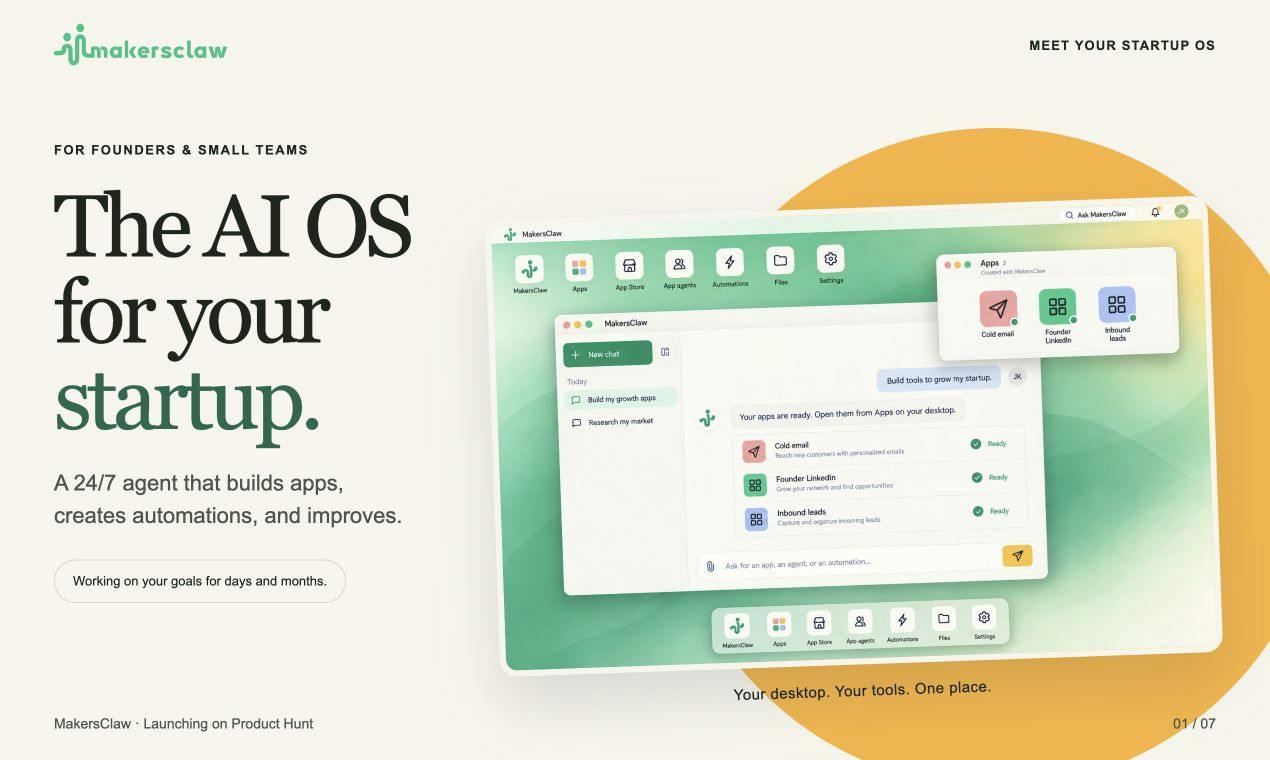
Makersclaw 2.0 shifts AI Agents from playing roles to dynamically building tools from goals, starting with GTM automation.
Makersclaw 2.0 launches on Product Hunt with a core shift: instead of hiring agents for specific roles, users describe goals and the system dynamically builds the required tools, agents, and workflows. Unlike agent frameworks tied to fixed toolsets, it claims on-demand tool generation plus continuous operation, work memory, and budget constraints. Starting with go-to-market as its first use case, it leverages GTM's repetitive, rule-describable tasks to validate agent automation value while holding a long-term "company operating system" vision — though the real reliability of dynamic tool generation and autonomous long-running execution remains to be proven.
From Hiring Agents to Defining Goals: Makersclaw's Shift in Thinking
Makersclaw 2.0 launched on Product Hunt with 95 upvotes and a #11 ranking, carrying an ambitious tagline — "the operating system for a company run by agents." What makes this product interesting isn't any single new feature, but rather its fundamental rethinking of what AI Agent products should look like.
According to the official introduction, the original version of Makersclaw placed "AI employees" inside Slack, Teams, and Telegram — letting them live in your chat tools like digital coworkers. But version 2.0 throws that idea out entirely: instead of "hiring" an Agent for a specific role, you simply tell Makersclaw what you want to accomplish, and it builds the tools, agents, and automation workflows needed to get there.
This represents a shift from "role-oriented" to "goal-oriented." In traditional Agent products, users must first figure out what kind of role they need — a marketing assistant, a customer service bot — and then configure the corresponding Agent. Makersclaw 2.0 removes that layer of abstraction entirely. You describe the goal; the system handles the orchestration.
The Core Difference: "Building Tools" vs. "Calling Tools"
Makersclaw 2.0 describes its approach as converting a goal into the "apps, agents, and automations" needed to achieve it. The key phrase worth noting here is "builds the tools for the job" — it doesn't pick from a preset toolbox, it dynamically constructs tools for the specific task at hand.
This is fundamentally different from most Agent frameworks on the market. The majority rely on fixed toolsets or plugin marketplaces, where an Agent's capabilities are bounded by existing integrations. Makersclaw claims to generate tools on demand based on task requirements, which theoretically gives agents far greater adaptability.
Beyond this build capability, the team also highlights three operational properties:
- Runs them continuously: Once built, tools keep working rather than executing once and stopping
- Remembers the work: The system retains memory of completed work, enabling continuous accumulation
- Operates within a budget: Works within user-defined budget constraints — a pragmatic design choice for cost control in automated systems
The budget constraint deserves particular praise. One of the biggest risks with autonomously running agents is uncontrolled consumption of compute and API call costs. Treating budget as a first-class citizen in the system design shows the team has genuinely thought about the cost anxiety that comes with real-world deployment.
From a technical standpoint, "dynamically building tools" typically means the system can generate code, API call logic, or workflow configurations at runtime — rather than retrieving matches from a predefined library. This capability relies on large language models' code generation abilities, combined with sandboxed execution environments to run newly generated logic. Similar explorations exist in the industry, such as OpenAI's Code Interpreter and various Code Agent approaches. However, these approaches share a common challenge: the correctness and safety of generated code are hard to guarantee, and in long-running autonomous scenarios without human supervision, errors can compound across the execution chain. So while "building tools" sounds exciting, the actual implementation — whether it involves genuine code generation and execution, or a more conservative template-based parameterization — directly determines the system's capability ceiling and risk profile. This is the most important question to probe when evaluating Makersclaw's real capabilities.
The GTM-First Product Strategy
Makersclaw 2.0 explicitly starts with "go-to-market" as its first use case, which explains why it's categorized under both Marketing and Artificial Intelligence on Product Hunt.
Choosing GTM as the initial wedge is a smart move. Go-to-market work typically involves large volumes of repetitive, process-driven tasks that still require some degree of judgment — lead generation, content distribution, channel operations, data tracking, and so on. These are exactly the areas where Agent automation delivers the most visible value, and where businesses are most willing to pay for efficiency gains.
Starting with GTM while holding onto the grand vision of a "company operating system" is a classic "nail it, then scale it" strategy: prove value in one concrete scenario, then expand to other areas of company operations.
In business terms, Go-to-Market (GTM) refers to a company's complete strategy and execution system for bringing a product or service to its target market — typically covering lead generation, sales funnel management, content marketing, channel partner operations, and market data tracking. These tasks share a distinct profile: rules can be clearly described, execution volume is high, and the judgment threshold is moderate. This makes GTM an ideal early target for Agent automation: clear rules give agents precise instructions, high volume means significant marginal returns from automation, and moderate judgment requirements sit comfortably within current LLM capabilities without causing frequent errors. By contrast, domains like finance and legal — while equally repetitive — have extremely low error tolerance, making them poor candidates for early autonomous Agent deployment. Makersclaw's choice of starting scenario reflects a fairly clear-eyed understanding of where current Agent capabilities actually stand.
An Ambitious Vision Worth Watching — But Still Unproven
Makersclaw 2.0 paints an appealing picture: a company's day-to-day operations run autonomously by agents, with humans only needing to set goals and budgets. This aligns well with the broader industry trend of AI Agents taking over repetitive work.
But a dose of healthy skepticism is warranted. The actual reliability of "dynamically building tools based on goals," the quality of what gets built, and the stability of long-running autonomous execution are all critical questions that can only be answered through real-world use. Ten comments and an #11 ranking on Product Hunt signals genuine interest, but it's a long road from there to validating a promise like "running an entire company."
For practitioners tracking the evolution of AI Agent product design, Makersclaw 2.0 offers a valuable case study. It represents one direction in the shift from "anthropomorphized roles" toward "goal-driven orchestration." How far that direction can go depends entirely on whether the underlying tool generation and autonomous execution capabilities can genuinely live up to the ambition.
Related articles
Free Open-Source Tool Rejected: The Community Controversy Sparked by r/DnD's AI Ban
A free open-source DnD campaign tool was rejected by r/DnD's AI ban — yet the same tool was approved a year ago. The case highlights the blurry line between AI tools and AI-generated content.
What LLMs Can You Run with 1.9TB of RAM? Exploring the Ceiling of Local AI Deployment
A Reddit user with 1.9TB of RAM sparked debate about local LLM deployment. We break down what massive RAM enables, where CPU inference falls short, and the real bottlenecks.
Researchers Use Claude to Hack OpenAI Systems: A New Wake-Up Call for AI Security
Security researchers used Anthropic's Claude to breach OpenAI systems, taking over employee accounts and accessing internal repos. What this means for AI security.