MasterGo AI + Cursor in Practice: Building a Full Multimodal AI App Solo

Build a full multimodal AI app solo using MasterGo AI and Cursor, from requirements to deployment.
This course centers on AI-assisted full-stack development, integrating MasterGo AI for UI design and Cursor for code generation alongside a Vue 3.5, Node.js, and MySQL stack. It walks developers through the complete workflow — requirements analysis, UI design, database modeling, API design, frontend implementation, testing, and deployment — using a layered development approach. The author argues that the core competitive edge in the AI era is effective human-AI collaboration: let AI handle repetitive work while developers focus on architecture and business logic. The final project integrates text chat, voice interaction, and image generation, serving as both a portfolio piece and a transferable methodology.
The rise of large AI models is rewriting the rules of software development. Products that once required an entire team can now be built end-to-end by a single developer using the right AI tools. This full-stack development course — built around MasterGo AI and Cursor — is designed with exactly that shift in mind, helping developers master the complete AI-assisted software development workflow.
The Opportunities and Challenges AI Brings to Developers
Jiang Sixikang, a frontend engineer at a publicly listed company and the course author, opens with a sharp observation: AI is creating both opportunities and challenges at the same time.
The opportunities play out on three levels. First, a lower barrier to bringing ideas to life — software development used to demand strong programming skills, but now even non-programmers can generate simple programs by talking to AI in natural language, and non-designers can quickly produce web UI mockups using AI design tools. Second, higher development efficiency — AI handles a large volume of repetitive coding tasks, freeing developers to focus on what actually determines project quality: requirements analysis and system architecture. Third, more room for innovation and entrepreneurship — a single idea, combined with the right AI assistants, can give birth to a new product. The author even predicts that "one-person companies" will become increasingly common.
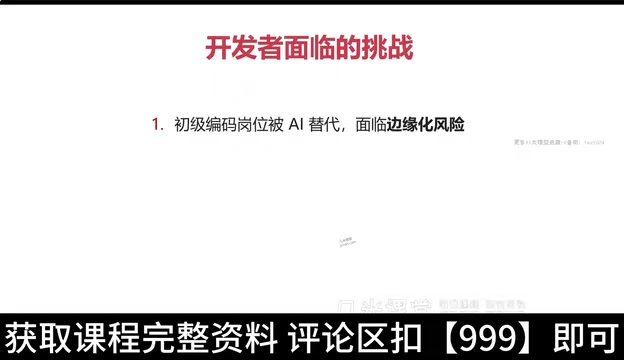
But the challenges are equally real. As AI gets better at writing code automatically, entry-level programming roles that handle simple, repetitive coding tasks are gradually being displaced. The author is candid: staying in repetitive, foundational work for too long risks being marginalized. The true competitive edge, therefore, isn't just "knowing how to use an AI coding assistant" — it's developing the ability to collaborate with AI: giving it effective instructions, reviewing its output, and refining results with your own domain knowledge.
A Complete Software Development Workflow
What makes this course especially valuable is that it isn't a scattered collection of tool tutorials. It's structured around a complete, end-to-end software development workflow. The entire process breaks down into a series of progressively deeper stages:
From Requirements to Design
The starting point is requirements analysis — clarifying what users need the software to accomplish and breaking that down into core goals. This leads into feature design, where specific functional modules and implementation paths are defined based on those requirements. The third step is design execution, translating requirements into UI mockups — and this is where MasterGo AI comes in. Developers don't need a dedicated UI designer; by writing precise prompts, they can control layout and visual style to produce design files independently.
An Engineering Mindset Through Layered Development
Once the design is ready, development begins. The author emphasizes a layered development approach, which is central to full-stack architectural thinking. The path goes: first build the structured data model and design the database (the foundation of the entire system); then design the API layer based on that data model (connecting frontend and backend); and finally develop frontend components, turning the UI mockups into interactive interfaces.
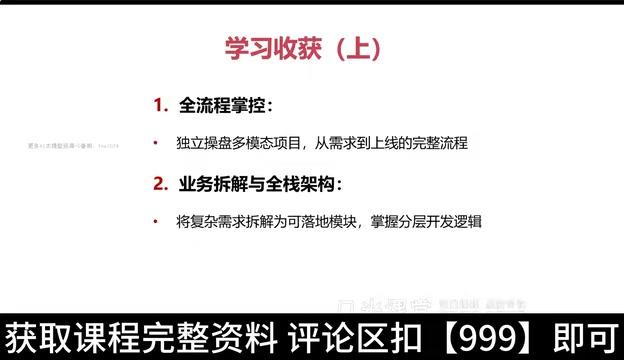
This sequence — database modeling → API design → frontend implementation — is fundamentally about training developers to plan system structure holistically, making complex projects manageable and clearly organized.
Layered Development is a classic architectural concept in software engineering. Its core principle is dividing a system into distinct layers by responsibility, where each layer only interacts with its immediate neighbors, avoiding cross-layer coupling. The most common three-layer structure in full-stack development maps directly onto this course's workflow: the Data Layer (database modeling — defining storage structure and relationships), the Service Layer (API design — encapsulating business logic and exposing standardized data channels), and the Presentation Layer (frontend components — rendering the UI and handling user interaction). Building bottom-up has a clear engineering rationale: the data model is the most stable part of the system. When it's well-designed upfront, the field definitions for your APIs and the data bindings in your frontend follow naturally, reducing rework. In AI-assisted development, layered architecture offers another benefit — clean boundaries between layers make it easy to break each layer's tasks into discrete prompts for AI to handle, reducing complexity per task and producing more predictable output.
Testing and Launch
After development comes functional testing — verifying completeness and stability. Once everything checks out, the application is deployed to a live server and shipped. From requirements to deployment, each stage builds on the last, helping learners connect the full operational logic of a software development lifecycle.
The AI Toolchain and Full-Stack Tech Stack
The course integrates today's leading AI-assisted development tools with a proven full-stack technology stack. On the AI toolchain side, it covers the UI design tool MasterGo AI, the code generation tool Cursor, and inference-related capabilities. The author is explicit that the teaching goes beyond "how to use each tool" — the deeper goal is for learners to internalize a transferable, foundational way of thinking that applies even when they switch to different AI tools down the road.
The full-stack tech stack is well-rounded: Vue 3.5 on the frontend, Node.js with supporting frameworks on the backend, and MySQL as the database. The ultimate goal is to achieve a genuine fusion of AI capabilities with full-stack development.
One theme the author returns to repeatedly is the logic of human-AI collaborative development: let AI handle repetitive and foundational work, while developers direct their energy toward higher-value tasks. Learning to work this way is what allows developers to become someone who amplifies their senior-level value through AI — rather than someone AI replaces.
MasterGo AI is the AI-assisted design feature built into MasterGo, a collaborative design platform popular in China. It supports generating UI wireframes, components, and design specs from natural language prompts — conceptually similar to Figma's AI plugin ecosystem, but optimized for Chinese-language contexts and domestic design conventions. Cursor is a code editor with deep LLM integration, built on VS Code. Its core capability is generating, modifying, and explaining code through in-editor conversation, with cross-file context-aware completion. Its main distinction from GitHub Copilot is a more complete "conversational programming" interaction model — developers describe what they need in natural language, and Cursor identifies the relevant files and provides complete change suggestions. Together, these two tools cover the full chain from visual design to code implementation, making them one of the most common pairings for solo development today.
Who It's For and What You'll Gain
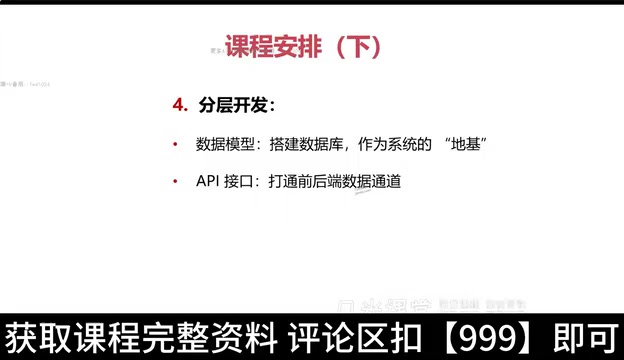
The course outlines six key takeaways, which add up to one core competency arc: mastering the full software development lifecycle; developing business decomposition and full-stack architecture skills; gaining proficiency with AI toolchains and full-stack technologies; building AI-powered design efficiency; learning human-AI collaborative development techniques; and walking away with a high-value portfolio project worth putting on a résumé.
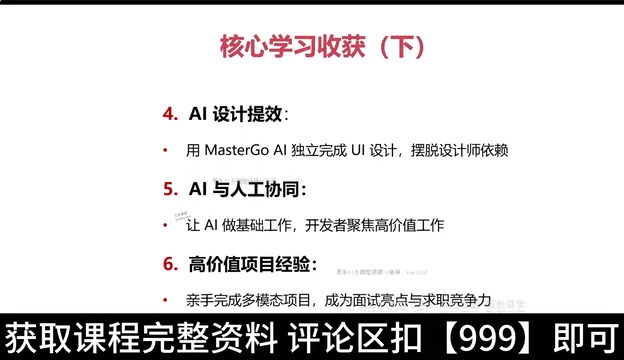
The author specifically notes that the final multimodal full-stack project integrates text chat, voice interaction, image generation, and information management — not just a résumé highlight, but a project you can confidently walk through in an interview, clearly explaining your requirements decomposition approach, full-stack implementation process, and how you used AI tools to accelerate the work.
The course is broadly accessible: frontend, backend, or full-stack engineers can use it to expand their skills and deepen their integration of AI tools into their development workflow; developers looking to boost productivity; and anyone wanting to build hands-on experience with multimodal AI development. The technical bar is low — a foundational understanding of HTML, CSS, and JavaScript is all you need to keep up.
The multimodal project at the end of the course touches on several of the hottest AI capability areas right now: text chat maps to large language model conversation APIs (such as the OpenAI Chat Completions API or comparable domestic services); voice interaction typically involves both Speech-to-Text (STT) and Text-to-Speech (TTS); and image generation relies on diffusion model APIs (such as DALL·E or hosted Stable Diffusion services). Integrating all of these into a single full-stack application presents real engineering challenges: async request management, streaming response handling, and designing multimodal data transport between frontend and backend. For a résumé, the value of this kind of project isn't just "used AI" — it's demonstrating the ability to integrate multiple external APIs, handle complex async scenarios, and ship a complete, working product.
Conclusion
This course has a clear positioning: it's not simply teaching you how to use a particular AI tool. It's trying to turn "AI-assisted full-stack development" into a reusable methodology. As AI increasingly takes over foundational coding, mastering the complete pipeline from requirements to deployment — and learning to collaborate with AI efficiently — may be exactly what allows developers to navigate the industry's transformation with confidence. For developers who want to stay competitive in the AI era, this kind of hands-on, end-to-end approach is well worth paying attention to.
Related articles

macOS Is No Longer UNIX: Apple Didn't Renew Certification, But the Technology Is Unchanged
Apple did not renew macOS's UNIX certification, and the Open Group has removed Apple's entry. This article analyzes the technical reality behind the expiration, Apple's possible intentions, and the practical impact on developers.

Building Stateful Multi-Agent Systems with Azure Cosmos DB
Based on the official Azure Cosmos DB tutorial, this article explains how to use the Agent Memory Toolkit to add shared persistent memory to a multi-agent travel planner, covering short-term, long-term, episodic, and semantic memory plus cross-session state continuity.

Production AI Agent Operations: A Three-Step Framework for Observing, Evaluating, and Optimizing
Azure Cosmos DB team proposes a three-step framework for production AI Agent operations: observe trace tracking, evaluate with LLM as a judge and regression testing, optimize cost across RU, retrieval, memory, and LLM layers.