Math Foundations for AI/Machine Learning: Four Core Areas & a Complete Learning Path Guide
A complete guide to the four core math areas needed for AI/ML and how to learn them efficiently.
This article systematically outlines the four core math areas essential for AI/ML — linear algebra, calculus, probability & statistics, and optimization theory. It provides a practical three-phase learning path from building intuition with visual resources to systematic study and hands-on project practice, along with recommended resources and mindset tips to help beginners overcome math anxiety.
Introduction: Math Is the Inescapable Foundation of AI/ML
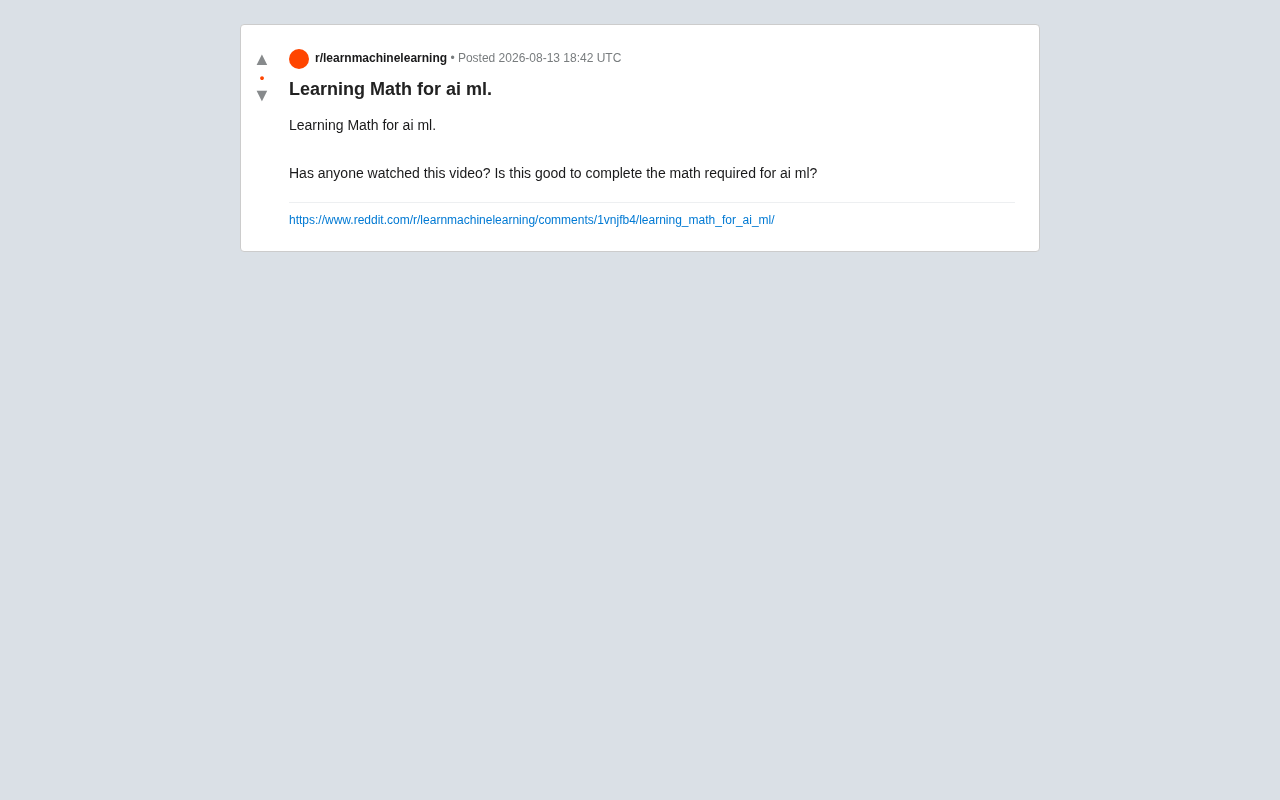
In Reddit's machine learning communities, one timeless question keeps resurfacing: "How much math do I actually need for AI/ML?" and "Can a single video tutorial cover all the math I need for AI?" Behind these questions lies the shared confusion and anxiety of countless beginners stepping into the field of artificial intelligence.
This article draws on community discussions to systematically outline the math knowledge required for AI/ML and provide a practical learning path. Whether you're a developer looking to switch careers or a practitioner who wants to deeply understand how models work, you'll find direction here.
What Math Does AI/ML Actually Require?
Many beginners mistakenly believe AI requires mastery of advanced pure mathematics. In reality, the math behind AI/ML leans more toward "applied mathematics" and primarily spans four core areas.
Linear Algebra: The Core Language of Data Representation
Linear algebra is the most fundamental mathematical tool in machine learning. Every layer of computation in a neural network is essentially matrix multiplication and vector transformation. You'll need to be familiar with the following concepts:
- Vectors, matrices, and their operations
- Matrix multiplication, transpose, and inverse
- Eigenvalues and eigenvectors
- Singular Value Decomposition (SVD)
- Basic concepts of tensors
Understanding these will help you truly see how data flows through PyTorch or TensorFlow, rather than treating frameworks as black boxes.
Calculus: The Core Engine of Model Optimization
The heart of model training is "optimization," and optimization is inseparable from calculus. The Backpropagation algorithm is essentially a large-scale application of the chain rule. Key topics include:
- Derivatives and partial derivatives
- Gradients and gradient descent
- The chain rule
- Extrema of multivariable functions
Once you understand how gradient descent iteratively approaches the minimum of a loss function, you'll truly grasp what it means for a model to "learn."
Probability and Statistics: Mathematically Modeling Uncertainty
Machine learning is fundamentally about dealing with uncertainty. From Naive Bayes to Dropout in deep learning, from loss functions to generative models, probability and statistics are everywhere. You'll need to master:
- Probability distributions (normal distribution, Bernoulli distribution, etc.)
- Bayes' theorem
- Expectation, variance, and covariance
- Maximum Likelihood Estimation (MLE)
- Basic concepts of hypothesis testing
Optimization Theory: Bridging Mathematical Theory and Engineering Practice
Building on your calculus foundation, further understanding of convex optimization, Stochastic Gradient Descent (SGD), momentum methods, Adam, and other optimization algorithms will give you more confidence when tuning hyperparameters and designing models.
Can a Single Video Cover All the Math You Need for AI?
Returning to the original Reddit question: can a single video complete your AI/ML math education?
The answer is: a single video is far from enough, but it can serve as an excellent starting point.
Video tutorials excel at being intuitive and beginner-friendly — they help you quickly build an overall framework and develop intuition. But math is a subject that requires "hands-on" practice. Simply watching without doing exercises makes it nearly impossible to truly internalize the knowledge. Experienced community members generally recommend:
- Use videos to build intuition: Prioritize visualization-focused resources like 3Blue1Brown to understand the geometric meaning behind concepts.
- Supplement with systematic textbooks: Resources like Mathematics for Machine Learning (free and open-source) provide a complete and rigorous knowledge framework.
- Reinforce through coding practice: Manually implementing matrix operations with NumPy or coding a gradient descent step in Python is more effective than watching a video ten times over.
Recommended Learning Path for AI Math
Phase 1: Build Mathematical Intuition (1–2 months)
Watch 3Blue1Brown's Essence of Linear Algebra and Essence of Calculus series, supplemented with Khan Academy's foundational courses, to develop an intuitive understanding of core concepts.
Phase 2: Systematic Deep Learning (2–3 months)
Study the book Mathematics for Machine Learning, or work through the math sections of Andrew Ng's machine learning course, to systematically fill in any knowledge gaps.
Phase 3: Hands-On Project Application (Ongoing)
Apply your math knowledge in real projects, and circle back to fill gaps whenever you encounter unfamiliar concepts. This "learn by doing" approach is often more efficient than studying math in isolation — and far better at sustaining motivation.
Overcoming Math Anxiety: An Important Mindset Reminder
Many beginners fall into "math anxiety," believing they must master all the math before they can start learning AI. This is actually a misconception. You don't need to become a mathematician — you just need to become an engineer who can understand and apply mathematical tools.
In practice, a "top-down" learning approach — starting with hands-on projects first, then diving deeper into the math when you hit something you don't understand — often aligns better with how most people learn compared to the "bottom-up" approach of grinding through all the math before writing a single line of code. It's also much easier to stick with.
Conclusion
Learning math for AI/ML is a marathon, not a sprint. A single video can be a great starting line, but true mastery comes from continuous learning, practice, and reflection. Instead of agonizing over "which video is the most comprehensive," just open a tutorial right now, pick up a pen and paper, and start your first matrix operation.
For the Reddit user who asked the original question, perhaps the best advice is this: watch that video, then get your hands dirty, and fill in whatever gaps you find along the way. Learning AI was never about waiting until everything is perfectly in place — it's about growing constantly while you're already on the journey.
Related articles

Rejecting AI as a Differentiator: The Engineering Rationale Behind the Anti-AI Movement
When AI becomes a marketing label, some choose to publicly declare they never use it. This article analyzes the engineering rationale, privacy concerns, and reliability considerations behind the anti-AI stance.
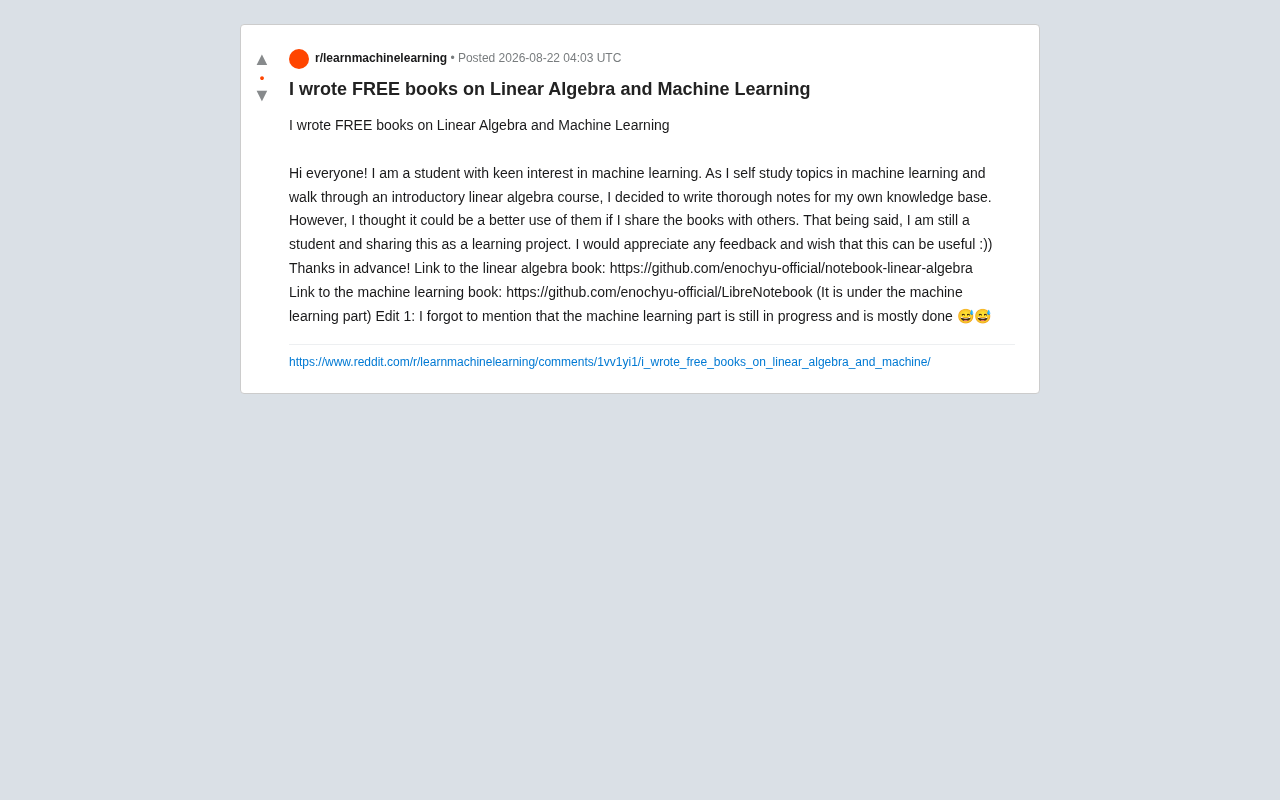
Free Open-Source Linear Algebra & Machine Learning Textbooks: Self-Study Notes from a Student's Perspective
A student compiled self-study notes into two free open-source textbooks on linear algebra and machine learning, hosted on GitHub for community collaboration.

Claude Code vs Cursor: Which Is Better? Core Differences & Real-World Comparison
In-depth comparison of Claude Code vs Cursor across accuracy, context capability, and auto-debugging. Covers AI coding tool evolution and selection advice.