Math Learning Roadmap for Machine Learning: A Complete Path from Precalculus to Deep Learning
A practical math roadmap from Precalculus to deep learning for engineers transitioning to ML.
This article provides a complete math learning roadmap for software engineers transitioning to AI/ML. It covers the four core math pillars — linear algebra, calculus, probability & statistics, and optimization — with a recommended study sequence, practical timeline, and tips for leveraging programming skills to accelerate mathematical understanding.
Learning Math for Machine Learning: Where to Start?
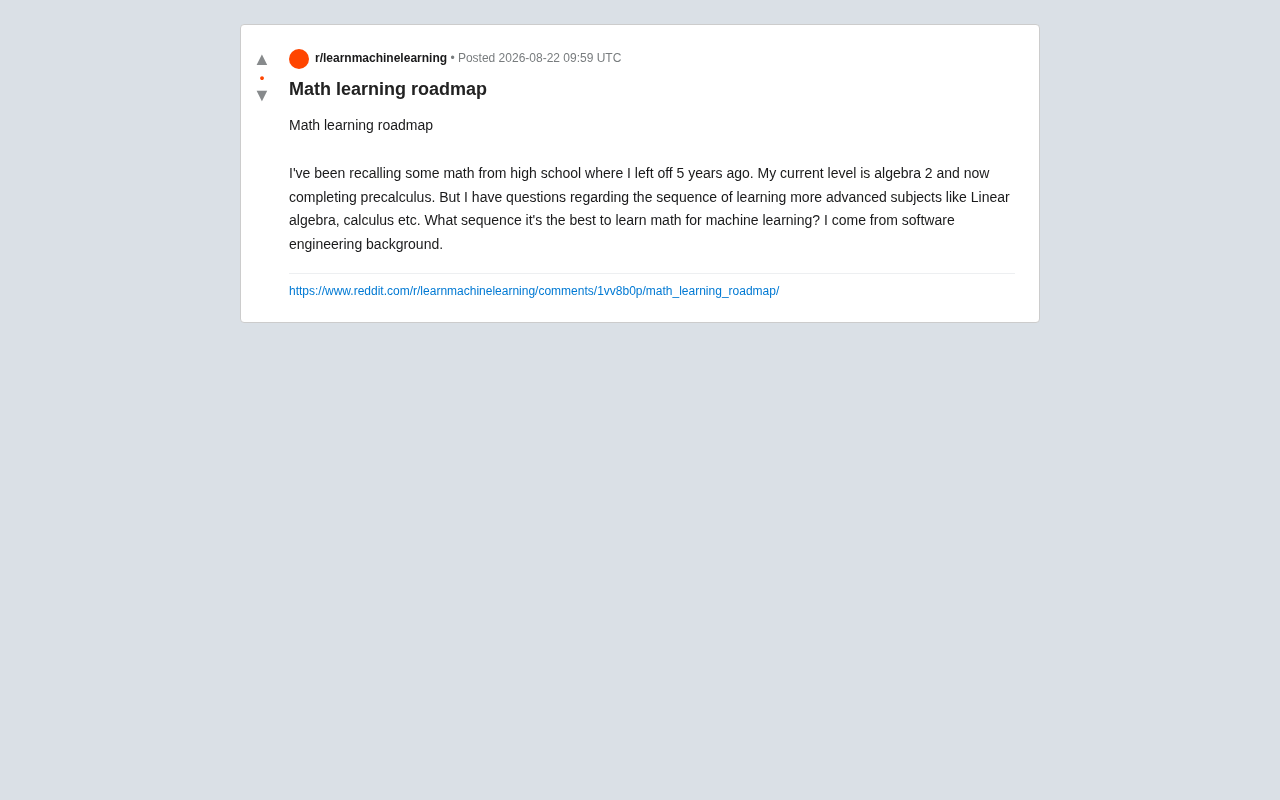
I recently came across a very representative question on Reddit: a developer with a software engineering background who hadn't touched math since graduating high school five years ago was working through Algebra 2 and studying Precalculus. His question was one many people share — in what order should I study linear algebra, calculus, and other advanced math to understand machine learning?
This is a problem that virtually every engineer transitioning into AI/ML will encounter. Math is both the foundation of machine learning and often the first barrier that discourages newcomers. The good news is: the math required for machine learning has clear boundaries and priorities. You don't need to become a mathematician, but you do need to build a knowledge base solid enough to support understanding of how models work.
This article addresses the specific situation from the original post — having completed Algebra 2, currently studying Precalculus, with a programming background — and lays out a practical math learning path for machine learning.
What Math Foundations Does Machine Learning Require?
Before planning a study sequence, let's clarify the target. The core mathematics supporting machine learning falls into four major areas:
1. Linear Algebra — The Most Critical Math for Machine Learning
This is the most frequently used branch of mathematics in machine learning. The forward pass of a neural network is essentially a series of matrix multiplications; data is stored and manipulated as vectors, matrices, and tensors; dimensionality reduction methods like PCA and SVD are built directly on eigenvalues and eigenvectors.
Linear algebra holds such a central position because the computational essence of modern machine learning is large-scale matrix operations. Take neural networks as an example: the computation at each layer can be expressed as y = Wx + b, where W is the weight matrix, x is the input vector, and b is the bias vector. The forward pass of a deep neural network is simply this matrix multiplication nested layer by layer. The reason GPUs can dramatically accelerate deep learning is precisely because GPU architectures are inherently suited for parallel matrix operations. PCA (Principal Component Analysis) finds the principal directions of variation in data by computing eigenvalues and eigenvectors of the covariance matrix, while SVD (Singular Value Decomposition) is widely used for dimensionality reduction and matrix factorization in recommender systems and natural language processing. Tensors are essentially higher-dimensional generalizations of matrices — the very names of PyTorch and TensorFlow reflect the foundational role of tensors in deep learning.
Core concepts include: vector and matrix operations, matrix multiplication, transpose and inverse, determinants, eigenvalues and eigenvectors, vector spaces, orthogonality, and more.
2. Calculus — Understanding How Models "Learn"
The "learning" process in machine learning is fundamentally about continuously optimizing parameters through gradient descent, and gradients are generalizations of derivatives. The backpropagation algorithm is built entirely on the chain rule.
Specifically, gradient descent is the most central optimization algorithm in machine learning. The basic idea is: for a loss function (a function measuring the gap between model predictions and true values), compute the partial derivative of the loss function with respect to each parameter (i.e., the gradient), then update the parameters in the opposite direction of the gradient to progressively reduce the loss. Backpropagation is the method for efficiently computing gradients in deep neural networks — it uses the chain rule from calculus to propagate error signals layer by layer from the output back to the input, avoiding redundant calculations. SGD (Stochastic Gradient Descent) computes gradients using only one or a small batch of samples at a time for efficiency; the Adam optimizer combines momentum and adaptive learning rate techniques and is one of the most commonly used optimizers in deep learning today.
The key areas are: single-variable differentiation, multivariable differentiation, partial derivatives, gradients, and the chain rule. Integration is relatively less important but comes up in probability theory.
3. Probability & Statistics
Machine learning is fundamentally about dealing with uncertainty. From Bayes' theorem and probability distributions to expectation, variance, maximum likelihood estimation, and the various statistical metrics for evaluating models — probability and statistics are woven throughout.
Looking deeper, Bayes' theorem provides a mathematical framework for updating beliefs after obtaining new evidence — Naive Bayes classifiers and Bayesian neural networks are directly based on it. Maximum Likelihood Estimation (MLE) is one of the most common methods for training model parameters — the loss function of logistic regression (cross-entropy) is essentially negative log-likelihood. Probability distributions (such as Gaussian and Bernoulli distributions) describe data generation processes and noise characteristics; generative models like GANs (Generative Adversarial Networks) and VAEs (Variational Autoencoders) are built directly on sampling and transforming probability distributions. At the model evaluation level, hypothesis testing, confidence intervals, and p-values help us determine whether differences in model performance are statistically significant rather than purely random fluctuations.
4. Optimization Theory
This area builds on calculus and covers convex optimization, gradient descent, and its variants (such as SGD and Adam). It typically follows naturally once you've mastered calculus.
Recommended Math Study Sequence
Given the original poster's starting point of "Algebra 2 + Precalculus," here's the recommended progression:
Step 1: Solidify Precalculus First
Since you're already studying Precalculus, finish it. Functions, trigonometry, exponentials and logarithms, and the concept of limits are direct prerequisites for calculus. Don't rush past this.
Step 2: Start Linear Algebra in Parallel
A common misconception is that you must finish calculus before touching linear algebra. In reality, linear algebra and calculus have very weak dependencies — you can absolutely start linear algebra as soon as you have a solid Precalculus foundation. For machine learning, linear algebra is arguably even more critical than calculus, so the earlier you start, the better.
Parallel study is feasible because linear algebra and calculus are typically offered as concurrent courses in undergraduate curricula. The core content of linear algebra — vector spaces, matrix operations, eigenvalue decomposition — doesn't require calculus as a prerequisite; it relies more on algebraic manipulation and abstract thinking skills. The only strong intersection between the two occurs in advanced topics, such as matrix calculus (differentiating with respect to matrices) and linear transformations in multivariable calculus, but these can be tackled after you have some foundation in both subjects. For machine learning learners, early exposure to linear algebra means you can understand data representation, model structure, and computational workflows sooner — knowledge that's almost immediately needed in introductory ML courses.
Step 3: Study Single-Variable and Multivariable Calculus
After completing Precalculus, move into Calculus I (single-variable differentiation and integration), then Calculus II, followed by Calculus III (multivariable calculus, especially partial derivatives and gradients). The multivariable portion is essential for understanding backpropagation and cannot be skipped.
Step 4: Probability & Statistics
This can be studied in parallel once you've progressed sufficiently in calculus. Basic probability doesn't strongly depend on calculus, but concepts like continuous distributions and expectations do require integration.
Step 5: Optimization Theory (Advanced)
With foundations in calculus and linear algebra, optimization theory will come naturally. This can be supplemented on an as-needed basis while working on projects.
Practical Advice for Learners with a Software Engineering Background
The original poster mentioned having a software engineering background — this is actually a huge advantage, but it also calls for tailored learning strategies.
Leverage Programming Intuition to Understand Math
Programmers excel at abstraction and logical thinking. Use code to verify mathematical concepts. Implement matrix operations with NumPy, plot functions with Python, simulate gradient descent in code — "running" abstract math makes understanding much deeper. This is a path that pure math students don't have.
Be Application-Oriented, Not Rigorous for Rigor's Sake
As an engineer, your goal is to "use math to understand and build models," not to pass a math department exam. So it's fine to emphasize intuition and geometric understanding over rigorous proofs of every theorem. 3Blue1Brown's Essence of Linear Algebra and Essence of Calculus video series are perfect for building this kind of intuition.
3Blue1Brown is a math education YouTube channel created by Grant Sanderson, renowned for its beautiful animations and exceptionally intuitive explanations. Its core animation tool, Manim, is a math animation engine developed by Sanderson himself. The Essence of Linear Algebra series uses geometric animations to show the actual meaning of matrix multiplication — linear transformations, change of basis, the geometric intuition behind eigenvectors — elevating learners from "knowing how to compute" to "understanding the essence." Essence of Calculus uses animations to explain the geometric meaning of derivatives, integrals, and limits. This visual, intuition-first teaching approach is particularly well-suited for learners with an engineering background, because it doesn't emphasize ε-δ style rigorous proofs. Instead, it helps you build a deep understanding of "what does this formula actually mean geometrically" — and this kind of understanding is extremely useful when actually building and debugging machine learning models.
Combine Projects with Learning — Avoid "Learn Everything First, Then Start"
The path most likely to fail is "I'll finish all the math before starting machine learning." A more effective approach is to learn and apply simultaneously: progress through math fundamentals while following introductory courses (like Andrew Ng's machine learning course) and getting hands-on. When you encounter matrices and gradients in code, go back and study the corresponding math — both your motivation and retention will be much better.
Andrew Ng is a Stanford University professor, co-founder of Google Brain, and co-founder of Coursera. His Machine Learning course on Coursera, first released in 2012, has had over 5 million enrollments and is widely recognized as the "gold standard" introductory course for machine learning. The course was fully updated in 2022 — the new version uses Python (the previous version used MATLAB/Octave) and covers core topics including linear regression, logistic regression, neural networks, decision trees, clustering, and recommender systems. The course's greatest strength is its relatively friendly math barrier — it assumes learners have basic linear algebra and calculus knowledge but provides intuitive explanations and optional mathematical derivations when needed, making it ideal for hands-on practice alongside your math studies.
A Pragmatic Study Timeline
For a learner who can dedicate 10–15 hours per week, a reasonable pace might look like:
- Months 1–2: Complete Precalculus while starting introductory linear algebra
- Months 2–4: Complete core linear algebra content; progress through Calculus I/II
- Months 4–6: Multivariable calculus + probability and statistics fundamentals
- Month 6 onward: Begin a formal machine learning course; supplement with optimization theory as needed
This timeline is not absolute — the key is consistency rather than speed. Math is a subject that requires repeated digestion. It's better to build a steady, solid foundation than to rush.
Conclusion
For learners like the original poster — picking up math again after five years with a programming background — the math journey toward machine learning isn't as daunting as it seems. The core sequence can be summarized as: solidify Precalculus → start linear algebra early → complete multivariable calculus → fill in probability and statistics → learn optimization as needed.
More importantly, maintain an application-oriented mindset, leverage your programming advantages, and learn by doing. Math is the key to deep understanding of machine learning, but it's a tool, not the destination.
Related articles

iPhone Duo Review Controversy: Why Apple's First Foldable Is Said to 'Should Be Called an iPad'
The Vergecast debates the iPhone Duo review controversy: is a 7 fair? Why are apps struggling? Why critics say it 'should be called an iPad'? We unpack Apple's first foldable's positioning mismatch and first-gen compromises, plus AI security flaws and agentic shopping.

Meta vs. Publishers: The AI Data Battle Over Terms of Service Changes and the Future of the Internet
Meta changed its business account terms to allow AI training on linked website data, sparking backlash from publishers and creators. Industry groups demanded negotiations, forcing Meta to remove 'training' wording and delay the effective date. The dispute reveals the deeper battle over data authorization and the future of the internet in the AI era.

When Outside Xbox Meets Blood on the Clocktower: A Legion Match in Minecraft
Outside Xbox guests Ellen and Mike play Minecraft Blood on the Clocktower in a Legion game. How can three good players fight an evil majority amid information noise? This article breaks down Legion mechanics, information-role mind games, and the endgame reversal.