Maximem Synap: A High-Speed Memory Layer Built for AI Agents

Maximem Synap offers plug-and-play memory infrastructure for AI agents with low-latency recall and high benchmark accuracy.
AI agents commonly suffer from "amnesia" — new sessions can't access prior conversation history. Maximem Synap addresses this with a unified memory and context infrastructure that handles entity resolution, temporal reasoning, and multi-level scoping out of the box. It claims 92% accuracy on LongMemEval, 93.2% on Locomo, and P75 recall latency under 15ms, with native support for 22 frameworks including LangChain, LangGraph, and Claude Agent SDK. A free tier lowers the barrier to entry, and its Product Hunt debut ranked #8 — solid, but not explosive. Whether it can stand out against Mem0 and Zep depends on real-world stability, cost structure, and documentation quality.
One of the biggest pain points for AI agents is that every conversation starts from scratch — like amnesia. User preferences, identity details, and interaction history shared in a previous session are often lost when a new one begins. Maximem Synap aims to fix exactly this. It positions itself as a memory and context infrastructure for AI agents, allowing each conversation to build on what came before.
What Problem Does a Memory Layer Actually Solve?
Most mainstream agent applications today rely on retrieval-augmented generation (RAG): past conversations or knowledge are chunked and stored in a vector database, then retrieved on demand. It works, but the engineering overhead is real — you have to maintain the vector database yourself, tune retrieval rankers, and deal with messy tasks like entity disambiguation and temporal reasoning.
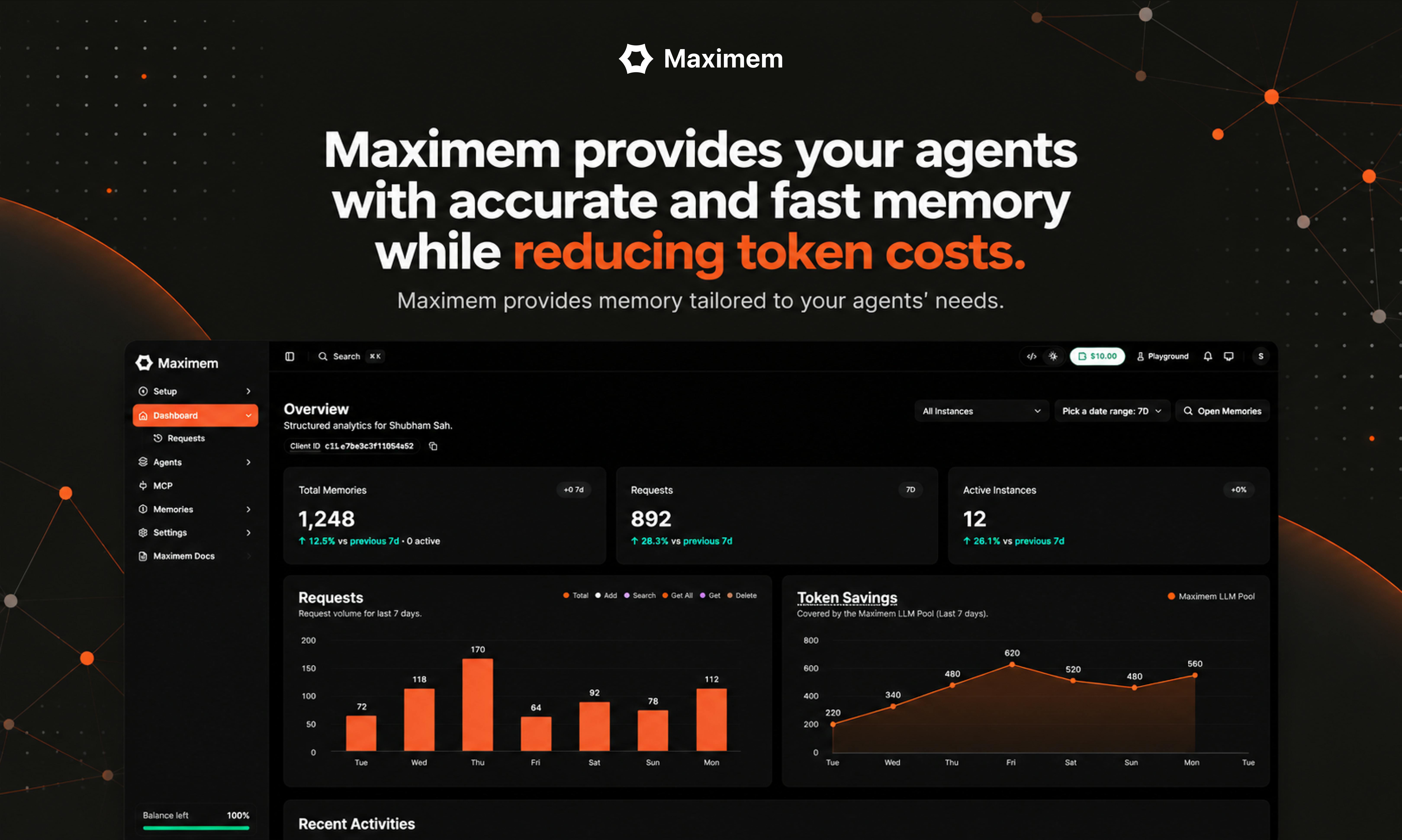
Maximem Synap's core proposition is to absorb all that complexity into a single, unified memory layer. According to its product documentation, the system automatically handles entity resolution, temporal reasoning, and multi-level scoping — meaning developers no longer need to build and tune their own vector databases or ranking models. Teams can focus on business logic instead of the plumbing beneath a memory system.
Entity resolution means the system can recognize that different references point to the same object — for example, "my boss," "Director Zhang," and "Zhang Wei" might all refer to the same person. The memory system needs to consolidate these into a single entity node rather than storing three separate records. Temporal reasoning involves managing the freshness of memories: if a user said "I work in Beijing" two months ago and "I just moved to Shanghai" last week, the system must understand that the latter supersedes the former — not present both with equal weight. Multi-level scoping means memories can be isolated or shared across dimensions like user, session, or agent role — for instance, whether a user's preferences in a shopping assistant should carry over to a scheduling assistant depends entirely on the business design. All three capabilities together are what make a memory system production-ready; a gap in any one of them leads to confusion or data leakage.
Performance Benchmarks: Speed and Accuracy Together
Maximem Synap makes some bold claims in its marketing materials. On two publicly recognized long-term memory benchmarks, it reports reaching 92% accuracy on LongMemEval and 93.2% on Locomo, positioning itself as the fastest and most accurate memory system on public benchmarks.
Even more notable is the latency: P75 recall latency under 15 milliseconds. For conversational agents that require real-time responses, memory retrieval is often a hidden bottleneck that quietly degrades the user experience — millisecond-level recall can make a meaningful difference. That said, these numbers are all self-reported by the vendor, and developers should validate real-world performance independently, especially since accuracy figures can shift significantly depending on data distribution.
LongMemEval and Locomo are among the more widely cited benchmarks in both research and engineering for evaluating long-term memory. LongMemEval primarily tests a model's ability to locate and correctly use specific information across very long conversation histories, covering both single-hop and multi-hop QA scenarios. Locomo (Long-Context Memory) focuses on cross-session contextual coherence and temporal reasoning. Both benchmarks require precise recall in the presence of significant noise, so the accuracy numbers do carry some reference value. However, it's worth noting that the distribution of benchmark test sets often diverges from real user conversations — benchmark data tends to be linguistically consistent with clear intent, while production inputs are full of ambiguity, abbreviations, and implicit context. That gap is exactly why vendor benchmark claims should always be interpreted with caution.
Ecosystem Compatibility Is a Key Selling Point
For developer tools, seamless integration with existing tech stacks often matters more than isolated performance gains. Maximem Synap claims native support for 22 frameworks, including the most widely used ones: LangChain, LangGraph, and Anthropic's Claude Agent SDK.
This broad framework coverage lowers the cost of adoption. Teams already building agents with LangChain can, in theory, plug in this memory layer without rearchitecting their entire stack. The fact that the product is tagged under Developer Tools, Artificial Intelligence, GitHub, and SDK on Product Hunt further signals its positioning as developer-facing infrastructure.
Adoption Barrier and Market Reception
On the commercial side, Maximem Synap offers a free tier with no credit card required — a common strategy for developer tools looking to attract early adopters by minimizing friction.
On Product Hunt, the product received 95 upvotes, 27 comments, and ranked #8 on launch day. For a developer tool, that's a solid mid-tier result — it shows the product is addressing a real need, but hasn't yet triggered explosive growth. The memory layer space already has established players like Mem0 and Zep. For Maximem Synap to stand out, benchmark numbers alone won't be enough. Reliability in real-world scenarios, cost efficiency, and documentation quality will ultimately determine how far it goes.
Mem0 offers a user-centric personalized memory graph with cross-application memory persistence and has built up a meaningful open-source community. Zep is known for structured extraction of conversation history and built its early reputation through deep integration with LangChain. Both have been validated in production projects. Maximem Synap is relatively new, and its differentiation centers on latency performance and benchmark accuracy — but brand recognition and community ecosystem are still in early stages. For engineering teams doing technology selection, maturity and documentation quality are decision factors that can't be overlooked.
A Few Things Worth Evaluating
For teams building long-horizon conversational agents, Maximem Synap offers an out-of-the-box memory solution that could save significant engineering effort compared to building a custom vector retrieval pipeline. But when doing your technical due diligence, there are three things worth verifying: first, whether the official benchmark numbers are reproducible on your own business data; second, whether the low-latency promise holds up under high concurrency; and third, what the free tier's actual usage limits are and what the cost model looks like at scale.
Memory is the capability that transforms an AI agent from a "tool" into an "assistant." The infrastructure race in this space is just getting started.
Related articles

Uber Deploys ChatGPT Work Company-Wide: AI in the Workplace Enters the Scaled Implementation Phase
Uber deploys ChatGPT Work to 30,000+ employees, extending it from engineering to all roles. We analyze its expert-engineer pairing, end-to-end automation, and questions of AI control and power concentration—insights for scaling AI in the workplace.

Shift at Midnight Hands-On: When "ID Verification" Becomes Alien Hunting
Shift at Midnight blends ID verification with horror survival in a four-player co-op game. We break down its inspection mechanics and chaotic humor.

Zelensky Recounts the Outbreak of War: I Need Ammunition, Not a Ride
Zelensky recalls the first day of war in a YouTube interview: farewell to family, rejecting Biden's evacuation offer with "I need ammunition, not a ride," and how Bucha shaped his stance on compromise and peace talks.