MCP 2.0 Deep Dive: How a Stateless Protocol Is Reshaping the AI Agent Communication Standard
MCP 2.0 goes stateless and sessionless in its biggest release yet, adding extensions and enterprise-grade governance.
The Model Context Protocol (MCP) shipped its largest update yet in July 2026 with MCP 2.0. The headline change is a stateless, sessionless architecture that eliminates the initialize handshake overhead — which accounted for 50% of messages in some deployments. Four new mechanisms replace the old model: server discover caching, multi-round trip requests for elicitation and sampling, optional subscriptions for event notifications, and an explicit state handler pattern for session-like behavior. MCP 2.0 also formalizes three tiers of extensions, introduces a 12-month feature support guarantee with mandatory conformance tests, and sets a roadmap focused on agentic message primitives, unified HTTP transport, and agent identity security.
MCP at Nearly Two Years: How a Community-Driven Protocol Grows Up
The Model Context Protocol (MCP) has been around for nearly two years. First released in November 2024, it has gone through multiple iterations — three versions in 2025, followed by an official update in July 2026. According to MCP's core maintainers — members of the Microsoft technical team — who shared updates in a recent "State of MCP" session, the team is already preparing a second 2026 release, tentatively scheduled for December 15 (though that date remains very preliminary).
As a community-driven project, MCP's growth metrics are impressive: package downloads have reached 514 million and continue to climb, the number of commit contributors to the GitHub repository keeps growing, and fork counts are steadily rising. Taken together, these signals confirm that developers are actively using, experimenting with, and pushing the protocol forward. MCP's positioning has always been clear: bring context to models, support agentic tool calls, and serve as the universal framework connecting large language models to external capabilities.
From Roadmap to MCP 2.0: Ripping Off the Band-Aid
In January 2026, the MCP team published its first roadmap, identifying several core priorities: transport layer and extensibility, message type expansion, governance maturity, and enterprise readiness. Building on that roadmap, the team shipped what they're calling "MCP 2.0" on July 28 — widely regarded as the largest release since the protocol's inception.
The reason it earns that label is that the team made some difficult decisions and introduced breaking changes. As the maintainers put it, this was done to make the protocol more durable and defensible going forward. Nearly every item in the July release maps directly to goals set in the January roadmap: extensive work on transport evolution to make MCP stateless and sessionless; updating tasks to be stateless and converting them into an official extension; improving governance processes; and strengthening enterprise readiness.
The Core Shift: Why MCP Went Stateless and Sessionless
The most talked-about change in MCP 2.0 is the move to a stateless, sessionless architecture. This is a breaking change that involved extensive internal debate and broad community consultation.
Protocol Overhead Was the Most Immediate Pain Point
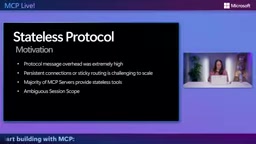
Feedback from large organizations revealed that the message overhead of the old protocol was extremely high. Because the protocol required maintaining state and an initialize handshake, internal team measurements found that 50% or more of all messages on some servers were protocol messages — things like initialize and list tools. As MCP grew in popularity and more agents started calling it, that kind of 50% overhead became difficult to justify, especially when there was no meaningful benefit to show for it.
What are "protocol messages"? They're the metadata exchanged between parties to establish a shared understanding before any real business logic is invoked. MCP 1.0 follows the JSON-RPC 2.0 spec, which requires clients to send an initialize request on first connection; the server then returns its capability description, and the client confirms before issuing any business requests. In local STDIO scenarios, this handshake happens once and is essentially free. But in cloud HTTP deployments, the handshake must be repeated every time a client instance restarts, a load balancer routes traffic to a new node, or a serverless function cold-starts. For high-frequency, short-lived agent calls, this fixed overhead is dramatically amplified — that's the real-world scenario behind the "50% protocol messages" figure.
The Practical Problems with Persistent Connections and Sessions
MCP 1.0 required remote servers to use persistent connections or sticky routing. This wasn't a problem for local STDIO transport, but it was a genuine challenge for HTTP. What the team observed in practice was that most MCP servers being built and deployed only offered stateless tools — which gave them confidence that the common case should be made simple and operationally lightweight.
Beyond that, the scope of a session was ambiguously defined by the protocol itself. When the same session-aware MCP server was moved from VS Code to ChatGPT or Claude, each host behaved slightly differently, the real-world results were poor, and very few servers actually tried to do it. Weighing all of these factors, the team ultimately decided to rip off the band-aid and build a stateless, sessionless protocol.
After Going Stateless: The Mechanisms That Replace the Old Model
The stateless redesign introduced a set of concrete mechanical changes. Understanding them helps developers grasp the underlying design logic.
Server Discover Replaces the Initialize Handshake
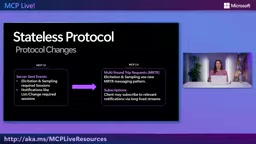
The old initialize step served multiple roles: protocol version negotiation, capability negotiation, and session creation. MCP 2.0 introduces a server discover feature: clients can query which protocol versions and data a server supports, and cache the result — no need to repeat this on every request or startup. At the same time, every MCP request becomes self-describing — it carries the client version and supported capabilities in a meta field or HTTP headers (when using streamable HTTP transport), and the server decides whether to accept or reject based on that information. For developers using the official SDKs, most of this happens transparently in the background. The most noticeable effect is faster startup and connection times, since multiple rounds of handshaking are eliminated.
Multi-Round Trip Requests Handle Elicitation and Sampling
Features like elicitation and sampling previously required sessions and persistent connections. MCP 2.0 introduces multi-round trip requests: when a tool call needs more information, the server returns a special error code meaning "additional input required"; the client then gathers that information (prompting the user or running sampling) and replays the request with the supplementary data. The key insight here is request replay — this is what makes the stateless model work.
Elicitation refers to the mechanism by which a server actively solicits additional input from the user during tool execution — for example, asking the user to confirm an action or fill in a missing parameter. Sampling refers to the server asking the client (i.e., the LLM) to generate a piece of text, enabling "server-driven inference" for intermediate steps that require model judgment. In a stateful protocol, both rely on persistent connections to maintain call context. In the stateless MCP 2.0 model, the solution is to break the entire interaction into independent HTTP round trips: the server suspends the request with a specific error code, and the client replays the same request with full context after completing the supplementary action. This requires clients to implement request replay logic, and means server-side tools must be designed to be idempotent — multiple calls with the same input should produce no side effects.
Subscriptions Handle Notifications
For list-change notifications, progress updates, and similar events, MCP 2.0 provides a subscription mechanism: the client proactively creates a persistent channel and maintains a long-lived connection, and the server pushes events down it. It's worth noting that notification delivery is best-effort — there is no delivery guarantee (which was also true in 1.0). The subscription feature is entirely optional and is better suited for performance-sensitive or real-time application scenarios.
Explicit State Handler Pattern Replaces Sessions
For cases where session-like behavior is genuinely needed, the official recommendation is the explicit state handler pattern: the MCP server exposes a set of tools for managing session-scoped state. For example, a "create shopping cart" tool returns a cart ID (a handler), and subsequent "add item" calls must include that ID. This pattern has proven effective in practice, and comes with a bonus — you can create multiple concurrent sessions (multiple carts), something the old protocol's session model couldn't support.
Extensions: Composable, Extensible Without Bloating the Core
MCP 2.0 formally introduces an extensions mechanism that allows capabilities to be added without bloating the core protocol, while giving the community a fast path for experimentation. Extensions fall into three categories:
- Official extensions: Part of the MCP spec and GitHub organization, subject to review by core maintainers, and prefixed with
io.modelcontextprotocol. MCP apps and tasks have both become official extensions. - Experimental extensions: Not yet formally adopted — examples include triggers and events extensions and skills over MCP extensions. These are working through working groups to gather feedback and implementation details, with the goal of eventually becoming official.
- Vendor-specific extensions: Developed outside the MCP organization; anyone can create them, and they're suited to customized scenarios where a vendor controls both the host and the client. If a vendor extension proves to have broader applicability, it can be contributed back to the community or proposed as an official extension.
The team specifically recommends that contributors who want to modify the protocol should implement their idea as an extension first, gather real-world data and feedback, and only then consider submitting an SEP for a new feature rather than going straight to a full proposal.
Governance Maturity: Giving Enterprises the Confidence to Bet on MCP
Governance evolution doesn't show up in the spec text, but it's the key to MCP becoming a trusted and stable protocol.
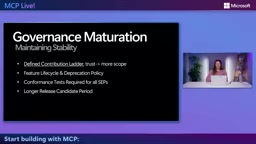
The team has published a new contribution ladder guide that clarifies roles and advancement paths. They've also introduced a feature lifecycle and deprecation policy — any new feature is supported for at least 12 months, with a formal deprecation process (sampling has already been deprecated). This matters especially to enterprises: they can confidently adopt MCP knowing that whatever version or feature they rely on has at least a 12-month support window.
In addition, all new SEPs and new features must include conformance tests to maintain protocol interoperability and help SDK developers align with the spec. The team has also shifted to longer release candidate (RC) cycles — with dedicated feedback windows that give SDK maintainers, server authors, and host creators sufficient time to try out the draft protocol. Only critical bug fixes are accepted before the spec is finalized.
SEP (Specification Enhancement Proposal) is a standardized proposal mechanism that MCP has adopted from open-source community practice, similar to Python's PEPs or TC39's Stage process. Anyone can submit an SEP describing a new feature's motivation, design, security implications, and backward compatibility. It then goes through working group discussion and core maintainer review before entering the spec draft. Conformance tests are an automatically enforced test suite required alongside every SEP, used to verify that an SDK or implementation fully and correctly supports the corresponding feature. Together, these two mechanisms form a closed loop of "say what you do, do what you say" — proposals have a process, implementations have verification, rather than relying solely on documentation to define behavior.
What's Next: From Messaging Patterns to Enterprise Security
In August 2026, the team published a new roadmap that continues and adds to several themes:
- Agentic message primitives: Following tasks and long-running operations, the rapid evolution of agents demands more message primitives.
- Unified HTTP-native transport: Exploring whether local MCP servers could also adopt HTTP-style transport instead of STDIO, avoiding duplicated work between HTTP headers and meta fields. This is under discussion in the transport working group and is unlikely to make the December release, but needs to be started early.
- Agent identity and enterprise security: Continuing to address new OAuth challenges and strengthen security capabilities.
- Improved core primitives: Such as file uploads for tool calls, richer interactions, and controls for what data should not be sent to the LLM.
A Closer Look at Agentic Messaging Patterns
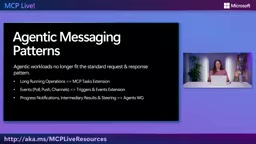
The maintainers specifically emphasized that the standard request-response pattern doesn't fit all agentic workloads and tool calls — deploying resources to Azure, for example, rarely returns an immediate result. MCP uses the tasks extension for long-running operations, and the team is planning to bring this official extension into the core protocol.
Currently, tasks operate only via polling. The triggers and events working group is exploring additional event messaging patterns: polling, pushing changes via webhook, and delivering real-time events over a streaming connection. The team will also add primitives for intermediary results — letting long-running tool calls or agents report "here's what I'm doing" — and supporting a steering mechanism that lets clients provide feedback and adjust direction mid-execution.
It's worth noting that the maintainers deliberately use the phrase "messaging patterns and primitives" rather than "agents" — because the agent space is still evolving rapidly, and the team wants to first see how far they can get with messaging patterns and primitives alone before deciding on next steps.
Polling is the pattern in which a client periodically queries the server for task status — simple to implement but at the cost of latency and wasted requests. Webhooks reverse the direction: the server proactively pushes a notification to a URL pre-registered by the client when status changes, offering lower latency but requiring the client to have a publicly reachable endpoint. Streaming connections (such as Server-Sent Events or WebSocket) continuously deliver events over a single HTTP connection, balancing real-time delivery with firewall traversability — a common choice for browser and serverless environments. MCP's current tasks extension only supports polling; the triggers and events working group is evaluating the applicable boundaries of the latter two models. The core challenge is how to let a server "know" where to push events and how to ensure no events are lost within a stateless protocol framework.
How to Get Involved: This Is a Community-Driven Project
MCP repeatedly emphasizes its community character. Developers who want to participate can: join working groups or special interest groups (each meets weekly or regularly, with corresponding Discord channels); propose or comment on SEPs within working groups; launch experimental or vendor-specific extensions to try out new ideas; or contribute to the spec, SDKs, and surrounding tooling. As the maintainers put it, MCP wouldn't be where it is today without the community — and the community will continue to drive its evolution forward.
Related articles
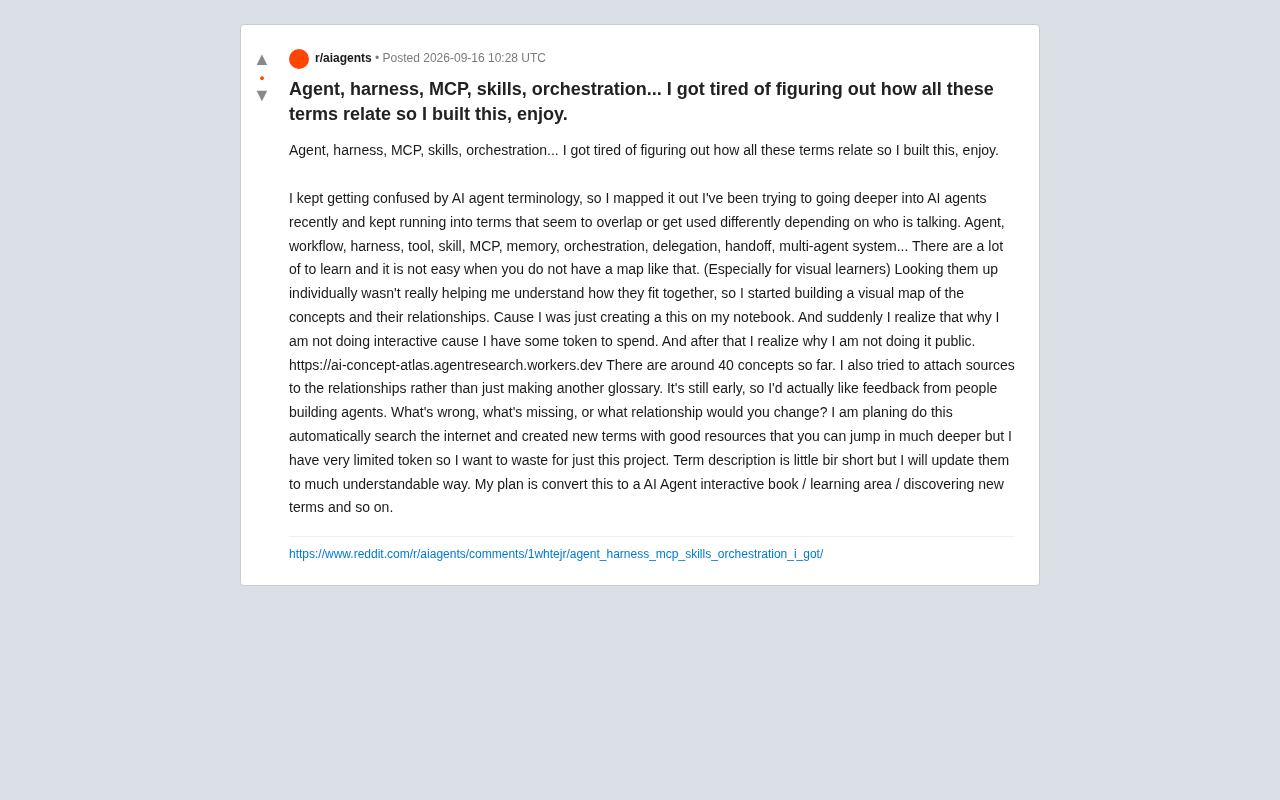
AI Agent Terminology Too Confusing? One Interactive Concept Map to Untangle 40+ Core Terms
Confused by AI Agent terms like MCP, harness, orchestration, and skills? AI Concept Atlas is an interactive map visualizing 40+ concepts and their relationships, with cited sources.
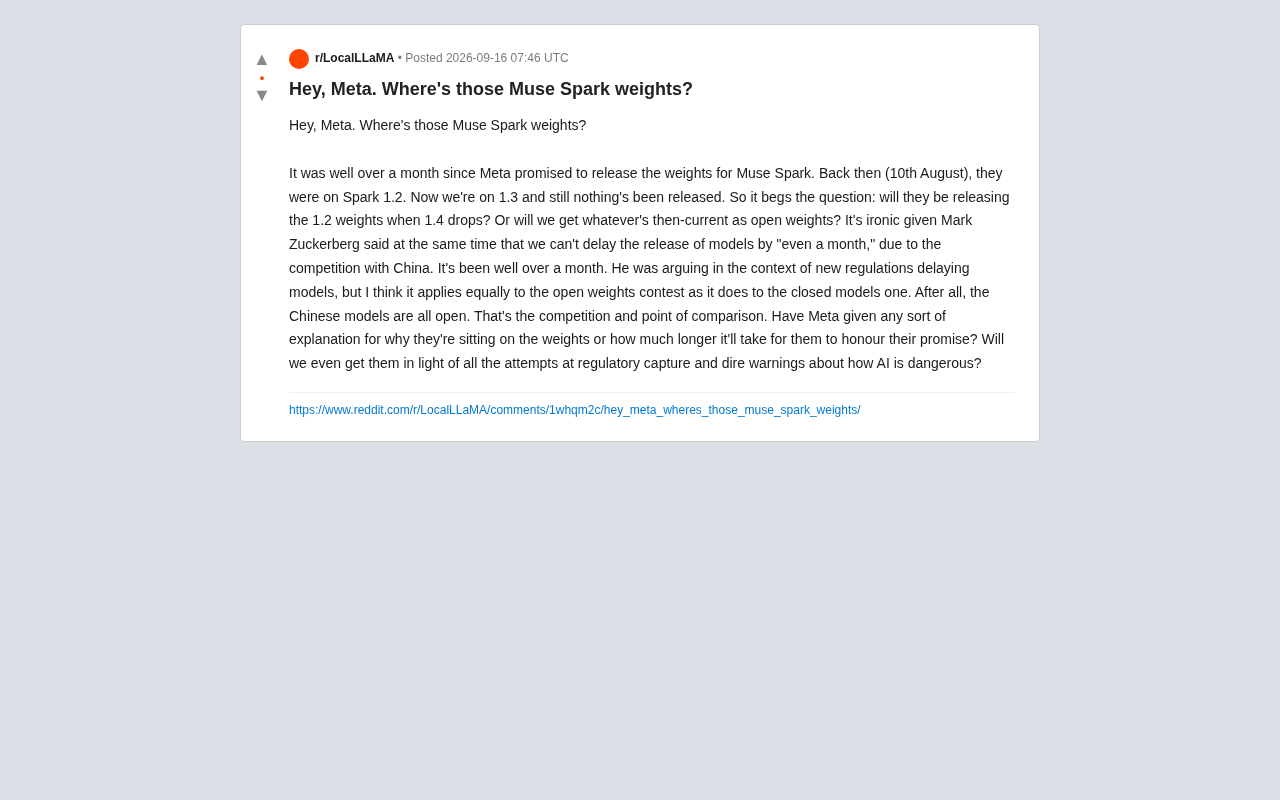
Meta's Broken Promise: Community Demands to Know Where the Muse Spark Weights Are
Meta promised to open-source Muse Spark model weights over a month ago, but still hasn't delivered. The community questions how this squares with Zuckerberg's "can't delay even a month" stance.
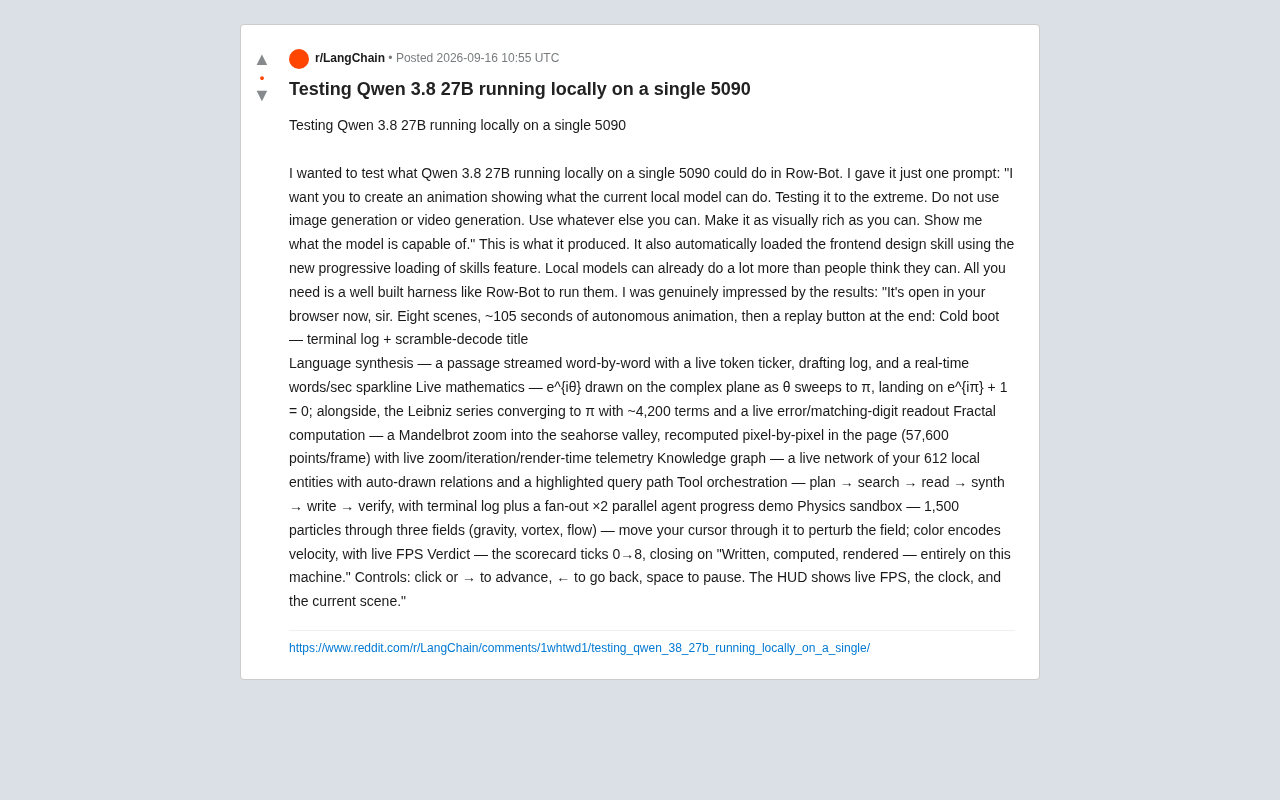
Running Qwen3 27B Locally on a Single RTX 5090: What Can It Actually Do?
A developer runs Qwen3 27B locally on a single RTX 5090 via the Row-Bot Agent framework, generating an 8-scene, 105-second interactive animation from one prompt — including real-time math, fractals, and physics.