MCP Protocol Explained: A Standardized Approach to Plug-and-Play Tool Integration for AI Agents
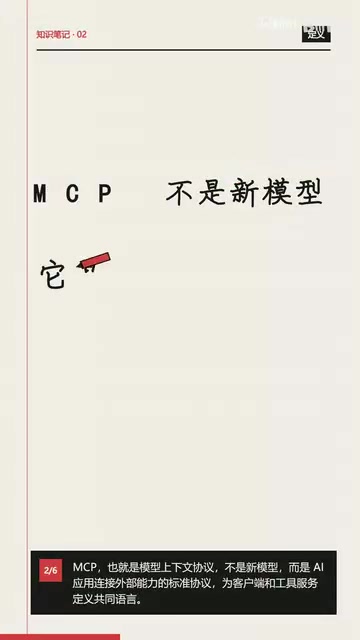
MCP standardizes how AI Agents connect to external tools, solving the M×N integration problem.
MCP (Model Context Protocol) is a standardized protocol that enables plug-and-play tool integration for AI Agents. Through its three-layer architecture of Host, Client, and Server, MCP eliminates repetitive adapter code by providing a universal interface—much like USB did for peripherals. It reduces the M×N integration problem to M+N, enabling tool reuse across AI applications while keeping security responsibilities at the application layer.
Why Connecting Tools to Agents Is Becoming Increasingly Painful
In traditional AI Agent development, every new external tool integration typically requires writing a separate set of adapter code. Want your Agent to search a database? Write one integration module. Want it to access a code repository? Write another. As the number of tools grows, the cost of these repetitive integrations scales linearly—or worse.
What makes it even more challenging is that these adapter codes are usually tightly coupled to specific clients. In mainstream Agent frameworks like LangChain, AutoGPT, and MetaGPT, tool integration relies on each framework's custom Tool abstract classes or function decorators—for example, LangChain requires developers to inherit from BaseTool and implement the _run method, while AutoGPT uses its own command registration mechanism. Switching to a different Agent framework or calling convention often means starting the integration from scratch. The lack of a unified "interface standard" between tools and clients creates the classic M×N integration problem, which has become a core bottleneck limiting the expansion of the Agent ecosystem.
It's against this backdrop that MCP (Model Context Protocol) was born. The problem it aims to solve isn't "models aren't smart enough"—it's the engineering headache of "connections are too chaotic."
What Exactly Is the MCP Protocol
First, let's clear up a common misconception: MCP is not a new model. It's a standardized protocol for connecting AI applications to external capabilities. Its positioning is similar to a universal interface specification in the software world, defining a common language between clients (AI applications) and tool services.
To use an analogy, MCP is to AI Agents what the USB interface is to peripherals. Before USB became widespread, mice, keyboards, and printers each had their own proprietary connectors. After USB standardization, all devices used the same port. MCP does exactly this—it eliminates the need for one-to-one custom connections between tools and AI applications, replacing them with communication that follows a single set of conventions.
This approach to protocol standardization has well-established precedents in the software industry. The most notable is Microsoft's LSP (Language Server Protocol), which solved the M×N adaptation problem between code editors and programming language support. Before LSP, every editor (VS Code, Vim, Emacs, etc.) had to independently implement syntax highlighting, auto-completion, error checking, and other features for each language. After LSP standardization, a language service only needed to be implemented once to work with all compatible editors. MCP directly draws from this successful LSP model, applying it to the connection scenario between AI Agents and external tools. Anthropic explicitly acknowledged LSP's architectural philosophy when designing MCP.
The core value of this protocol lies in "standardization." When both tool providers and application developers follow the MCP specification, neither side needs to create custom adaptations for the other.
Breaking Down MCP's Three-Layer Architecture
MCP's operation typically involves three key roles. Understanding their division of responsibilities is essential to mastering this protocol.
Host: The Agent's Runtime Container
The Host is the environment where the Agent resides—it's the primary runtime entity of the entire system. Common Hosts include AI applications like Claude Desktop and Cursor, or custom Agent runtimes built by developers. A single Host can connect to multiple Servers simultaneously, aggregating capabilities from different sources.
Client: Responsible for Establishing and Maintaining Connections
The Client runs inside the Host and is responsible for establishing and maintaining connections with external Servers. It initiates communication and plays the role of an "intermediary." Under the hood, MCP uses JSON-RPC 2.0 as its message transport format—a lightweight remote procedure call protocol that encodes requests and responses in JSON, supporting three message patterns: single requests, batch requests, and notifications. The choice of JSON-RPC over alternatives like gRPC or REST was primarily driven by its simplicity and broad language support. Nearly every programming language can easily parse JSON, which significantly lowers the technical barrier for Server implementation.
At the transport layer, MCP supports two main modes: Stdio (Standard Input/Output) mode is suited for local deployment scenarios, where the Client launches the Server as a subprocess and they communicate via stdin/stdout, offering low latency with no network configuration needed. SSE (Server-Sent Events) mode targets remote deployment scenarios, using HTTP long-polling connections to enable real-time message pushing from server to client, ideal for Servers deployed in the cloud or on remote machines. The choice between modes depends on the deployment architecture—Stdio for local tools, SSE for cloud services.
Server: Exposing Tools and Resources
The Server is the capability provider. It exposes three types of content: Tools, Resources, and Prompts. Any external capability that needs to be called by an Agent is packaged and exposed through a Server.

The distinction among these three capability types reflects a philosophy of fine-grained permission design. Tools are executable functions that the model can actively invoke, such as file read/write operations, API requests, and database queries—they produce actual side effects. Resources are read-only contextual data sources, similar to GET endpoints in REST APIs. They provide background information to the model without producing side effects—for example, reading configuration files or checking system status. Prompts are predefined interaction templates that help users interact with specific tool scenarios in a structured way. The separation of these three follows the principle of least privilege—not all capabilities require execution permissions, and independently defining read-only resources and templates reduces the risk of unintended operations.
The elegance of this layered design lies in its clear separation of responsibilities: the Host manages runtime, the Client manages connections, and the Server manages capabilities. All three are decoupled, and any one of them can be independently replaced or extended.
A Complete MCP Tool Invocation Flow
Now that we understand the role assignments, let's look at what happens inside MCP when an Agent actually needs to use a tool.
The entire process can be broken down into several steps:
- Establish Connection: The Client first establishes a connection with the Server (via Stdio or SSE channel).
- Capability Discovery: Once connected, the Client "discovers" what capabilities are available on the Server, reading tool documentation and parameter schemas (structure definitions).
- Model Selection: The model selects the appropriate tool from the available options based on the current task requirements.
- Execution and Return: The Server executes the selected tool and returns structured results back to the Client.
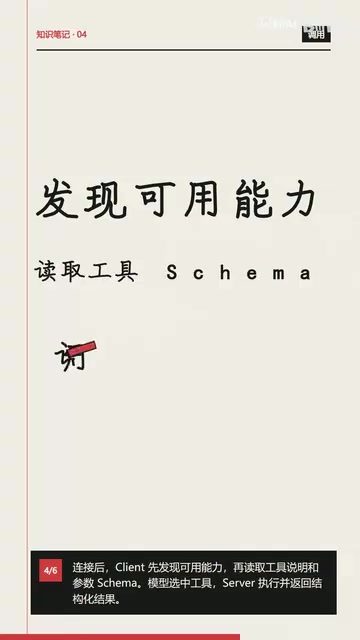
There's a noteworthy design detail here: the model doesn't blindly invoke tools. Instead, it first reads the tool's description and parameter schema, understands what each tool can do and what inputs it requires, and only then makes its selection. In MCP, tool parameter schemas are defined based on the JSON Schema specification, a standardized language for describing JSON data structures. Each tool uses a schema to declare its input parameters' types, whether they're required, value ranges, and other constraints. Large language models parse these schema descriptions through their Function Calling capability, autonomously deciding during inference when to call which tool and what parameters to pass. Major model providers including OpenAI, Anthropic, and Google all support this schema-based function calling paradigm, which is also the technical foundation enabling MCP to work seamlessly with multiple models.
This makes tool invocation predictable and controllable, and the structured results returned are easy for the model to process further.
MCP's True Value: Reducing the Engineering Cost of Repetitive Integration
Many people mistakenly assume that MCP allows Agents to "magically gain access to more tools." This is a misreading. MCP's value doesn't lie in increasing the number of tools—it lies in drastically reducing repetitive integration code.
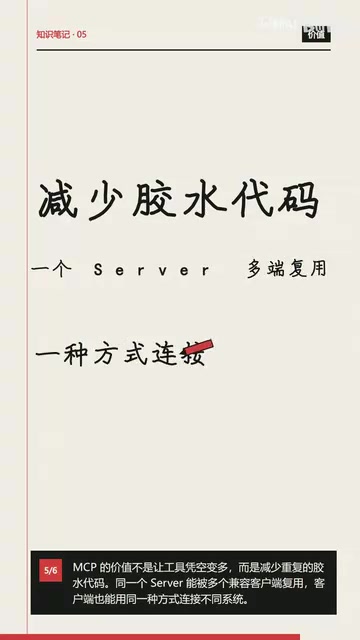
This manifests in two directions:
- A single Server can be reused by multiple compatible clients. Tool providers only need to implement once according to the MCP specification, and their tools can be called by any MCP-compatible AI application—no separate adaptation needed for each client.
- Clients can connect to different systems using the same approach. Application developers only need to master one MCP connection method to integrate with any tool service that follows the protocol, without learning and maintaining multiple different integration patterns.
This effectively simplifies the "N clients × M tools" combinatorial adaptation problem into an "N clients + M tools" problem where each side implements the protocol once. To put it in concrete numbers: if there are 10 AI applications and 20 tools, the traditional approach requires up to 200 sets of adapter code, while the MCP approach only needs 10 Client implementations plus 20 Server implementations—a total of 30 sets of code. As the ecosystem scales, the cost savings from this reuse become increasingly significant. Currently, Anthropic officially maintains several reference Server implementations including file system, GitHub, Google Drive, Slack, PostgreSQL, and more. The community is also rapidly contributing various third-party Servers, and the ecosystem is taking shape at an accelerating pace.
MCP's Security Boundaries: Protocol Does Not Equal Security Guarantee
Finally, an important boundary needs to be emphasized: MCP only addresses the standardization of connections and invocations—it is not responsible for security.
Authentication, authorization, approval of dangerous operations, and verification of service trustworthiness—these security-related responsibilities still fall on the application layer. MCP is more like a "universal power outlet"—it ensures the plug fits and electricity flows, but the outlet itself can't prevent you from plugging in a faulty device.
This means several specific security concerns that developers must handle themselves: Authentication—the MCP protocol doesn't have built-in OAuth, API Key, or other authentication mechanisms; Server access control needs to be implemented separately at the application or network layer. Operation Approval—when tools involve irreversible operations like file deletion or data modification, applications should design Human-in-the-loop confirmation mechanisms. Input Validation—while schemas define parameter structures, security checks like injection prevention and operation scope limitations must still be implemented by the Server itself. Server Trustworthiness—community third-party Servers vary widely in code quality and security; code audits should be conducted before integration.
In other words, adopting MCP doesn't mean you can relax your security posture. Developers still need to design comprehensive permission controls and operation approval mechanisms at the application layer, and evaluate the trustworthiness of connected Servers. Treating MCP as a security safe is a dangerous misconception.
Summary
As a Model Context Protocol, MCP provides a unified standard for connecting AI applications to external tools through its three-layer architecture of Host, Client, and Server. Its core contribution is eliminating the engineering cost of repetitive integration, enabling tool reuse and connection standardization. Just as the LSP protocol unified the connection between editors and language services, and the USB standard unified peripheral interfaces, MCP is establishing a universal language for the connection layer of the AI Agent ecosystem. But it is ultimately only a "connection layer" solution—true intelligence comes from models, and true security comes from application-layer design. Understanding MCP's capability boundaries is the key to using this protocol effectively in real-world projects.
Related articles
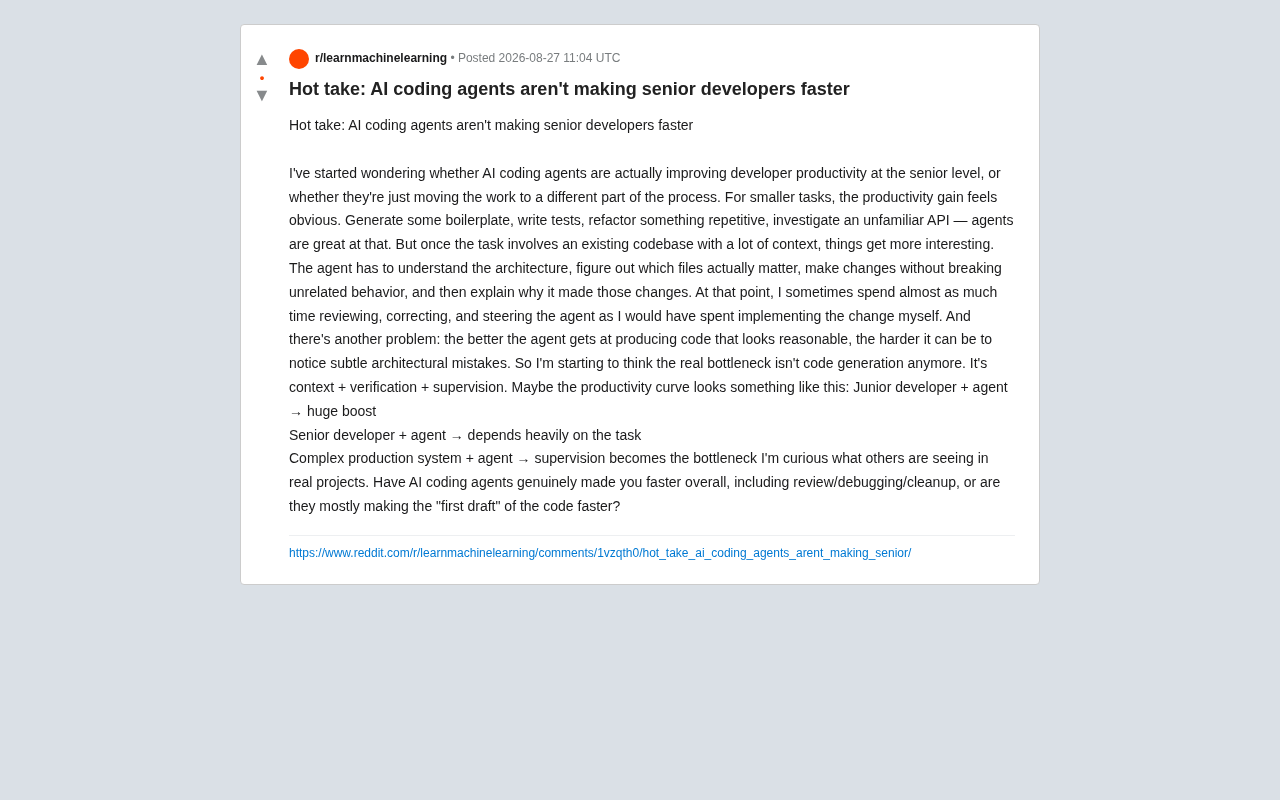
Do AI Coding Assistants Actually Boost Productivity for Senior Developers? The Truth About Bottleneck Migration
Do AI coding assistants truly boost senior developer productivity? This article reveals how productivity bottlenecks migrate from code writing to verification and supervision.

Heteropessimism: Why Modern Dating Feels Increasingly Hopeless
Heteropessimism is becoming a cultural phenomenon: women use self-deprecating humor about relationships with men, reflecting political regression, economic inequality, and emotional struggles.

Organizing Machine Learning Notes with Claude Code: Self-Study Practices and Methodology for CS189
A self-learner uses Claude Code to restructure UC Berkeley CS189 machine learning notes by topic, using a dual-document approach to map knowledge connections and fill conceptual gaps.