MCP vs Traditional APIs: Cutting Integration Cost from N² to N+1

MCP reduces AI assistant-to-service connections from N×M to N+M, turning integration from maintenance hell into a protocol agreement.
The article compares the integration topology of traditional direct tool calling versus MCP (Model Context Protocol). In the traditional model, each assistant needs a custom adapter for each service, connections grow as N×M (four assistants and four services means 12 connections), and each server-side schema change breaks the corresponding connection, creating maintenance hell. MCP lets services describe their own tools, and AI discovers tools automatically via standard JSON-RPC, reducing connections to N+M—three assistants and three services drop from 9 to 6, and four assistants and four services drop from 16 to 8. MCP converges integration topology and shrinks the blast radius of changes, but tool semantics, permission boundaries, and result reliability still need separate design.
When AI assistants grow from 1 to 4, traditional API integration work balloons from 1 connection to 12; MCP (Model Context Protocol) brings that number down to 8. Behind this is a fundamental shift in the connection paradigm.
The N² Dilemma of Traditional API Integration
Direct tool calling starts out simple enough: one assistant connects to one API, and you write a bit of adapter code. But the problem explodes exponentially as the number of assistants grows linearly.
According to analysis from a YouTube tech channel, suppose you first integrate Cursor—you need to write a custom adapter for it. Then you add ChatGPT, and duplicate glue-code files start piling up.
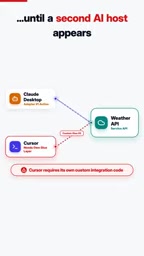
What's trickier is the two-way expansion. Every time you add a new service (say GitHub or Slack), you have to write a separate integration for each assistant. Four assistants plus four services means 12 connections.
And every server-side schema change breaks one of those connections, taking the corresponding assistant offline.
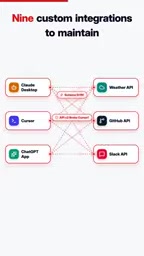
This pattern drags teams into "maintenance hell": duplicated code, scattered failure points, and slowed iteration. The number of connections grows as N², while maintenance capacity is finite.
MCP's Flip: Self-Describing Services, Automatic Tool Discovery
The Model Context Protocol (MCP) reverses the flow of information. Instead of each assistant hard-coding service interfaces, the service itself describes which tools it offers.

Any AI can query an MCP server via standard JSON-RPC and instantly discover available tools—no pre-written adapters required. This means tool descriptions are decoupled from the calling protocol; when the server upgrades its schema, assistants can adapt automatically through the discovery mechanism rather than crashing outright.
"Write once, connect to all AI models" is the core promise of this architecture. Integration work converges from one copy per assistant to a single copy exposed uniformly by the server.
JSON-RPC is a lightweight remote procedure call protocol that uses JSON as its data format. It defines three message types—request, response, and notification. A request must include the jsonrpc version, a method name, and optional params; a response contains either result or error. Unlike REST, JSON-RPC doesn't rely on HTTP verbs and URL paths to express semantics—all operations are distinguished by a unified endpoint and method name, making it ideal for scenarios like tool discovery where you first query capabilities and then call a specific method. In MCP, the client retrieves the tool list via the tools/list method and then executes a specific tool via tools/call. The entire interaction naturally supports dynamic extension without redesigning interface paths for each new tool.
The tool discovery mechanism is what sets MCP apart from traditional hard-coded integration. In the traditional model, an assistant must know in advance each API's endpoint, parameters, and return structure. In MCP, the server registers the list of tools it provides at startup, including metadata such as tool names, descriptions, and JSON Schemas for input parameters. After connecting, the client first calls the discovery interface to pull this list, then dynamically selects tools and constructs parameters based on user intent. This "discover first, call later" flow means that when a new tool is added or a parameter structure changes, as long as the server updates its metadata, all connected assistants can automatically pick up the change—no need to republish adapter code. Tool discovery is thus the technical cornerstone of MCP's promise to "write once, connect to all AI models."
3+3 Instead of 9: The Math of Connection Cost
The video uses an intuitive comparison: three AI assistants connecting to three services requires nine connections (3×3) in the traditional approach, but only six (3+3) with MCP—each assistant connects to the protocol once, and each service exposes the protocol once.
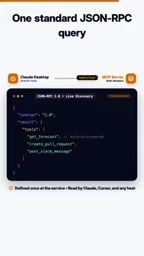
Connections drop from N×M to N+M—this is MCP's most direct engineering value. As the number of assistants and services continues to grow, the gap widens further: four assistants and four services is 16 vs. 8; ten assistants and ten services is 100 vs. 20.
This convergence not only reduces code volume but also shrinks the blast radius of schema changes. Changes happen on the server side, and all assistants connected through the protocol benefit uniformly—no need to fix them one by one.
Star topology vs. mesh topology is key to understanding MCP's engineering value. Traditional direct calling forms a mesh topology: each assistant has an independent connection to each service, any two nodes may have an edge between them, the number of connections grows as N×M, and troubleshooting requires checking each path individually. MCP restructures this into a star topology: all assistants connect to the protocol layer, and all services also connect to the protocol layer, which acts as the central hub. Star topology compresses connections to N+M and centralizes compatibility logic in one place—any server-side change only needs to be adapted once at the central node. The cost is that the protocol layer itself becomes a critical path, requiring guarantees for its stability and version compatibility—an operational concern to consider when deploying MCP.
Engineering Perspective: What MCP Solves and Doesn't Solve
What MCP truly solves is the "integration topology" problem: transforming point-to-point mesh connections into a star structure, letting the protocol layer handle compatibility.
But what the video material doesn't cover is that MCP doesn't automatically handle differences in tool semantics, permission boundaries, or the reliability of call results—these still need to be designed separately on both the server and assistant sides.
From a deployment perspective, MCP is better suited to environments where the tool ecosystem changes frequently and multiple assistants coexist. If you only have one assistant connecting to one stable API, the simplicity of direct calling still has advantages.
For teams drowning in glue code, MCP offers a path out of maintenance hell: trading N² connection debt for an N+M protocol agreement.
The blast radius of schema changes refers to how large the affected scope is when a server-side interface definition changes. In traditional point-to-point integration, a schema change in one service directly breaks all assistant connections that depend on it—the blast radius equals the number of all downstream assistants for that service; if the change involves multiple services, the impact compounds further. MCP centralizes schema descriptions into the server's tool metadata, so changes happen in one place on the server, and all assistants connected through the protocol automatically obtain the new definitions via the re-discovery mechanism, shrinking the blast radius to "the server itself plus the protocol layer." But note that a smaller blast radius doesn't mean zero risk: if a change involves adjustments to tool semantics or parameter meanings, the assistant side may still need to modify its calling logic—so version management and backward compatibility strategies remain necessary.
One-line Summary
MCP reduces the number of connections between AI assistants and services from N×M to N+M, turning integration from maintenance hell into a protocol agreement.
Paragraph Summary
The article compares the integration topology of traditional direct tool calling versus MCP (Model Context Protocol). In the traditional model, each assistant requires a custom adapter for each service, connections grow as N×M (four assistants and four services means 12 connections), and every server-side schema change breaks the corresponding connection, creating maintenance hell. MCP lets services describe their own tools, and AI queries and automatically discovers tools via standard JSON-RPC, reducing connections to N+M—three assistants and three services drop from 9 to 6, and four assistants and four services drop from 16 to 8. MCP converges integration topology and shrinks the blast radius of changes, but differences in tool semantics, permission boundaries, and result reliability still need separate design.
Related articles

AI Can Read Neural Network Weights Directly: Do Models Already Exceed Expectations?
A Reddit developer experiment shows language models can directly read neural network weights and infer their function. Astra, Opus 5.5, and Muse Spark 1.3 all passed the test, sparking discussion on model generalization and training sources.

India's Microdrama Market Explodes: EloElo Secures $80M Investment from NBCUniversal
EloElo secures $80M from NBCUniversal to boost StoryTV, its microdrama platform with over 33M monthly active users, as India's microdrama market draws global capital.

Acoustic Detection of Multi-Rotor UAVs: Fusing Handcrafted Features with Pre-Trained Embeddings
Study reveals data leakage from random splits in UAV acoustic detection, proposes source-disjoint protocol with stacked ensemble of handcrafted features and YAMNet embeddings, achieving 95.29% accuracy for low-cost drone detection.